Sabio Tarot · Reading methods and spreads
Four-Card Spread for a Project

A project can seem like a single question—“Will it go well?”—but it often hides different problems: what you have to work with, what is holding you back, who or what can help you, and what a small test would be. Four positions let you separate those layers without turning each card into a prediction. The reading ends with a concrete priority, not a verdict about the future.
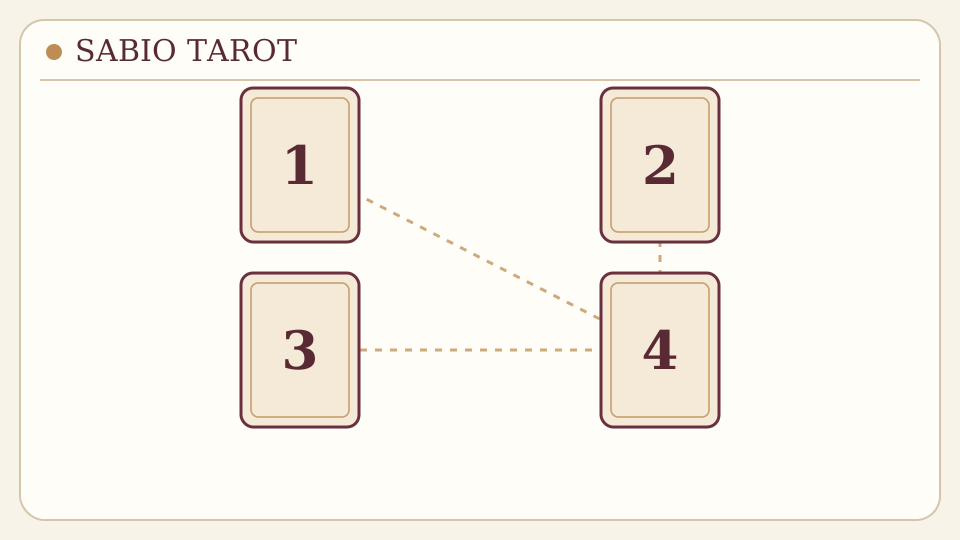
- 1Resources
- 2Friction
- 3Support
- 4Next step
Define the four positions
Draw a square. In the top left, place available resource; in the top right, main friction; in the bottom left, accessible support; in the bottom right, low-cost next step. Write the question: “How can I begin this project sustainably over the next two weeks?” If the project already exists, specify which phase you are reviewing. Do not use “support” to guess who will come to rescue you: it can be a tool, a person you can already talk to, or protected time.
Read the resource card before the obstacle card; that way you avoid letting the difficulty monopolize the interpretation. Contrast friction and support: does the support reduce the obstacle, or does it act somewhere else? The last card should translate into an action you can try without waiting for the other three to change magically. If you cannot describe that action, perhaps the question is still too broad.
Fictitious example: a ceramics sample
Example created for this article, with no real clients. Mara wants to prepare a small ceramics sample for a fair. She asks how to begin the selection phase. She draws Eight of Pentacles as the resource and reads it as accumulated practice, a reasonable hypothesis because she already keeps finished pieces. In the friction position appears Two of Swords: it suggests that she postpones selection while trying to find a perfect criterion. In the support position comes Three of Cups: she can ask two colleagues to assess the clarity and variety of the sample. For the next step comes The Magician: she sets out a table, photographs ten pieces, and prepares a first set.
The synthesis is not “the fair will be a success.” It is: “There is already material; the block is in choosing; seek an outside perspective and make a first visible selection.” Mara decides to photograph ten pieces on Thursday and ask for comments on Friday. She also checks outside the tarot the registration date and the booth dimensions. If the fair does not accept her format, she will change the plan; the spread does not alter that requirement.
Prioritize and review
On a sheet of paper, write one sentence per position and underline only the most useful relationship: a resource that allows you to get through a friction. Date the next step and define how you will know whether it was done. When reviewing, keep the original text of the reading; do not rewrite it so that it seems to have predicted the outcome. To improve an extensive synthesis, see how to synthesize several cards. Divide the sheet into four quadrants and note in each one the position, the fact that supports it, and the question that remains open.
How to relate the quadrants without adding up four labels
The layout works best if you read it in pairs before writing a conclusion. Compare resource and friction: does the already existing resource serve to reduce the obstacle, or do they refer to different matters? Then compare support and next step: what support makes the proposed action possible, and what permission do you need to use it? In Mara's fictitious reading, the Eight of Pentacles makes sense as accumulated practice only because there are finished pieces; the Two of Swords names her indecision when selecting. The Three of Cups can suggest a review group, but that suggestion becomes real only if the colleagues accept. The Magician reminds her that she can do something with the material, although it does not reveal whether the fair will accept her.
Do a language test. A poor synthesis says: “There is work, doubts, friends, and creative power.” It lists four labels and leaves the question intact. A useful synthesis says: “Since I already have finished pieces, I can choose a first series; the doubt about what to exclude is reduced if I ask for two opinions; today I will photograph ten pieces.” Each card plays a role, the relationships are visible, and a verifiable step appears. If you cannot unite the four, perhaps there are too many positions for this phase; go back to two cards about the main difficulty.
If the support that appears is not available
Imagine that Mara's colleagues cannot review the photographs before the registration deadline. Do not force the interpretation to the point of claiming that “another person will appear.” Ask what function you needed: an outside perspective, selection criteria, or encouragement. It is possible to get a brief review from another person, use the fair's guidelines as an objective list, or reduce the number of pieces. The card does not designate a specific person. Symbolic support can be interpreted in several ways, and all of them need verification.
If the next step also depends on a resource you do not have—a camera, a space, money—reduce the size of the task: make a list of pieces, ask to borrow a photograph, check costs. The last position is called “low-cost next step” precisely to prevent it from becoming an entire project. You can repeat the review after working, but you do not need another spread until there is new information.
Adapt the positions to the real phase
A project in the idea stage does not have the same risks as one presented to clients. For an initial idea, “resource” can be interest, materials, and a free hour; “friction” can be not having defined an audience. For an advanced project, the resource may be a mockup and the friction a specific piece of feedback that you still do not understand. Write in the margin which phase you are consulting. “My project” without a phase allows any card to be given a retrospective explanation.
The same card also changes function with the position. A Four of Swords in resource could be protected time to think; in friction, a pause that delays a delivery; in support, permission to rest before deciding; in next step, a limited pause. This flexibility does not mean that all meanings are valid: each reading must rest on the question, the position, and a verifiable situation. When a card seems not to fit, return to the question before drawing another.
Closing sheet for a project
Write four lines with verbs: “I already have…,” “I struggle with…,” “I can ask for or use…,” “Before [day] I will….” Then add a fifth line: “I will know whether it was useful when I observe….” The review can measure a delivery made, a response received, or a more precise doubt. Do not measure success by whether the card “came true.” The purpose of this spread is to organize resources and decisions under uncertainty. If there is a contract, funding, or health consequences, those matters require appropriate data and advice outside the reading.