Sabio Tarot · Reading methods and spreads
Three-Card Spread for Comparing Two Options

A comparative spread fails if we call one card "good" and the other "bad" without having defined what matters to us. This layout places a common criterion above and one card below for each alternative. In this way, both options are read with the same question and not as two guaranteed futures. It works for reversible or exploratory decisions; if there are important requirements, risks, or costs, get that data outside tarot.
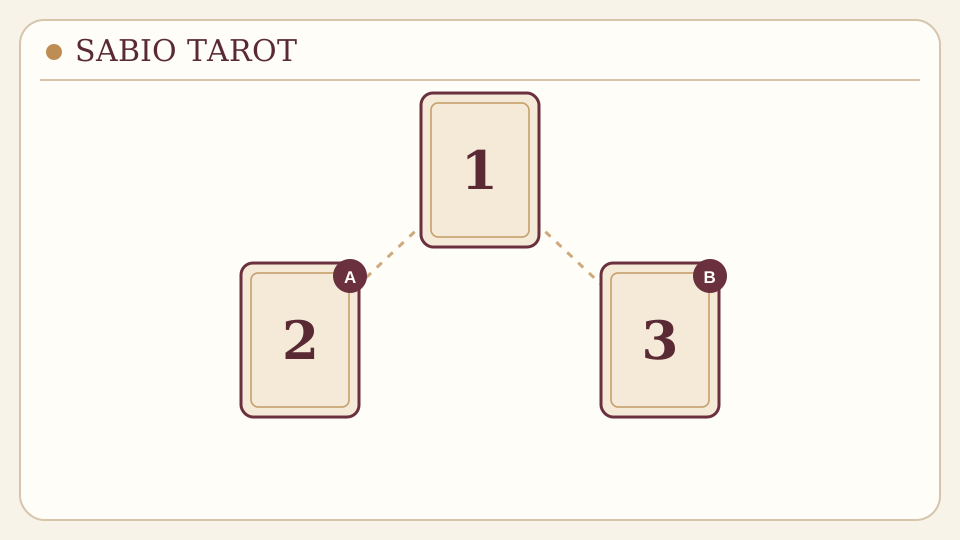
- 1Shared context
- 2Option A
- 3Option B
Prepare the Comparison Before Shuffling
Write A and B with concrete names: for example, "in-person course on Saturdays" and "online course at my own pace." Define a shared criterion: "What supports a sustainable study routine for two months?" The top card corresponds to central criterion or need; the bottom left, to what is worth observing in A; the bottom right, to what is worth observing in B. Draw the triangle and note the positions before drawing the cards. Changing them afterward to favor one option empties the exercise.
Read the common card first. Does it speak of time, energy, support, discipline, or learning? Do not assign it a fixed meaning: formulate a hypothesis you can compare with your situation. Then ask how each alternative responds to that same need. The conclusion may be "A offers structure, B allows flexibility; I need to know which one I will actually maintain." Both may appeal for legitimate reasons.
Fictional Example: Two Ways of Learning
Invented case, not a reader's testimonial. Nico wants to choose between an in-person workshop and a recorded course. His written criterion is "sustain weekly practice." Temperance comes up in the center: as a reading hypothesis, the need is a workable cadence. For A comes Three of Wands; Nico interprets it as an impulse to expand resources and connect with other participants. For B comes Four of Pentacles; it suggests preserving margin and controlling schedules, but perhaps also locking himself into an overly rigid plan. Neither card reveals what each course will actually be like.
Nico checks schedules, price, and access conditions. He discovers that the workshop requires travel that he cannot do on some Saturdays; the recorded course allows repeating exercises, although it lacks a group. His provisional decision is to try an open class of the workshop and review the syllabus of the recorded course. The spread made the criterion of consistency visible; the real information tipped the choice. If A and B had turned out equally attractive, the honest answer would have been data is still missing.
Avoid Drawing a Fourth Card as an Arbiter
Do not draw a fourth card titled "winner" when you feel uncomfortable. Note what cost, support, and exit condition each option has in a table. You can also read how to choose a spread and how to synthesize cards before expanding the number of positions. Draw the common criterion in the center and connect A and B with two equal lines: this way you verify that neither alternative gets an advantage because of the order of the cards.
What Changes If Both Options Seem Favorable
Two attractive cards are not a problem that must be solved by drawing a fourth. They may indicate that both alternatives satisfy different parts of the criterion. Return to your initial sentence and turn it into two observable indicators. For Nico's study, "sustaining practice" could be measured as attending at least three sessions per month and completing one exercise of his own each week. Then ask which option actually facilitates each indicator with its schedule, its price, and its form of follow-up. The card does not provide that data; the course program and Nico's experience do.
If A and B have similar support, write a provisional conclusion: "Either can work if I meet these conditions." Choosing based on cost, proximity, or personal preference is valid. Tarot does not need to produce an artificially broken tie. You can also design a reversible test, such as attending a sample class or watching a free lesson. The possibility of experimenting is often more informative than an additional card with the function of "breaking the tie."
What Changes If Both Seem Difficult
Two uncomfortable cards may indicate that the decision is framed poorly. Before reading them as "both paths will fail," look for a third alternative, change the timeline, or check whether the goal is still appropriate. For example, if both the workshop and the recorded course require more hours than Nico has, a reasonable option is to study with a manual for a month and review afterward. That option was not drawn in the triangle, but it may appear when examining the real time constraint.
Write a hypothesis and an objection next to each card. "The Four of Pentacles suggests to me control of the schedule" is a hypothesis; "it could also indicate that I am holding on to a routine that no longer serves me" is the objection. Choosing between the two requires looking at how Nico has studied until now. This step is especially useful when a card receives opposite meanings on the internet: there is no need to gather ten definitions; you need to return to the criterion and concrete experience.
Compare the Options with the Same Demands
A frequent bias consists of demanding exhaustive proof from the option you do not want and accepting a vague impression of the favorite. Use the same table for A and B: weekly time, total cost, available help, condition for leaving, and first experiment. If you do not know a piece of data, mark it "pending." Do not fill the box with the meaning of a card. Symbolic reading and practical comparison can coexist without one masquerading as the other.
In the example, Nico could write: A requires ninety minutes of travel, offers direct conversation, and allows leaving after one session; B fits his schedule, requires creating his own calendar, and allows repeating videos. Only then does the central Temperance card acquire a useful function: it reminds him that he is looking for a sustainable rhythm. If the travel leaves him exhausted, A's social offering may not compensate. If he tends to leave recorded courses unopened, B's flexibility may be a false advantage.
A Written and Revisable Closing
Write at the end: "My criterion is…; A provides… and requires…; B provides… and requires…; before deciding I will check…" Save the date. A week later, record what information you obtained and whether it changed your preference. Do not reinterpret the cards afterward to make them match the result. That review distinguishes a spread that helped you think from a story we construct afterward. When the decision affects money, employment, or formal studies, confirm conditions with the responsible sources; tarot does not verify places, contracts, or accreditations.