Sabio Tarot · Reading methods and spreads
Three-Card Spread for a Shared Decision

A decision between two people cannot be resolved by drawing cards in one person's absence and announcing what the other “actually wants.” This spread is for preparing your part of the conversation. The positions are: my need, what I must ask the other person, and the point that could be negotiated. The second card does not represent their private thoughts; it represents an open question that still needs their answer. The third does not create an agreement: it proposes a ground for dialogue subject to consent.
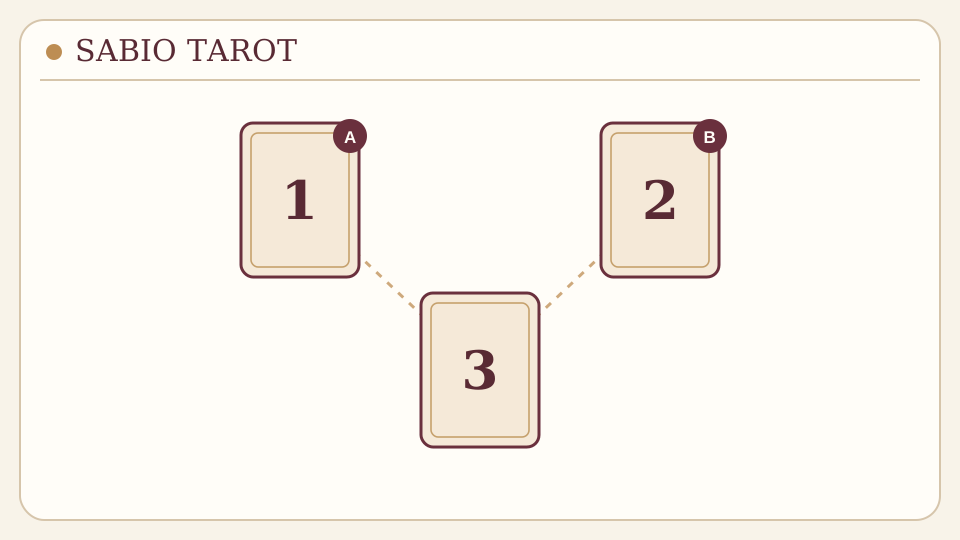
- 1Wish A
- 2Wish B
- 3Negotiable point
Before the spread: define who decides what
Choose a real and bounded decision: “How can we divide the use of a shared workspace over the next month?” Write down who is involved and what commitments already exist. If there are more than two people, the best preparation may be a list of questions for the group, not a spread about each individual. Also distinguish what you can decide for yourself from what requires agreement. You can arrange your own schedule, but you cannot unilaterally assign someone else's.
Place the first card on the left, the second on the right, and the third between them. The diagram suggests a meeting zone, but it does not assume that zone exists. Under the first, write a need in the first person. Under the second, a question that does not contain the desired answer. Under the third, a provisional proposal that the other party can accept, change, or reject. If you cannot write those three sentences, reframe the query before interpreting.
Fictional example: sharing a workshop
Invented scenario, with no real querents. Iris and Dani share a small workshop. Iris needs to use the large table to prepare pieces on Tuesdays; Dani has also started using it that day. Iris asks how to prepare a proposal. Under her need appears Four of Pentacles, and she recognizes that she needs reserved space for delicate materials. Under what she must ask appears Two of Cups: she writes, “What hours do you need, and what part of the table is indispensable for your work?” Under the negotiable point appears Temperance: she proposes dividing the afternoon into two slots, but leaves open the possibility of alternating weeks.
The synthesis is: “I need a stable stretch of time for pieces I cannot move quickly; I don't know what Dani needs; I will offer two time slots and listen to see if they fit.” Iris checks the workshop calendar before speaking. Dani explains that they only need the full table for an hour to cut material. They agree that Iris will use the space from four o'clock and Dani from six to seven. That agreement is born from the conversation, not from Temperance decreeing it.
If the other person's answer does not match your hypothesis
Suppose Dani responds that they need the whole afternoon because of an urgent delivery. Iris can look for another table, propose alternating days, or postpone part of her preparation. The spread does not lose value because it did not foresee the urgency; it had reminded her that she needed to ask. The second card functions as an explicit space for missing information. The mistake would be to reinterpret it afterward as if it had shown exactly Dani's delivery.
It can also happen that Iris discovers that her own need changes: she thought she required the whole table, but only two of her pieces cannot be moved. Recognizing this does not mean automatically giving in; it means speaking with greater precision. A shared decision improves when each person can change their proposal upon receiving new data. Tarot can prepare that readiness to listen, but it cannot replace it.
From symbol to verifiable agreement
A proposal like “be more balanced” is too vague. Define days, hours, materials, notice periods, and what they will do if a plan changes. In the example, the agreement could include “we will confirm use of the table on Monday afternoon; if there is an exceptional delivery, we will talk before changing it.” That way, it is clear what Temperance means in that situation without treating its symbol as a universal rule. The agreement must be stated in both people's words.
If the decision has financial costs or formal conditions, consult the contract, the budget, and whoever manages the space. No card signs for Dani or obligates Iris to accept conditions she does not want. For a broader reading on respect and consent, see how to read tarot for another person; here the specific point is preparing a conversation without appropriating the absent voice.
What to do when there is no common ground
The bridge card may be difficult, or the dialogue may show that no immediate solution exists. Do not force “harmony” because the third position has a negotiable name. Write down which needs are compatible, which are not, and who can help review usage rules. Perhaps they should reserve alternate days, rent another space, or suspend a specific activity. An informed disagreement can be more respectful than a symbolic agreement that no one will be able to fulfill.
If the other person does not wish to participate in a reading, respect that. You can use the three positions to prepare your own questions without showing them cards. On a sheet of paper, draw two circles: one for what you can decide and another for what depends on the other person. Leave the intersection blank until you talk; tarot cannot complete it for them. After speaking, record the facts and the agreement separately from the initial interpretation. The spread ends when you know what to ask and what concrete proposal you can put on the table; the agreement exists only when both people accept it.
Two sentences worth distinguishing
“The Two of Cups tells me that you want to collaborate” attributes to Dani a desire that they have not expressed. “The Two of Cups reminded me that I must ask you what you need” honestly describes the card's function in Iris's preparation. The difference seems small, but it changes who retains authority over their preferences. Practice rewriting any sentence about the other person as an open question or as a hypothesis marked as yours.
It is also worth distinguishing proposal and agreement. “We could alternate afternoons” is a proposal; “we will alternate afternoons” requires Dani to accept it. Iris can send both alternatives in writing and ask for a response before reserving the space. If Dani does not respond, she must not interpret the silence with another card as consent. She can organize only what is under her control and leave the shared part pending.
When one person has more power over the decision
Not all shared decisions are symmetrical. If one person manages the workshop, pays the rent, or controls access, the conversation takes place within prior rules. Before shuffling, review those rules and ask whether they can be modified. A bridge card does not correct a power imbalance or replace a formal procedure. If speaking directly is not safe or will not give one of the parties a voice, seek an appropriate channel. The method still helps Iris organize her need, but the final step may be to consult the rules and ask for mediation, not to negotiate face to face.