Sabio Tarot · Reading methods and spreads
Two-Card Spread: Situation and Possible Response
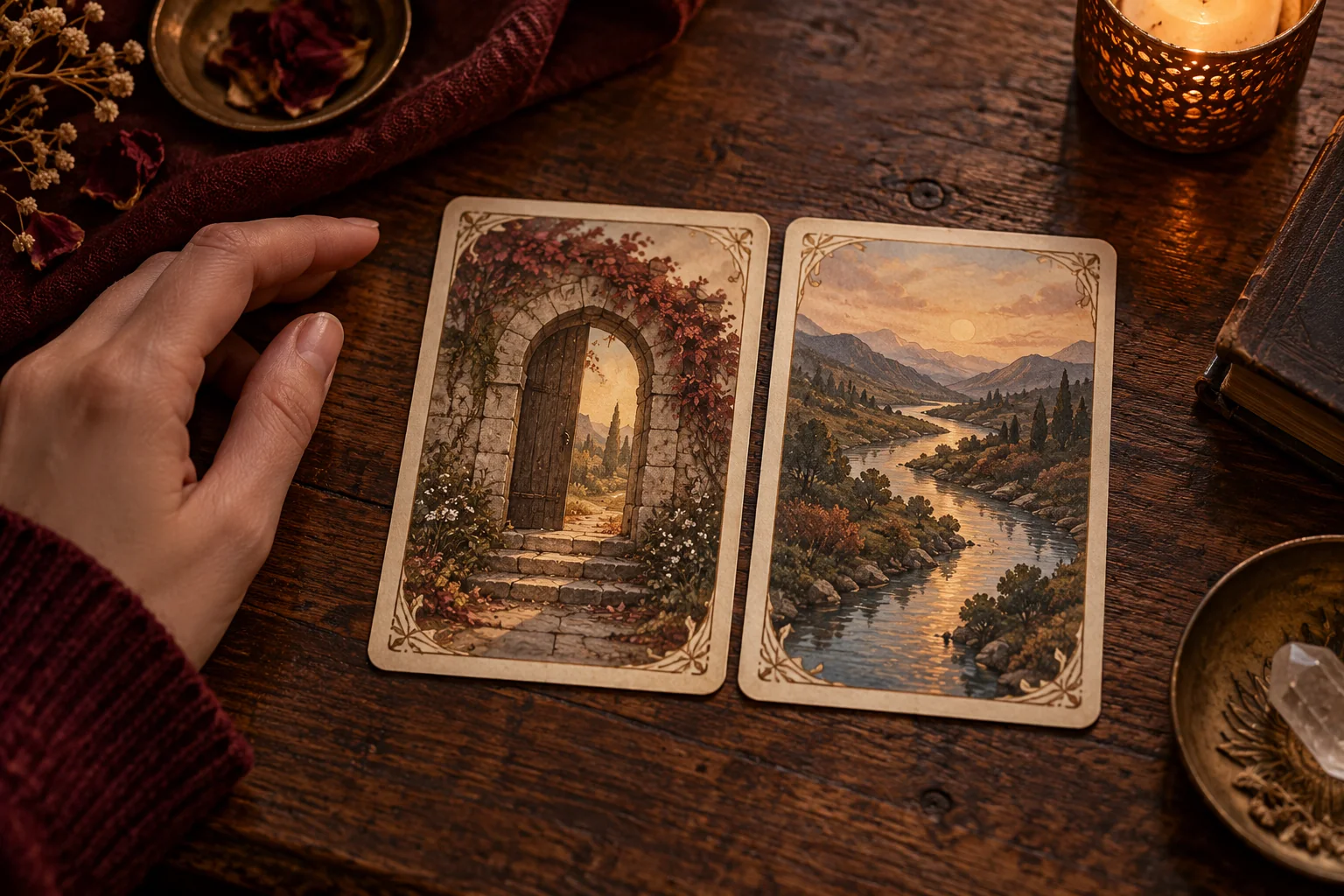
Two cards are enough when the question asks you to understand something that is happening and decide on a response of your own. The first position describes a situation worth observing; the second opens up a possible action. The key is to read the connection: the second card responds to that situation; it is not an independent prediction. If you need to know what another person is thinking or to demand an exact date, this spread does not turn a guess into a fact.
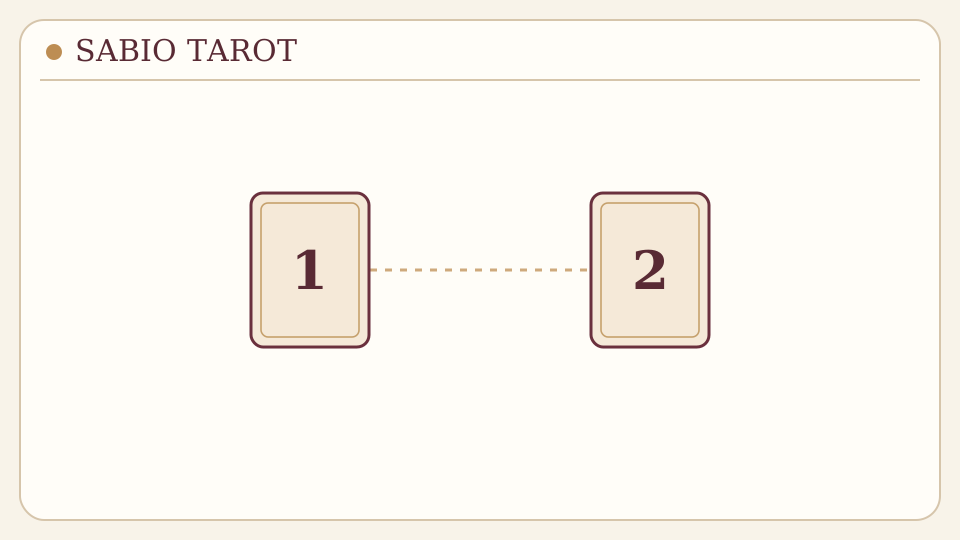
- 1Situation
- 2Possible response
What Kind of Question It Accommodates
Try: “What should I recognize in my difficulty studying, and what adjustment can I try this week?” The first part forces you to look at the starting point; the second asks for a limited and verifiable action. By contrast, “Will I pass?” only invites you to call each card favorable or unfavorable. Before shuffling, write the question in one line and decide what you would count as visible progress after a few days.
Place one card on the left for situation and another on the right for possible response. An arrow between them reminds you that you should complete a sentence such as: “Given that I observe X, I will try Y.” Do not add a third card to confirm the response immediately; first check whether you have understood the relationship between the two. If you need to review how to read a pair without isolating it, see two cards together.
Method: Three Passes and a Synthesis
On the first pass, describe what is visible and the provisional meaning of each card in its position. On the second, ask whether the response compensates for, continues, reduces, or tests the situation. A dynamic card next to one that suggests pause may suggest choosing a moment for action, not canceling one of them. On the third pass, return to the question: what external fact is missing for the action to be reasonable? The reading does not replace schedules, requirements, or real conversations.
In Marseille, the minor numerals show suits and arrangement, not narrative scenes like those of Rider-Waite-Smith. If you change decks, keep the positions but look again at the actual images before talking about characters or gestures. Books of combinations can help you practice linking cards; the final sentence, however, must answer your specific question.
Fictional Example: Studying with Less Distraction
Example invented to teach the method; it does not come from a real consultation. Alba asks: “What am I overlooking when preparing for an exam, and what small change can I try?” Before drawing cards, she sets the positions. In the first, the Two of Pentacles from a Marseille deck appears; as a hypothesis, she reads it as two demands competing for limited time. In the second, The Hermit appears; in the response position, it suggests setting aside a stretch of study time in silence and checking which tasks really fit. The combined reading does not say “you will pass”; it says “if distributing your time scatters you, try a protected block and review how much you get through.”
Alba contrasts that idea with her schedule, where two assignments are due at the same time. She decides to try three thirty-minute sessions with her phone put away and to note at the end which topic she covered. If it does not work, she will revise the plan; she will not repeat the spread looking for another promise. The useful synthesis is a hypothesis and a test, not certainty about the outcome.
When to Close
Close when you can write a sentence that contains the situation, the response, and a fact you will verify. If the cards seem contradictory, formulate two plausible readings and see which holds up better against the question; the position of each card prevents any meaning from serving for everything. In your notes, draw two numbered boxes and connect both with the phrase “that is why I try…”. If you cannot complete that arrow without inventing facts, return to the question.
An Alternative Reading of the Same Pair
The pair from the example does not force Alba's conclusion. The Two of Pentacles could speak of a real ability to alternate tasks, not only of distraction; The Hermit could represent the individual study she already practices and that she now needs to verify. If the problem were “I study a lot but I don't know whether I understand,” the possible response would be to ask for external correction after working alone. The cards are the same; the question and the facts change. That is why it is worth recording the original wording and not attributing to the drawing information that comes from Alba's schedule.
This contrast is a test against automatic reading. Write a second synthesis for the same pair and mark which external fact would make one or the other preferable. In the example, if Alba records frequent interruptions, the distraction hypothesis gains strength; if she already studies without interruptions but gets corrected exercises wrong, she may need feedback. The spread does not distinguish those scenarios on its own. It is about using the cards to pose good questions and then seeking evidence.
If the Second Card Seems to Negate the First
Imagine a situation you interpret as movement and a response that suggests waiting. Do not conclude that “the cards contradict each other” before trying a relational sentence: “Since there are too many changes, I first need to stop and organize.” The reverse also fits: “Since I am motionless, I will try one small step.” The position decides what function each image serves. A card in the response position may suggest moderating, continuing, or reformulating what was observed in the situation; it does not have to repeat its energy.
If you cannot find a reasonable connection, go back to describing the image and narrow the question. Perhaps “my life in general” is too broad for two cards. Perhaps the two positions you chose overlap: “what is happening” and “what is going on” do not provide distinct tasks. Reword them as “signal I can observe today” and “action I can try before Friday.” In that case, it is better to start over in another session, not to keep drawing cards to cover up a confused question.
Template for Practicing Without Depending on an Example
Write in your notebook: question; verifiable situation; card one and visible detail; card two and visible detail; verb that links them; small action; date or condition for review. The verb is crucial. “Pause,” “check,” “simplify,” or “ask for help” expresses a relationship; two abstract nouns rarely show what to do. The action must be under your control and proportionate to the problem. If the reading concerns a contract, a symptom, or an investment, the appropriate action may be to seek professional advice, not to decide by the deck.
Then try swapping the positions only as a study exercise, without pretending that it was the original spread. Ask what sentence would come out if The Hermit were the situation and the Two of Pentacles the response. You will notice that the reading changes: “When working alone, it is advisable to balance two subjects” is not equivalent to “When balancing two demands, it is advisable to reserve solitude.” That difference teaches why it is not enough to remember isolated meanings and why the order chosen before shuffling is worth preserving.