Sabio Tarot · Reading methods and spreads
Four-Card Spread for Studying Tarot

When studying a difficult card, drawing three more without a plan usually adds noise. This practice uses four positions with a different objective: card to study, visible detail, hypothesis, and counterexample. It does not claim that chance “defines” the card’s correct meaning. It forces you to look at the actual edition of your deck, compare an interpretation, and recognize when it would stop working.
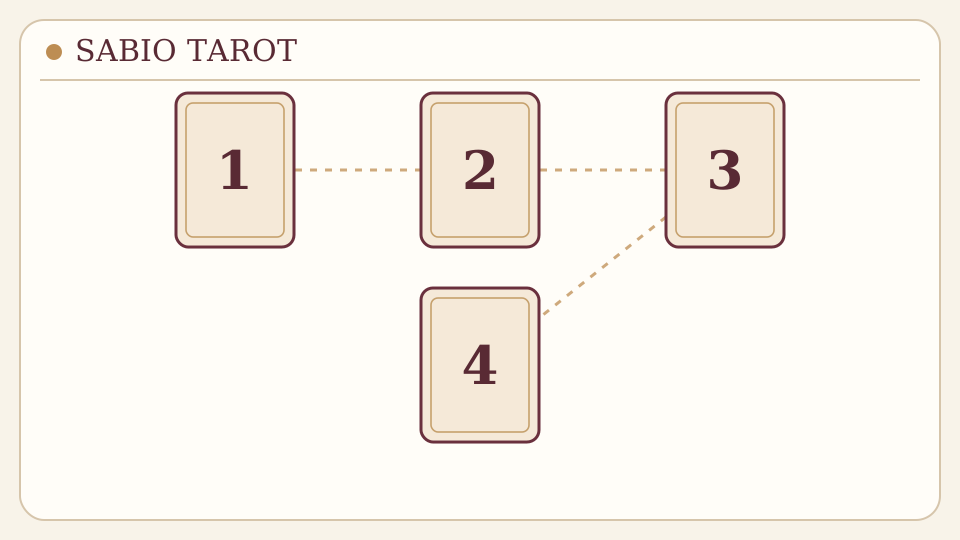
- 1Difficult card
- 2Visible evidence
- 3Hypothesis
- 4Counterexample
Prepare the exercise as a small investigation
Choose a simple question about a fictitious or everyday situation and write down which deck you use. The first position is the card you want to study; you can choose it deliberately instead of drawing it at random. The second card works as a magnifying glass: what detail of the first image did you overlook, or what aspect of the question calls for observation? The third is a reading hypothesis. The fourth, a possible objection: in what context would the hypothesis be excessive? Keep the positions fixed and write one sentence for each.
This structure avoids a common mistake: treating the fourth card as the “final result” and turning the exercise into prediction. Its role is to review a reading, not to dictate a verdict. In Marseille, compare number, suit, distribution of symbols, and visible figures. If you use Rider-Waite-Smith, you can describe scenes from the numerals, but do not automatically transfer those details to Marseille.
Fictitious example: studying The Hanged Man
Invented didactic example. Tomás chooses The Hanged Man in a Marseille edition because he usually reduces it to “stagnation.” His practice question is “how can I review a plan that is not moving forward?” As a magnifying glass, he draws Two of Wands and notes that there are two open tasks; that fact comes from his plan, not from a hidden truth. As a hypothesis, Temperance comes up: it proposes that the pause can serve to coordinate times and resources. As a counterexample, The Chariot comes up: if the project already has sufficient data and an immediate deadline, calling any delay “waiting” could be an excuse.
Tomás writes: “In this question, The Hanged Man may invite a review of a blockage; I do not know whether the pause helps until I compare tasks and deadline. I will try a two-step plan before deciding to keep waiting.” He then consults his manual and notes which part matches and which does not. He does not claim that the cards diagnose his will or that all Hanged Men have this meaning.
How to correct your own record
The quality test is being able to point to a detail of the card and write a reasonable alternative. If everything is reduced to words such as “sacrifice” or “victory” without position or context, observe again. Keep a photo or the exact name of the edition and date the note; comparing two variants without identifying them can produce false discrepancies. The guide to not understanding a card offers a previous step, while how to synthesize helps write the conclusion. Divide your notebook into four boxes and reserve space in each for observation and an alternative interpretation.
Observation before theory
To study The Hanged Man from a specific edition, Tomás must start with what he sees in his copy, not with an image from the internet that may come from another deck. He can note the figure’s orientation, posture, surrounding elements, printed number, and title. Then he marks in another color the sentences that are inferences: “seems motionless,” “perhaps he chose to wait.” A third layer collects meanings he finds in his manual. This way he knows what comes from the image, what he proposes, and what he takes from a source. A difference among those layers is not a failure; it is information about how he constructs the reading.
The magnifying-glass card does not replace that first inventory. The Two of Wands does not prove that Tomás has exactly two tasks; he knows that from his schedule. The number coincidence can help him remember that there are two fronts, but it does not authorize inventing a third. If the magnifying glass does not add a useful detail, write that it added nothing. An honest exercise can leave a box empty or provisional.
Why a counterexample is needed
Many manuals present a central meaning and several nuances. When we learn a new card, we tend to apply the first meaning to any question. The fourth position asks for a case in which our hypothesis would be bad. If Tomás concludes “The Hanged Man always recommends waiting,” The Chariot helps him ask what happens when there are already sufficient data and an imminent deadline. The answer could be “execute one step” or “ask for an external decision.” Not because The Chariot has authority over The Hanged Man, but because the initial hypothesis was too broad.
You can try another counterexample without drawing any more cards: “What if the question were about resting after an injury?” There, the word “wait” could be sensible, but discussing treatments would require professional advice. The purpose of the exercise is to adjust language to different contexts. A card does not bring a universal instruction or replace the real conditions of the case.
Compare the edition without mixing systems
If you study Marseille, write which edition you use and check how it numbers its trumps; variants matter. If you study Rider-Waite-Smith, review the details of the scenes, especially in the illustrated minors. A description taken from the Five of Cups of Rider-Waite-Smith cannot pass as observation of a Marseille numeral that only presents suit symbols. If you compare two decks as an exercise, place their names side by side and point out which detail exists in both and which only in one. Do not turn an editorial difference into a supposed contradiction of tarot.
In this study spread, the first card can be chosen deliberately and the others can be drawn. That does not reduce the value of the exercise: the goal is to train observation and hypothesis review, not to simulate that a random sample revealed a hidden truth. If you prefer not to draw any, you can choose four cards intentionally to represent the four roles and reason about them. Explain in your notebook which method you used so as not to confuse practice and consultation.
Rubric for reviewing the record one week later
Return to your notes and ask: can I point to two real observations from the edition? Does my hypothesis answer the question? Does the counterexample demonstrate a specific limit? Have I confused an inference with a fact? What would change if the same card came up in another position? Write an improvement in a different ink and keep the initial version. Learning tarot includes recognizing how your reasoning changed, not memorizing a perfect definition from the first attempt.