Sabio Tarot · Reading methods and spreads
Options Spread Without a Winner Card

There are decisions in which both alternatives offer something valuable and both cost something. Asking a card to declare 'A wins' usually hides the real criterion. This spread lays out three positions per option: cost, support, and condition necessary for the path to be viable. Six cards may seem like many, but each has a bounded task, and the person deciding writes the closing. If you are already comparing two options with a single criterion, start with the short three-card spread; use this matrix when you need more detail.
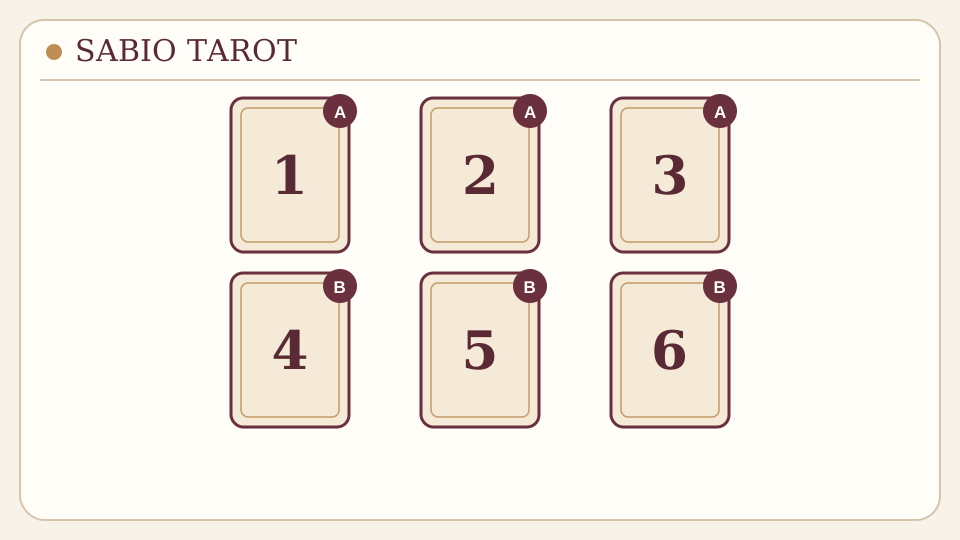
- 1A: cost
- 2A: support
- 3A: condition
- 4B: cost
- 5B: support
- 6B: condition
Write the alternatives and a common scale
Name A and B in equivalent terms: 'keep the current schedule' versus 'reduce one afternoon of work to study.' Write down what matters to you: available money, rest, learning, responsibilities. Draw two columns, each with three rows: cost I must assume, support I can use, and condition I must check. Clarify that 'cost' does not mean a bad omen and 'support' does not promise that someone will show up. They are invitations to look at consequences and verifiable resources.
Draw the three cards for A first and then those for B, without changing the rows. First do a vertical reading of each option; then compare horizontally costs, supports, and conditions. Finally, consult figures, schedules, and the people involved. If an option affects third parties, their consent cannot be deduced from a card.
Fictitious example: study time
Invented example, not a work recommendation. Julia considers keeping her schedule or negotiating one free afternoon per week. For A, she reads Two of Pentacles as the cost of sustaining several demands, Queen of Wands as support from her current organization, and Four of Swords as the need to check rest. For B, she reads Five of Pentacles as a warning of possible reduced income, Three of Pentacles as the possibility of discussing a distribution, and Justice as a reminder to review conditions in writing. These are reading hypotheses, not contractual data.
Julia calculates her budget, looks at the relevant agreement, and requests a conversation with her manager. She discovers she can reorganize one workday without reducing hours, a third alternative the spread had not foreseen. The matrix helped her identify what she needed to ask; the real information made it possible to decide. She does not have to choose A or B because that was how the columns were labeled.
A conclusion that leaves room
Summarize each option in one sentence with a cost, a support, and a pending condition. Then write: 'Before choosing I will check…' If the conditions cannot be verified today, set a review date and stop the reading. Choosing a spread also means knowing when not to draw more cards. Place both options at the same level in your table and add a final box called 'decision with data'; avoid declaring a winner just because of its position.
Don't turn six cards into six verdicts
The matrix has six positions, but only two alternatives. First read each column as a set: the cost of A makes sense together with the support and condition of A; the same is true for B. Then compare equivalent rows. Are the costs of the same type, or is one immediate and the other deferred? Does a support already exist or does it require asking for it? Can the condition be checked before choosing? These questions prevent calling one option 'good' because it has a pleasant card and the other 'bad' because of an uncomfortable card.
In the example, the Five of Pentacles in B's cost does not prove an economic loss. It can remind Julia to calculate how much she would earn if she changes hours. If the calculation shows she would not lose wages, the initial hypothesis is discarded. Justice in the condition does not certify that a negotiation is legal or advantageous; it reminds her that she must read real documents or seek competent advice. A useful symbol can lead to a check; it should not pretend to be that check.
Unequal by nature, comparable by function
Perhaps one option costs time and the other costs money. Do not add them as if they were the same unit. Julia can decide how much she values an afternoon of study, what expense she could take on, and what rest she needs. The function of the cards is to help her name those trade-offs. An external table can put numbers where possible and leave questions where it is not possible. The decision will still be human, with preferences and constraints that no deck knows on its own.
Nor should you attribute to B's 'support' a person who has not agreed to help. If the Three of Pentacles inspires the idea of negotiating a distribution, Julia must ask and listen to the answer. If the answer is negative, update the matrix. If a third alternative appears, such as reorganizing the schedule without reducing hours, add it to the practical analysis. Do not draw three more cards out of obligation: the new option can already be evaluated with data.
Another fictitious example: two places for a meeting
Additional invented scene. A small group must choose between meeting in a library or in a community room. For the library, the cards suggest a cost of silence and rigid schedules, support in reference materials, and the condition of confirming capacity. For the room, they suggest a cost of reservation, support for speaking aloud, and a condition of transportation access. The group does not ask which venue 'wins'; it checks schedule, price, accessibility, and participants' needs. If someone cannot get to the room, that fact weighs more than a favorable card.
This second example shows a limit of the matrix: a shared decision requires listening to those who will participate. The cards can help you prepare questions for the group, but they do not represent its consent. A responsible synthesis would be 'The library works if we can work in silence and there is space; the room works if the cost and the commute are viable.' That language preserves the conditions that could change the choice.
Sign that you need fewer cards
If while formulating A and B you discover that only one criterion worries you, such as travel time, you do not need six cards: check the schedule. If what you seek is to understand which personal value drives the doubt, one or two cards may be enough. The matrix is justified when several costs and supports are mixed. Choosing the layout out of curiosity is fine as entertainment, but presenting it as decision analysis requires recognizing its limits and completing the external data.
Keep the chart with a date and a closing sentence: 'I will choose after checking these two conditions.' When you review the result, do not declare that a card anticipated a fact you learned later. Point out what question it helped you ask and what information changed the decision. That record is more useful for learning to read than a scoreboard of hits constructed afterward.