Sabio Tarot · Minor Arcana
Four of Swords: Chosen Rest or Blockage

A student has been reviewing the same chapter for weeks and cannot finish it. The Four of Swords appears. It can be read as an invitation to rest, but it is also worth asking whether the pause has already become a way of not submitting the work. The distinction is not written on a single card. It requires looking at available energy, deadlines, the quality of rest, and what will happen afterward. The four can help design a pause with purpose and review.
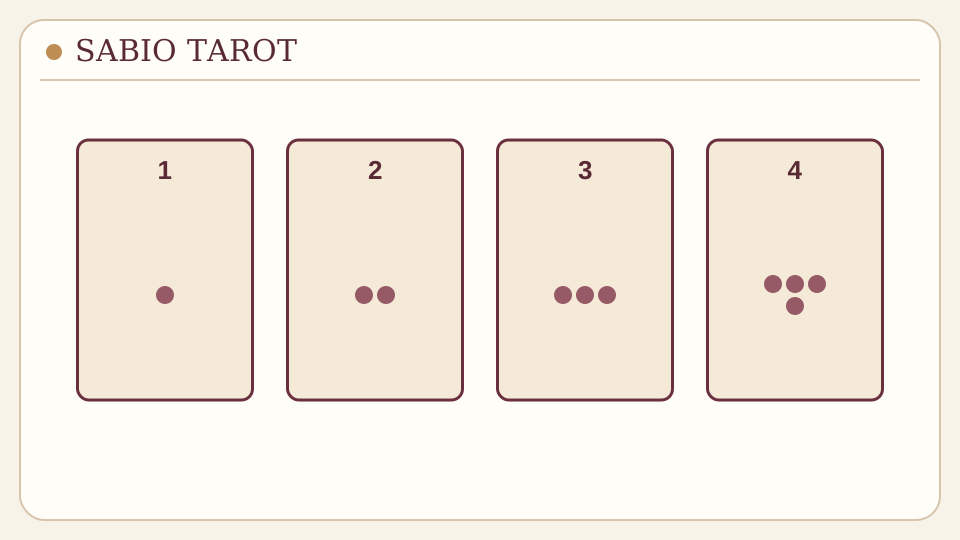
- 11
- 22
- 33
- 44
The Scene of a Concrete Stillness
In Rider-Waite-Smith, Waite describes the effigy of a knight in a prayerful attitude over a tomb. His primary description provides information about that image; it does not authorize announcing a death or diagnosing exhaustion in the person consulting. The visible stillness can suggest retreat, silence, or suspension. The person's question decides whether those words help them think about their situation.
In a Four of Swords from Marseille, four symbols of the suit are laid out. A motionless figure is not necessarily represented. The Metropolitan Museum documents the numeral character of traditional cards; the V&A contextualizes the scenes of the Rider-Waite-Smith. For an honest comparison, first describe the copy in front of you and then formulate your hypothesis: four as structure, swords as language or conflict, pause as possibility and not as visible data in all decks.
How to Recognize a Restorative Pause
Restorative rest usually has some recuperative quality: sleeping, stopping answering messages, taking a walk, or asking for relief. It does not demand immediate subsequent productivity, but it can have a practical limit and a kind review. “Tonight I won't touch the chapter; tomorrow I'll read a fresh paragraph” is different from “I won't open it again until I feel absolute certainty.” The first sentence protects energy and allows checking the effect; the second can hide an impossible condition.
However, one should not impose a schedule on someone who is ill, grieving, or under a caregiving burden. If fatigue is persistent or interferes with daily life, tarot does not identify its cause. It may be appropriate to seek medical assessment or social support. A careful reading avoids the reproach of “laziness” and also does not promise that a day off will solve a complex problem.
When It Could Be Avoidance
Avoidance is better seen in facts than in labels: every time the deadline to send the draft arrives, the person finds a new task; they do not request the clarification they need; or they turn small tweaks into a prerequisite for starting. Even then, there can be valid reasons, such as fear of an unfair evaluation. Ask what minimal action would allow learning something without compromising the entire project. Sometimes resting first is indispensable; other times, sending an imperfect version reduces more anxiety than continuing to wait.
In “resource,” the Four of Swords can legitimize protecting time without interruptions. In “obstacle,” it invites examining whether the retreat has stopped serving. In “action,” it perhaps suggests a scheduled pause. In “outcome,” it does not certify hospitalization, convalescence, or success after rest. The position modifies the question we ask; it does not turn the symbol into medical advice.
Fictional Example: Finishing a Report
Case invented for didactic purposes. Raúl is preparing a report for an association. He is missing two sections and has slept little because of work. He asks: “What sequence will allow me to close a reviewable draft?” He uses three positions: 1) current state, 2) necessary rest, and 3) return action. Four of Swords, Four of Cups, and Page of Pentacles come up. The first four does not decide whether Raúl is blocked or exhausted; his account of little sleep matters more than a predefined meaning.
The Four of Cups in “rest” makes him recognize that another collaboration offer overwhelms him, and he decides not to respond to it until Friday. The Page of Pentacles in “return” suggests a small material task: open the document on Thursday, write three bullet points per section, and send that structure to the president to confirm scope. Raúl sets two nights without working on the report and a forty-minute block on Thursday. If he is still exhausted, he will talk about the deadline. The reading does not ask him to deny his tiredness to demonstrate willpower.
Suppose that after sleeping and getting confirmation, Raúl keeps correcting the cover for hours and does not write the sections. That new fact would support the avoidance hypothesis. Then the action changes: ask another person for a structure review or agree on a partial delivery. The reading updates with evidence. There is no fixed “truth” of the Four of Swords that prevents correcting the plan.
A Schedule Without Guilt
Write down what activity you are going to stop, how much real leeway you have, and what signal will tell you to review the pause. For example: “I will not review the document today; tomorrow I will check whether I can summarize the two sections in ten lines.” If you cannot, ask what support or deadline change is needed. The schedule is an instrument of care and coordination, not a test of personal worth. Leave room for unforeseen events, and do not use the reading to pressure other people to rest according to your rules.
In a relationship, withdrawal can serve to lower tension if the desire to talk again is communicated and the safety of both parties is respected. Indefinite silence used as punishment is different. At work, rest may require agreements with the team. Regarding health, consult professionals if there are worrying symptoms. The card does not allow one to infer medical rest or to advise stopping treatments.
The diagram of the four helps study the numeral before talking about rest. You can continue with Swords and Thought, the numbers two, three, and four, and Tarot Rider-Waite from Scratch. The question left by the Four of Swords is concrete: “What rest protects my capacity, and what signal will indicate to me how to return?”