Sabio Tarot · Decks and systems
Sun, Moon, and Stars in the Tarot: Three Images, Several Functions
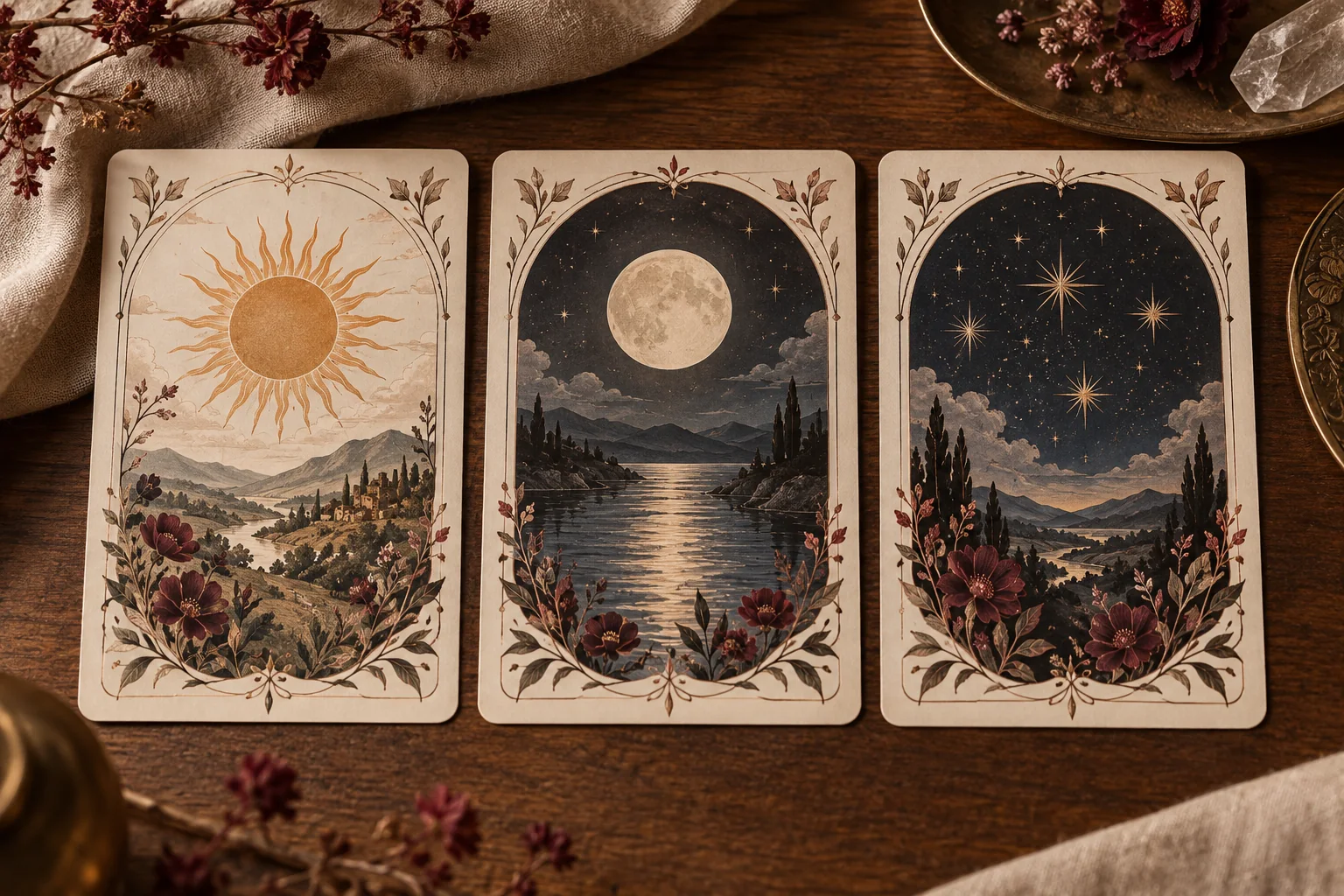
The Sun, The Moon, and The Star are titles of well-known cards, but a celestial body drawn in the image can also appear as a detail of another composition or in a newly designed deck. Title, visible object, and symbolic reading are three different things. This article compares the reproductions that appear on a specific cover and the illustration on this page. It does not turn “sun = success,” “moon = deception,” and “star = hope” into a universal table capable of resolving any question.
Start with the celestial body that actually appears
On the cover of Tarot Rider-Waite from Scratch, cards titled The Star, The Moon, and The Sun are reproduced. When you look at them, note where each celestial body is located, how much space it occupies, what other elements remain beneath it, and whether the scene shows any action. In The Star, a figure is seen beside water and stars in the sky. In The Moon, a celestial body is visible above a landscape and creatures on different planes. In The Sun, the celestial body dominates the upper area of a scene with other elements below. These observations correspond to those reproductions; they do not prove that all later editions draw them the same way.
The V&A includes the celestial bodies among images of the trumps and documents decks from different periods. Its text supports the existence and visual evolution of those cards; it does not assign each celestial body an answer valid for any query. If a specific manual gives a traditional interpretation, cite that manual and its edition. If you propose a metaphor during a reading, present it as your own hypothesis.
The illustration on this page allows practice without impersonating a historical card
The illustration on this page shows three invented cards: one with a sun over a landscape, another with a moon over water, and a third with several stars in a dark sky. They are not The Sun, The Moon, and The Star from Rider-Waite-Smith or Marseille, even though they use similar celestial bodies. They serve to ask what changes when a celestial body occupies almost the entire sky, when it appears reflected, or when there are several points of light.
In the original sun, the disk occupies the upper part and the rays spread over terrain and flowers. In the original moon, the reflection in the water creates two luminous zones. In the stars one, several forms share the sky and no human figure dominates the scene. You can describe that without adding “joy,” “intuition,” or “guidance.” Those words might arise in a particular question, but they are not printed as facts in the landscape.
The same word does not explain three compositions
Try applying “clarity” to all three images. In the sun, it may seem an immediate metaphor because of the general light; in the moon, perhaps the light illuminates only partially; in the stars, clarity is distributed in separate points. If you use the same word in all three cases, specify what degree and what distribution they show. The difference between a broad light and several small lights can inspire different questions: “What part do I already understand?”, “What detail remains hidden?”, or “What scattered indications do I need to gather?” They are not predetermined answers.
The reverse exercise also helps. Ask what would happen if the query were about a project that already has too many ideas. The scattered stars could serve as a metaphor for multiple options, not necessarily for guidance. If it were about resting, the moon could evoke a slower rhythm, but not indicate a sleep disorder. The celestial body does not diagnose or predict; context decides which association is useful and which would be forced.
Fictitious example: preparing an exhibition
Scene invented to teach the method. Malena must choose a title for a small exhibition. She asks, “How can I better communicate the central idea?” She uses the illustration on this page of the three cards as a reflection exercise, not as a historical deck. The stars card makes her think of six works that share motifs but not a clear narrative. She writes one sentence for each work and discovers two thematic groups. Her action is to draft a provisional title for each group and ask someone to read them without prior explanation.
If she had chosen the sun card, she might think of a central motif that dominates the selection; if she chose the reflected moon card, she might ask whether the title really reflects what the works show. They are working metaphors. The content of the exhibition is checked by looking at the works; the audience's reaction will be known by asking, not by interpreting a celestial body.
Comparing a historical edition with a new illustration
Place beside an identified historical card and the illustration on this page a chart with three columns: shared feature, exclusive feature, and provenance. “There is a sun” may be shared; “a human figure appears beneath it” may be seen only in one. This difference prevents attributing to an old work a flower, hill, or reflection that belongs to another image. Rider-Waite-Smith is associated with Pamela Colman Smith, as the V&A documents; the illustration on this page is contemporary.
It is also worth distinguishing card title and secondary motif. A small moon in the background of a card with another name does not make that card “The Moon.” In a current deck, the artist may introduce celestial bodies into cards that historically did not have them. The reading should begin with the card and the edition you have before you. To expand the comparison between systems, consult the library's deck guides, without assuming that their images are interchangeable.
How not to fabricate a history of the symbol
A visual similarity between two cards separated by centuries does not prove direct transmission. There may be shared tradition, conscious reinterpretation, or coincidence. To assert a genealogy, you would need dated objects, a catalogue, and studies that document the link. The V&A offers a general history of tarot; a specific claim such as “this star was copied from that edition” requires additional evidence. If you do not have it, write “both show stars” and leave the cause open.
This caution also applies to esoteric associations. You can explain that a certain modern reading relates a celestial body to an idea, provided you cite who formulated it and do not present it as the original meaning of all the cards. In a practical guide like this, it is enough to differentiate what is visible from the hypothesis. Precision does not take imagination away from the reading; it lets you know where it begins.
Closing in three layers
Write: “The card is titled…,” “in this edition the celestial body appears…,” and “for this question I propose….” Add an alternative that the same image would also allow and an external fact that you need to verify. The guide to a card's position in the spread helps prevent turning the celestial body into the total answer of the spread. An invented image can serve to practice observation without becoming a historical document.