Sabio Tarot · History and curiosities
Symbols added by a contemporary edition
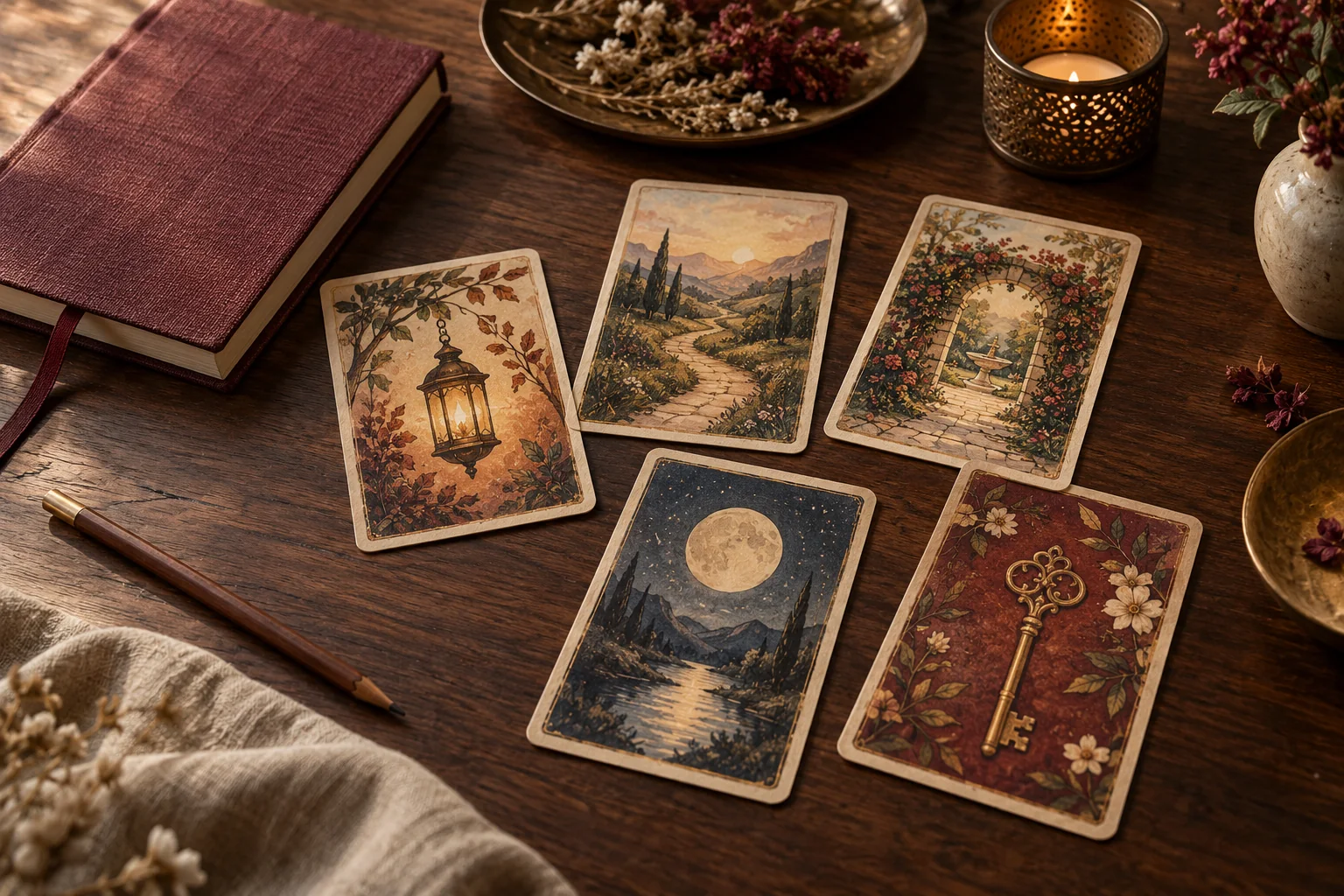
A new deck may place a key where another shows a flower, change an urban background to a garden, or give a tool to a character who previously had empty hands. Such decisions can enrich a reading. The error appears when they are presented as if they were “the ancestral meaning” of that card in all traditions. To work with a modern addition, you must identify the edition, observe the change, and attribute the interpretation. There is no need to diminish the artist’s creativity; it is enough not to falsify history.
The edition is part of the information
Before studying a detail, note the deck title, artist’s name, and publisher if given, year, printing, and specific card. Look at the box, booklet, and credits. Some reissues keep the name but change color or correct an image. An app may crop or animate the card. If you do not know which edition you are viewing, phrase the observation cautiously: “in this reproduction a key appears,” not “Arcanum X always carries a key.” The V&A visual history shows decks with changing imagery and explains the impact of modern designs such as Rider-Waite-Smith. It does not authorize erasing each deck’s identity under a single meaning.
The BnF documents a 1639 Marseille tarot with identifiable manufacturing details. That object serves to compare chronologies, not to call a current deck “false” because it added symbols. Contemporary art can legitimately enter into dialogue with a tradition. The historical question is narrower: what is documented in the old object and what appears in the new one? If there is a difference, do not invent that the artist took it from a specific source. Look for a statement, a companion book, or a process archive before attributing inspiration.
A pedagogical case with original images
The illustration on this Sabio Tarot page presents imagined motifs such as a lantern, a path, a floral arch, a night landscape, and a key. They are original illustrations for learning, not facsimiles of Marseille or Rider-Waite-Smith. We can use them to rehearse how to name an added symbol. If a fictitious card carries a key, the correct observation is “there is a key in this design.” One possible interpretation is “the key makes me think of access or a requirement.” It would not be correct to say “this key has appeared in tarot since the 15th century” without an object and a source that attest to it.
The distinction changes the reading experience. One person may find the key useful as a metaphor for a condition that must be met. Another may associate it with responsibility for closing something. Both proposals belong to a context. Neither requires asserting that all keys in European art had the same intention or that the maker of an old card thought the same way. The original Sabio Tarot illustration serves to compare contemporary motifs; it does not reproduce a historical card.
Fictitious example: a symbol that opens a question
Invented reading. Lucía uses an authorized contemporary deck that has placed a bridge over a river in its card of a traveling figure. She asks how to decide between two training courses. Her manual does not include an explanation of the bridge, so Lucía does not attribute an official meaning to it. She observes: “The figure is near the bridge, but I don’t know whether she crosses it.” She proposes two hypotheses: perhaps she needs to verify an access requirement; perhaps she fears abandoning the previous course before having a place in the new one. She checks the real information: requirements, enrollment, calendar, possibility of changing, and cost. She discovers that one enrollment expires soon, but there is a waiting list. The bridge helped her ask what concrete condition she must resolve; it did not predict that she would obtain a place.
In the same case, another reader might focus on the water and not the bridge. Lucía does not have to impose her metaphor. She asks which detail is relevant to the decision and which distracts. If the image leads to a conclusion contrary to the data —“cross now, even if you don’t have admission”—the data must weigh more. A responsible reading can inspire options, but not replace contracts, deadlines, or material resources. The image belongs to an artistic object; the decision belongs to the person.
Compare without building a false opposition
A current symbol is not automatically “deeper” for being new or “less authentic” for not being in an old deck. It can make a contemporary issue visible: diversity of bodies, digital work, the city, ecology, or care. It can also be a purely aesthetic choice. To analyze it, take one identified old card and one identified modern card. List elements preserved, transformed, and added. If an old figure looks at one object and the modern one looks at another person, describe that change. Then ask whether the artist’s book explains why. If it does not, offer a reading as a personal interpretation, not as proven intention.
It is not enough to search for “traditional tarot” in images and choose the first thumbnail. It may be a recent recreation. Use a library or museum catalog to date the reference. Check whether the photo shows the front, back, or a reconstruction. A detail that looks new may exist in an intermediate edition. A comparison of two copies allows you to say “it is not in copy A and is in B”; it does not allow you to say “it had never appeared.” This nuance protects the reader from a false history and leaves room to expand the research.
What to do with the deck’s booklet
The booklet is a primary source on how the publisher presents its own edition. It may explain that the key symbolizes a choice for the artist, but it does not prove that historical readers saw the same thing. Cite title, author, edition, and page if you use its explanation. If the booklet does not comment on the detail, do not fill its silence with an invented attribution. You can write: “The booklet consulted does not comment on the key; I propose a reading of my own here.” That precision is valuable for someone who buys the deck and compares their copy with the website.
There are also localization decisions. A word added to the card may change in a translation while the image remains. An app may replace an icon for another screen. If the symbol you study depends on a label, keep the original language and the translation you use. If it depends on color, verify the reproduction and printing. Monitor differences are not necessarily decisions by the artist. Write “in my printed copy” when that is the datum. The more localized the observation is, the easier it will be to correct it if another printing changes.
Editorial template for an honest record sheet
A useful record sheet can have these fields: observed edition, visible detail, documented comparison, artist’s explanation if it exists, reading proposed by Sabio Tarot, and limits. Invented example: “Puertas del Camino deck, 2025 edition; silver key in the margin; it does not appear in the consulted reference object; no artist statement located; here it is used as a question about requirements; it is not attributed to the entire tradition.” The reader understands what they could verify and what interpretation they may adopt or discard.
If you study a specific edition, Tarot Rider-Waite from Scratch can serve as a complementary guide. The imagined key in this exercise remains a motif of the illustration, not proof about that deck or that book. To relate a detail to the card’s function, consult the position in the spread and note what part of the interpretation comes from your question.
Closing
Contemporary creativity deserves a name and credit. Historical tradition deserves objects and sources. Between the two, the reader can do a flexible reading: “I see X in this edition; its creator says Y if it is documented; in this question it suggests Z to me.” When those three sentences are not confused, a new symbol can bring clarity without becoming a false antiquity.