Sabio Tarot · History and curiosities
How to Cite the Image of a Tarot Card
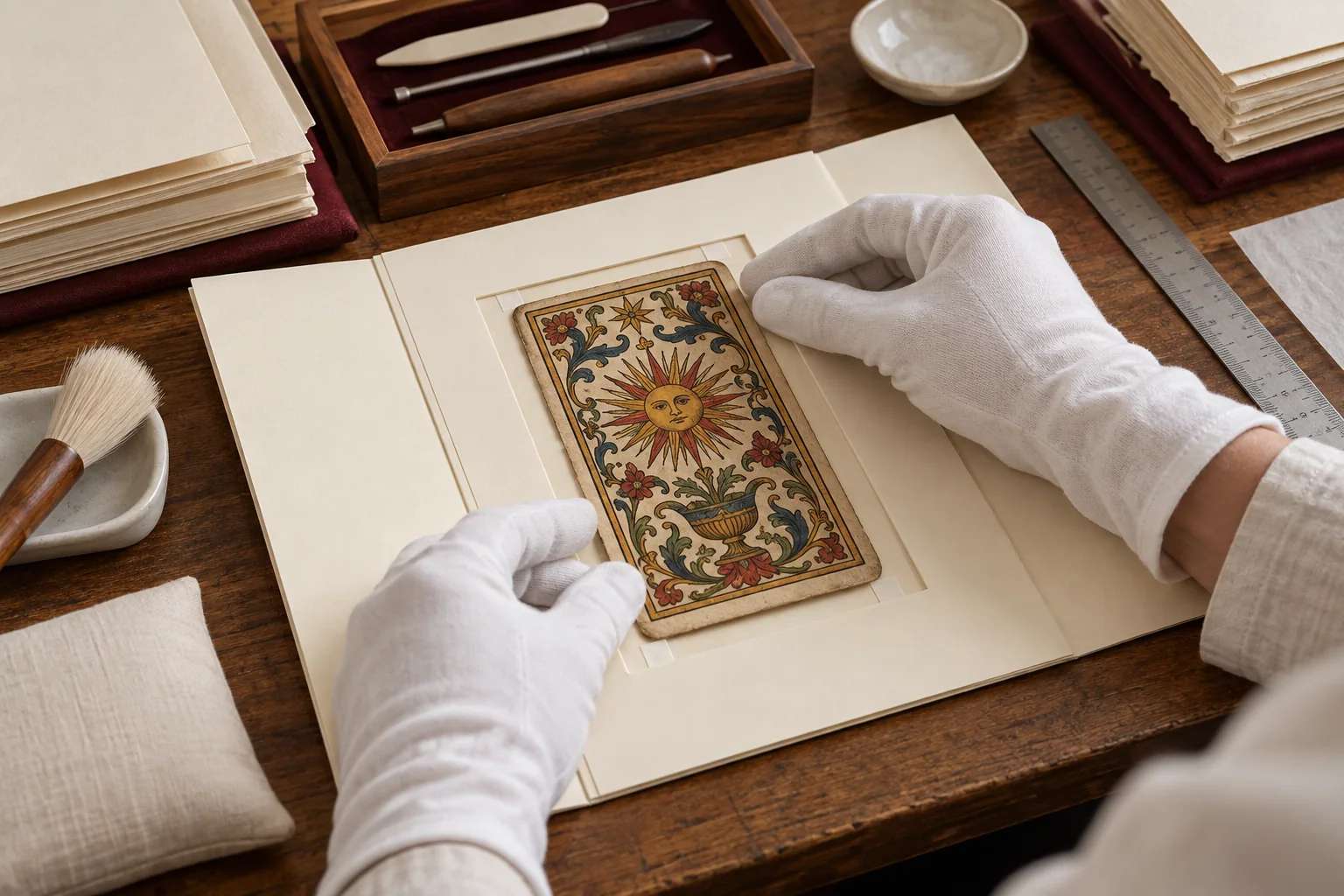
A card appears in an article, a class, or a social media post, and the caption says only “Tarot de Marseille.” The reader does not know which edition they are looking at, who took the photograph, when the object was produced, or whether there is permission to reuse the image. A useful credit answers several questions at once. But two tasks must be separated: identifying the work and verifying the right to reproduce that specific image. A flawless citation does not replace a license; a reusable image without a source record does not help study tarot history either.
Start with the Object Shown in the Image
Record the card’s title as it appears, its number and suit if applicable, the name of the deck, the known maker or artist, the publisher, the date or attributed range, the technique if relevant, and the institution or collection that holds the copy. Do not invent data that the source leaves open. The British Museum record for a deck by Suzanne Bernardin provides a registration number, place, approximate date, technique, and description of the set. Those fields allow another person to locate the object. A generic mention of “old Marseille” does not.
If the source holds only one card, cite that card; if it holds a complete deck, do not claim that you saw every card when you consulted only a photograph of the cover. The Met catalogs an Italian print titled Tarocchi Cards from around 1500 and notes an approximate dating and specific techniques. The record classifies it as a print and gives the sheet’s measurements: do not turn it into a complete deck. Copy the degree of certainty: “ca. 1500” is not “exactly 1500,” and “anonymous” is not the name of an identified workshop. If your article is based on a commercial reissue, add its current edition even if it is inspired by a historical model.
Citing the Object and Crediting the Photograph
A museum photograph represents an object, but it may have its own production data and terms of use. Distinguish “Card X, deck Y, century Z, collection A, inventory number” from “Photograph: institution or photographer, license or permission.” The British Museum explains how to check conditions and use its “Use image” feature for collection images. Do not assume that every thumbnail visible on its website can be incorporated without review into a commercial page. Check the record and the current conditions for that image.
Nor does a Google search or a social network become a source of rights just because it displays a preview. It may link to a catalog, a collector’s photograph, or an unattributed composite. Follow the chain back to the rights holder or the repository that specifies terms. If you cannot establish origin and permission, use your own illustration or describe the card in words. The need for an attractive image does not justify posting a file of uncertain provenance.
A Verifiable Caption Template
An adaptable structure would be: “[Printed title and number], from [deck], [maker/artist if documented], [place and date or range], [institution, inventory number]. Image: [photographer or institution], [license/permission and link]. [Changes made, if any].” The brackets are fields to verify, not text to publish as is. If an institution allows only citing the page without copying the photograph, link to the record and use an original diagram to accompany your explanation.
Invented pedagogical example: “The Door (XII), Tarot of the Garden, original illustration by Sabio Tarot, 2026. Image created for this guide; it does not reproduce a historical card.” In an original work created by you, the credit can be shorter because you know its origin, but its nature should be made clear. In a real museum photo, do not replace artist and provenance with “Source: internet.” If the photographer appears in the record, include them when the conditions require it. If they do not appear, do not invent their name.
Creative Commons Licenses: Read the Specific Variant
Creative Commons explains that reuse depends on the terms of the license applied to the material. CC BY 4.0 allows sharing and adapting, including for commercial purposes, with appropriate attribution, a link to the license, and an indication of changes, among other conditions. Do not reduce “Creative Commons” to a single permission: variants exist with different conditions. Before downloading, save a screenshot or record of the license that accompanies that image, the source URL, the credited author, and the date of access.
If you crop, translate labels, or overlay arrows, indicate the modification and check whether the license allows adaptations and under what terms. A photograph’s license does not always clarify all rights in the elements appearing within it, especially if it is a contemporary deck. If the rights situation is unclear, request permission from the relevant rights holder or create your own diagram that explains the feature without copying the protected composition. This guide is an editorial checklist, not a definitive legal decision for all countries and uses.
Fictitious Example: Two Images for an Article
Invented case. A writer prepares an article about the Two of Pentacles. They find a photo of a historical card in a catalog and a photograph of a modern deck in a shop. For the first, they identify the institution, inventory number, and terms of use; they discover that they can link to it, but they have not verified permission to publish it on their website. They leave the link to the catalog and draw an original diagram of two circles to explain the observation method. For the second, they contact the publisher or use an image authorized by its press program. Until they receive a response, they do not upload the photo. The article remains useful because it contains text, a precise reference, and its own visual.
The same writer writes the alt text for the original illustration: “Diagram with two circles separated by a vertical axis and arrows indicating the distance between them.” They do not write “Historical Marseille Tarot from 1639” because the diagram is not that object. The caption reports provenance, and the alt describes what is visible to someone who cannot see the image. They are related tasks, but not the same. A good credit does not replace alt text, and nice alt text does not replace permission.
What to Do with a Book Cover
A book cover from Sabio Tarot may show card reproductions and editorial typography. If a web listing uses that same cover, it must check the production file and the rights in its elements. Do not assume that being able to sell a book allows you to extract each card from the cover for another campaign. If the project has authorization for the cover on the web, cite it as an editorial cover and link to the book’s listing; if a cropped card is reused, review the scope of the permission. A crop can lose the cover’s context and make it appear to be a standalone reproduction of a historical object.
When it comes to your own photographs of a purchased deck, remember that owning the physical object does not by itself resolve the rights in the artwork for online publication. You can photograph it for private study and then seek reproduction permission if you want to publish the image. For a practical guide, an authorized photo can be valuable; if there is none, a careful description and a reference to the catalog are enough to teach the method without taking shortcuts.
Editorial Checklist Before Publishing
Check five things when using an image: identity of the object, source of the reproduction, reuse conditions, visible credit, and an accessible description faithful to what appears. If permission or attribution is missing, choose another image. The imagined scene on this page illustrates an archive consultation; it does not replace the institutional record for a historical card. This separation helps the reader know when they are looking at a visual explanation and when at evidence.
A tarot article gains trust when the reader can go from a claim to the object that supports it. The credit is not an ornament at the end: it allows editions to be compared, artists to be recognized, and errors to be corrected. To study cards with context, Tarot de Marseille from Scratch can accompany practice; to publish an image, always follow the identification and rights process for that specific image. Name the card, credit the archive, and keep the permission before putting it online.