Sabio Tarot · History and curiosities
Where Does a Specific Tarot Symbol Come From?
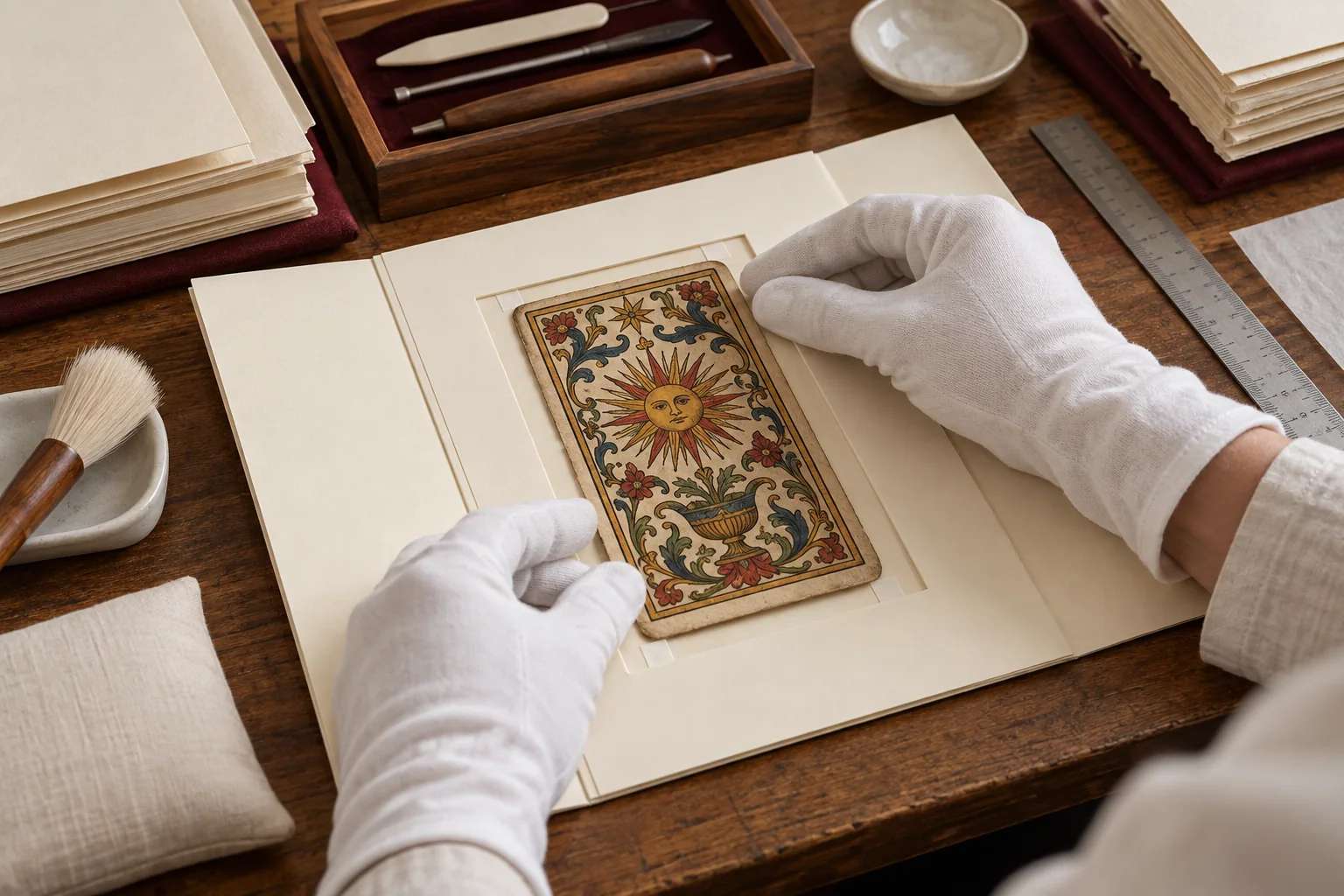
Asking about the origin of a symbol seems simple: we look for an old image, find another similar one, and draw an arrow between them. But resemblance does not prove descent. Two artists may reach for a crown, a key, or a star without knowing each other; a publisher may copy an earlier deck; a restoration may alter a color; a digital reproduction may lose details. To answer well, you have to identify objects, dates, provenances, and documented links. This article presents a method any reader can apply before repeating a seductive but unsourced story.
Define the motif precisely
“The sun in the tarot” is an enormous question. “The solar disk with a face on trump XIX of this edition” is investigable. Write down which traits you are looking for: shape, location, color, relation to figures, accompanying text, and the printed name of the card. Sometimes a trait that seemed central disappears when you enlarge the image; other times the label changes between editions. Small photographs and modern reconstructions are not equivalent to the preserved object. If your object is a current commercial deck, note publisher, artist, year, and edition number before asking about its precedents.
The motif may be a figure, an object, or a manufacturing detail. The BnF presents a tarot by Philippe Vachier dated 1639; it notes, among other data, a date on the Two of Pentacles and a workshop mark on the Two of Cups. It is a good example of the difference between a symbol and a material inscription. The printed date helps identify the object; it does not mean that “the Two of Pentacles represents 1639.” Before telling a symbolic genealogy, classify what type of detail you are studying.
Build a chain of objects, not loose images
Look for institutional records that can answer: Where is the object? What is its inventory number? What date does the institution attribute to it? Who is cited as maker or artist? Which parts are preserved? The Met documents luxury Visconti-Sforza cards from the fifteenth century and explains that the surviving set is not a complete deck without intervention. Its record of anonymous Italian cards around 1500 registers engraving and coloring techniques. These sources serve to situate materials and chronology; they do not by themselves prove that a specific detail in a later deck copies an earlier one.
A minimal chain might be: dated object A, dated object B, a document linking workshops or models, and object C that uses the motif in a modern edition. If the intermediate document is missing, write “resemblances are observed between A and C; I have not established a direct transmission.” That is a legitimate and useful conclusion. Historical research advances by degrees of certainty; it does not require turning every gap into a reliable story. That honesty helps the reader distinguish a documented history from a fictitious chronology.
Three distinct questions that are often confused
The first is when we have a preserved representation. The date of the object establishes a testimony, not necessarily the first use of the idea. The second is when the motif became frequent in a family of decks; it requires comparing several copies. The third is what it meant to its users. For the latter, period sources are needed: manuals, inventories, testimonies, or documented uses. Seeing an animal on an old card and attributing a modern esoteric meaning to it mixes three questions into a single answer.
The V&A summarizes the history of the cards and the shift from game uses toward later divinatory practices. This general sequence does not authorize projecting the meaning of a twenty-first-century guide onto every Renaissance deck. A symbol may preserve its form and change function. It may also change form and keep a name. That is why the visual origin of a motif and the history of its interpretation are related but separate lines of research.
Fictitious example: the key on a current card
Invented investigation to explain the procedure. A reader finds a golden key in a recent deck titled “Tarot of the Threshold.” She wonders whether “the key is an ancient Marseille symbol.” First she photographs the box and the card for her private archive, notes artist and date, and consults the booklet. The booklet says the key was added as an image of access to decisions. She already has an attribution for that edition. Then she looks at catalogs of identified historical decks; she finds some key in a similar image, but not the same composition. Her prudent conclusion is: “This key is documented as a decision by the current artist; there are key motifs in other objects, but I have not yet proved that one is a direct source of the other.”
In a fictitious reading about career training, the key can inspire the question “what requirement opens this option?” That is a useful contemporary metaphor. It does not need an invented Egyptian, medieval, or secret genealogy to work. If someone claims a precise origin, the reader can ask for object, date, reliable reproduction, and a document supporting the relationship. Asking for sources does not take the magic out of the image; it avoids confusing interpretive imagination with history.
How to evaluate a source found on the internet
Prioritize museum, library, and archive catalogs for identifying objects. Then look for academic publications or facsimiles with complete references. A shop may offer data about a current commercial edition, but it usually has a sales incentive and an abbreviated description; use it for what it knows, not as proof of remote origins. An image without provenance on social media does not allow dating a deck by apparent style. A date in a blog may come from another record copied with an error. Open the primary source, record the identifier, and check whether the text says “ca.,” “attributed to,” or “possibly.”
Pay attention to updates. In 2026 the BnF presented a complete Marseille tarot from 1639 that requires qualifying old claims about “the oldest copy” of certain typologies. A page that does not indicate when it was written may repeat a superlative that has already been surpassed. Instead of looking for the definitive first, state what the source does establish: “The BnF preserves and documents this dated copy.” The word “first” requires having ruled out relevant earlier objects, something very difficult.
Reusable research log
Create a table with seven fields: defined motif, object, date and degree of certainty, provenance, observed trait, exact source, and type of proposed relationship. Under relationship, write “resemblance,” “documented copy,” “same edition,” “later interpretation,” or “unknown relationship.” The last option is not a failure. With it you avoid a false arrow. Also keep the date on which you consulted each page, since catalogs can update attributions. If you publish an image, add a rights field; a museum allowing you to view a photo does not equal a license to reproduce it on your website.
The archival scene accompanying the page is imagined; it helps recall the consultation process, but it does not prove the presence of a symbol on a historical card. To document that symbol, follow the museum identifier and observe the reproduction linked to the record. Always separate the pedagogical illustration from the evidence supporting a claim about an object.
What conclusion to publish
A good answer can say: “On this specific card, X appears; institution Y preserves a dated object Z with a similar trait; there is no evidence here of direct transmission; the interpretive association comes from this later manual.” It may seem less decisive than “X comes from a secret temple,” but it allows the reader to verify and continue investigating. To practice with a deck, Marseille Tarot from Scratch offers a starting point for reading; for the history of the symbol, keep the documentary discipline. Name the object, separate date and meaning, and leave uncertainty visible.