Sabio Tarot · History and curiosities
How to distinguish an inherited motif from a modern reinvention
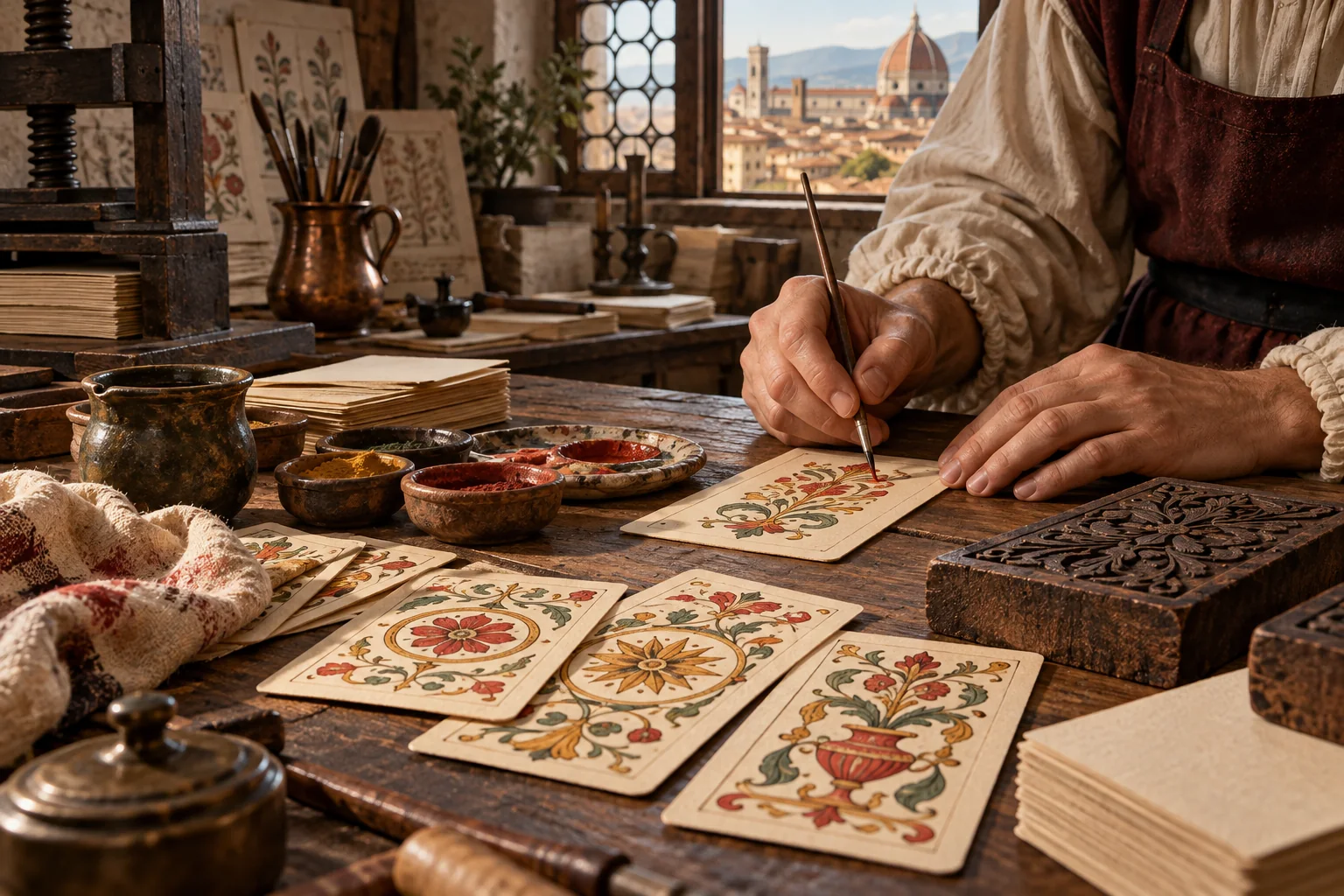
A new card can keep an old name and transform its entire scene. Another can closely copy a historical composition but add a small element that changes the reading. Calling everything that looks old “traditional” and everything with modern colors “original” hides those nuances. To study a motif, you have to compare identified objects, not general impressions. You also have to accept that, between two editions, sometimes the proof of how an image traveled from one workshop to another is missing.
Three different continuities
Continuity of name occurs when two cards are called something similar. Continuity of structure appears if they keep number, suit, position in the series, or general arrangement. Continuity of detail concerns a specific object, a posture, or a relationship between figures. A card can share name and structure without repeating the detail; another can share a detail by visual coincidence. That is why a single similarity is not enough to conclude that edition B directly inherited edition A.
The BnF documents a complete tarot by Philippe Vachier from 1639 and explains the historical use of the name “Tarot de Marseille.” The British Museum catalogues a complete deck by Suzanne Bernardin, produced in Marseille between 1800 and 1850. These two records make it possible to ask questions about continuity over time. They do not by themselves allow us to state that Bernardin copied an exact plate by Vachier; that would require a card-by-card comparison and evidence of transmission or model. For now, the catalogues support the identity of the objects, approximate dates, and recorded techniques.
A protocol for comparing two cards
Start with one record per object: deck name, maker or artist, production date according to the catalogue, institution or provenance, inventory number, and reproduction quality. Then describe each card separately. Make a list of elements visible in A and another in B without using value adjectives: central figure, objects, number, title, color, background, frame. Only then place both lists side by side. Mark “is retained,” “is transformed,” “is added,” “disappears,” or “cannot be seen.” That last category is essential if a photograph cuts off the edge or the record does not show the reverse.
Visual comparison is not yet a causal history. If two decks have an anthropomorphic sun, there may be a shared tradition, copying from a common model, or independent development within a broad visual repertoire. To argue direct influence, look for workshop, engraver, publisher, reprint, commercial advertisement, or creator statement data. If none appears, write “they share a motif documented in dated objects; direct relationship not established.” Far from weakening the page, this sentence explains exactly what the reader can learn.
Fictitious example: the arch and the door
Invented exercise with an imaginary contemporary deck. A publisher releases a tarot called “Doors of the Path.” On one of its trump cards, a floral arch appears. A reader sees in a catalogue an old card with two columns and declares: “the modern arch comes from those columns.” Her observation of forms may be interesting, but the statement of provenance is not yet proven. Record both images, distinguish arch from columns, and check the modern artist’s note. If the artist explains that he drew the arch from a family garden, that statement documents his declared inspiration, even though the image may evoke other cards for an observer.
The doors and paths on this page are imagined. You can compare them with an old card to ask whether the access is open, whether there is a figure before it, and what occupies the center, but the resemblance does not prove an inheritance between the two images. In a reading about a job change, the arch can inspire “what specific requirement is missing to cross?” The answer is verified in the job posting or with the company, not in the drawing.
The production technique also changes the appearance
A motif can seem reinvented because the printing method or palette changed. The BnF describes the Vachier copy as woodcut with color applied through a stencil. The British Museum records the Bernardin deck as hand-colored woodcuts. The Met shows luxury cards from the 15th century with very different materials and production conditions. It is not reasonable to compare digital colors from photos without taking into account pigment, paper, aging, lighting, and color balance. A chromatic difference does not always mean new symbolism; it may be material, editorial, or photographic.
If color is your topic, try to find two copies from the same print run or a technical description from the museum. Note whether the red area appears with an identical outline but different saturation; it could be a reproduction issue. If the shape of the object changes, there is a clearer graphic change. Even then, “graphic change” does not automatically equal “change of meaning.” The manufacturer’s manual or a reading testimony can provide that second layer. Separating the two prevents an iconographic analysis from becoming artist psychology without evidence.
When can we speak of reinvention?
The word works well when a contemporary edition declares a reinterpretation or shows a new composition against identified references. Even so, it is worth saying what was reinvented. The name, the main figure, the setting, the gender of the characters, the relationship between objects, or the purpose of the deck? A new image can retain inherited symbols and combine them differently. “Reinvention” does not mean creation from scratch or total rupture. It can be a deliberate decision by the illustrator to speak to a current audience.
Avoid the argument “it does not appear in two old cards that I have seen, therefore nobody had used it.” Two objects do not represent all decks ever produced. What you can say is “it does not appear in the two copies examined.” If more records and manuals are reviewed, the conclusion can be strengthened. The V&A offers an overview of design changes and uses; use it as historical context, not as proof of every small iconographic addition in any current deck.
A table the reader can reproduce
Suggested columns: feature, edition A, edition B, degree of similarity, source of attribution, and provisional conclusion. Invented example: “upper arch; absent in A; floral in B; clear difference; note by artist of B; addition documented for B.” Another: “two figures; present in A and B; partial similarity; only reproductions; transmission not established.” The table forces you not to lose sight of the gaps. It can be accompanied by your own geometric sketches, avoiding copying protected cards. If an institutional photo is reproduced, its conditions of use must be reviewed and it must be credited fully.
Ask a second person to describe the cards without knowing your hypothesis. If they identify different features, perhaps the size of the images prevents a conclusion. Return to the catalogue and, if possible, to the object or a higher-quality reproduction. Also compare intermediate editions: often a supposed innovation was already present in an earlier version you had not seen. Recording the chain of findings, even when it contradicts your first idea, produces a valuable and correctable article.
Closing: genealogy deserves precise verbs
Use “looks like,” “shares,” “repeats,” or “transforms” for visual observations. Reserve “copied,” “derives from,” or “was inspired by” for relationships supported by sources. In Tarot de Marseille from Scratch you can study a reading tradition; to compare motifs, always return to dated objects. A modern reinvention can be very good, and an inherited continuity can change meaning. The important thing is that the reader knows what is seen, what is known from documents, and what interpretation we propose today.