Sabio Tarot · Decks and systems
Printed Numbers and Interpreted Numbers in Tarot
A figure on a card can indicate its place in a series, the number of drawn objects, or be the starting point for a later numerological association. Confusing these layers leads to mistakes: calling a card “VIII” when in the edition in front of you it bears “XI,” or deducing a personal destiny from the number of objects without explaining the tradition you are using. This article offers a practical inventory for reading printed numbers before interpreting them.
Three Layers Worth Writing Separately
The first is the card's label: the Roman or Arabic numeral that the manufacturer printed. The second is what you can count in the image: cups, wands, figures, or stars. The third is the interpretive rule that you or a manual apply to that number. The same numeral can appear in the first two layers and receive different readings in the third. If you do not indicate which one you are using, the reader will not know whether you are talking about a material mark or a symbolic hypothesis.
On the cover of Tarot de Marsella: casos reales: 60 consultas leídas paso a paso, de la pregunta a la respuesta (Spanish edition used as a visual source) La Force appears with XI at the top. On the cover of Rider-Waite Tarot from Scratch Strength appears with VIII. The difference is visible in those reproductions. It does not mean that one card is “stronger” for having a higher number. It means that the editions follow different orders. The V&A documents the historical development of decks and of later interpretations; to state why a specific author changed a numbering, a specific source about that decision would be needed.
Counting Drawings Is Not the Same as Reading the Numeral
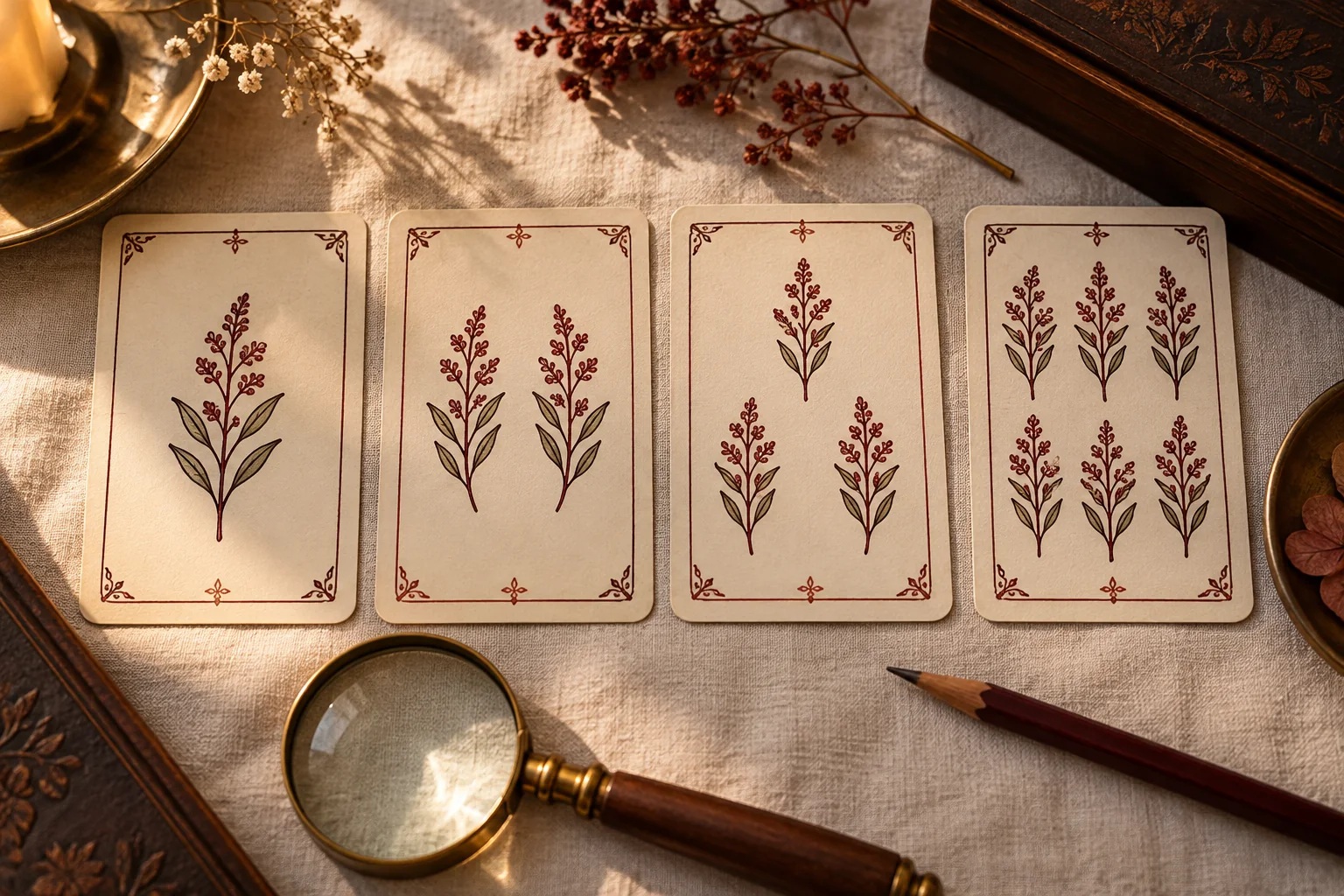
The illustration on this page shows four invented cards with one, two, three, and six decorative branches. It does not represent a historical suit or a Marseille deck. You can count the branches to practice, but none of them bears a printed number that you should attribute to traditional tarot. That distinction is crucial. An image generated to teach quantities can suggest the visual structure of a numeral, but it does not attest to how the wands of an eighteenth-century manufacturer are arranged.
In a real Marseille numeral, verify the suit, the quantity, and the organization of the symbols in your edition. In a Rider-Waite-Smith card, the title or numeral and the scene can coexist. Do not assume that the number of characters matches the number of the card. A Six of any suit may show fewer than six people; the six identifies the card or the suit's emblems, not necessarily the cast of characters.
Fictional Example: Comparing Two Manuals
Invented scenario. Irene reads a Marseille manual and a Rider-Waite-Smith manual to study Strength. She sees XI on one cover and VIII on the other and thinks one is wrong. Before choosing a meaning, she notes the title, number, and edition of each reproduction. She discovers that both books work with different visual systems. She decides to study each card within its own deck and not copy examples based on numerical position without checking them.
Then she asks whether the number is relevant to the query at hand. If her question is about how to sustain a habit, the figure's gesture and the position in the spread may contribute more than the numeral. If she is studying publishing history, the numerical difference is indeed the main object. The same printed mark can be central or secondary depending on the task. For a practical reading, there is no need to resolve the entire history of the orders before formulating a modest hypothesis.
Numerology: Name the Source or Say It Is Your Method
You can interpret a number as repetition, cycle, choice, or culmination within a specific tradition. If you do so, identify the manual or school and avoid presenting it as the original meaning of all decks. The V&A explains that numerology and other systems were incorporated into esoteric interpretations in periods later than the first recreational uses. That general chronology prevents retroprojecting a modern rule onto a fifteenth-century painted card without evidence.
To practice, write “my method associates the two with a relationship” instead of “the Two always means a couple.” Then look at the actual image: two swords arranged in a certain way are not the same as two people conversing. The word “relationship” can serve as a reading hypothesis, but it will need a question and a position to become concrete. If the card belongs to a deck with scenes, also observe what the figures do; if it is a numeral without a scene, work with symbols and arrangement, without considering characters that do not exist.
Common Mistakes When Comparing Numbers
The first is reading a blurry Roman numeral with excessive confidence. Enlarge the image or consult a reliable record of the edition. The second is confusing the card number with the quantity of visible objects. The third is treating an order variation between decks as if it were a printing error. The fourth is attributing an association from a modern manual to a historical workshop without citing a source. The fifth is looking for a meaning in every visible numeral even when the number contributes nothing to the question.
A simple record avoids all five: edition, card, printed number, counted elements, numerological hypothesis and source. If a field is missing, leave a dash instead of filling it from memory. The record also makes it possible to discover an interesting fact: two editions can share a title and an approximate scene while differing in number, palette, or printed text. The comparison should record all those differences before proposing a cause.
Exercise with the Illustration on This Page
Look at the four cards with imagined branches. Count main motifs, not small leaves, and write a number for each one. Then describe the organization: one isolated branch, two parallel, three separated at heights, six in two rows. Without assigning them tarot names, ask what changes when the quantity is distributed in another way. The exercise trains number and arrangement; to study a Marseille numeral, open the record for a specific edition.
When returning to a real historical or commercial card, keep the same rigor and add provenance. If you want to know what drawing an old edition had, consult a museum record for that object, not the didactic visual. To begin with the general functioning of numerals, the minor arcana library offers a study path. The reading closes when you can say what numeral is printed, what the image tells, and what part of your interpretation belongs to a chosen rule.