Sabio Tarot · History and curiosities
Tarot Cards in an Exhibition: How to Read the Museum Label
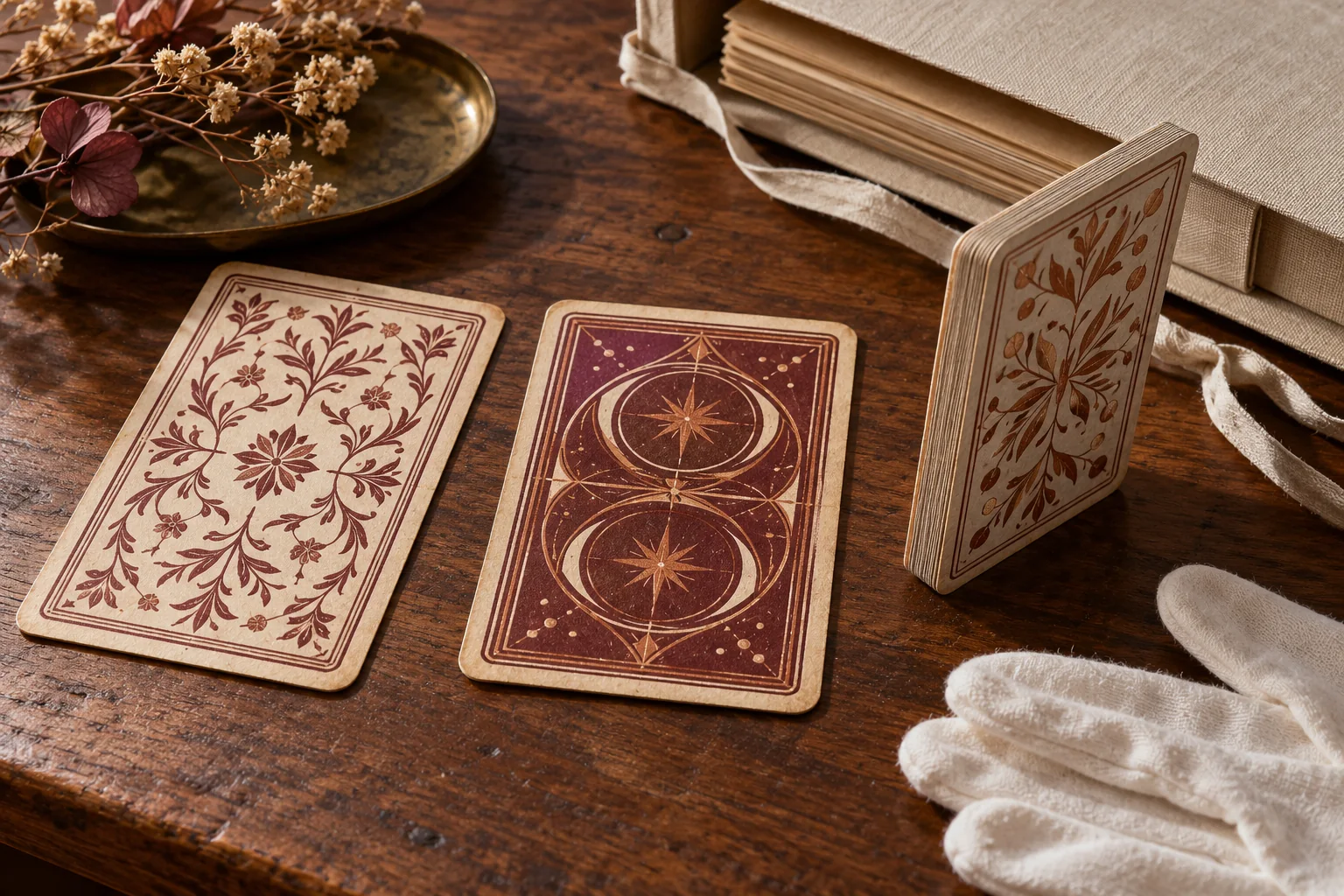
A card in a display case draws attention through its figure. The label next to it seems like a formality, but it contains the clues to knowing what we are seeing: an original piece, a reproduction, a card from an incomplete deck, or a modern recreation. It also often condenses the museum’s research into a few lines. Reading it slowly prevents us from confusing the date of manufacture with the date of acquisition, an attribution with a signature, and the image shown with an entire tradition.
The Morgan Library & Museum offers online data equivalent to a label for its Visconti-Sforza cards: title, shelfmark MS M.630.1–35, proposed creation in Milan around the middle of the 15th century, technique, dimensions, and acquisition by Morgan in 1911. The Metropolitan Museum of Art, in The World in Play, presents historical playing cards with attributed workshop, place, technique, number of surviving cards, and lending collection. Not all the pieces in that exhibition are tarot; the label helps precisely to distinguish them.
First line: object title
The title may describe an individual card, a group of cards, or an ideal deck. If you read “Visconti-Sforza Tarot Cards,” ask how many specific pieces are exhibited or catalogued by that institution. The Morgan preserves thirty-five, not a complete original box of seventy-eight. If the display case shows a single card, its label may carry the name of the figure and the title of the set. Both levels are useful, but they should not be confused. What does a museum preserve when it preserves a tarot card? explains why the inventory is decisive.
The label may use a modern name to orient the visitor. That it says “Tarot de Marseille” does not prove that those words were printed in a game prior to the documented appearance of the name. The BnF explains that the name functions as a later historical category for a graphic type. In an exhibition, the museum may use an understandable convention and clarify it in the long text. Look for that clarification before copying the label as an original title.
Date: look for words of approximation
“Circa,” “between,” “attributed to the ... century,” and “after” are signs that the dating has a margin. The Morgan places its Visconti-Sforza cards in an approximate range and records their purchase in 1911 separately. The purchase date is not the date of creation. If an old deck was annotated or restored, there may be more dates. A brief label may not bring them all together; the digital catalogue and the conservation note may expand them. Do not erase the adverbs of caution when taking notes.
The BnF presents the Vachier game of 1639 as a find that modifies the known chronology of the “Marseille” type manufactured in that city. A future label could say “the oldest known,” not “the first ever produced.” The difference of two words reflects a historical principle: the survival of an object does not equal the absolute invention date of a model.
Authorship: an attribution is not a signature
If the label says “workshop of Bonifacio Bembo,” the institution proposes a production context. If it says “probably by,” it preserves a doubt. “Anonymous” does not mean that the card appeared without human work, but that those responsible for it cannot be identified with certainty. Also read the role of each name: maker, artist, engraver, publisher, or owner. In printed cards there may be more than one person behind the design and the coloring. How a tarot image is attributed details how to respect those degrees of certainty.
A label may include a patron or a family associated with the provenance. That family’s coat of arms does not turn its members into painters. Nor does the name of a modern collector indicate who made the card. The complete record usually separates authorship, provenance, and acquisition credit. Copying only the first visible name is a frequent way to produce a false attribution.
Technique and dimensions: the object’s real scale
Paper, layered cardboard, paint, gilding, woodcut, and stencil coloring describe different processes. The Morgan catalogues its pieces as illuminated cards on cardboard; the BnF describes the Vachier tarot as a woodcut colored with pochoir. That technical line explains part of what we see and how an image could have been reproduced. The dimensions correct the distortion of a screen or an exhibition photo: a card enlarged on a panel may have been much smaller in the hand.
If an exhibition shows a large photograph of a fragile card, check the caption. The photo may reveal details, but it is not the original. If the museum exhibits a reproduction because the original is in another institution, the label must indicate this. If a facsimile is presented that completes lost cards, it is important to know what was copied and what was recreated. What is a tarot facsimile? offers a vocabulary for those situations.
Credit, collection, and loan
The name of the institution at the end of the label indicates who preserves the piece or who lent it, depending on the format. It does not always indicate where it was made. An Italian playing card may be in New York today; a French one, in Paris. The Met exhibition brought together objects from different collections and described their surviving examples. To cite a card, record institution, inventory number, and credit. That information allows the reader to locate the object when the exhibition closes.
Credit also matters for images. That an old piece is visible on a website does not mean that its photograph may be reused freely: the photo, the object, and the label text may have different conditions. When studying an image outside the museum, look for the credit and distinguish a photograph of the historical piece from an explanatory drawing or a reconstruction. The difference affects what you can assert about the card’s material details.
Curatorial text: observation and interpretation
Long labels may explain that a figure represents a virtue, a social hierarchy, or a common motif of Renaissance culture. The Morgan offers that contextual reading for the trumps. It is a curatorial interpretation based on comparison; not necessarily a phrase spoken by the person who painted the card. When citing it, write “according to the Morgan” and link the page. If you add another contemporary reading for a spread, separate it from the museum commentary.
A good exercise during the visit is to divide notes into three columns: “physical fact,” “museum proposal,” and “my question.” The first includes measurements and inventory; the second, attributed authorship and proposed contexts; the third, what you want to investigate later. In this way a personal impression does not end up in your notes as a catalogued fact.
A richer visit in ten minutes
Choose a single card and read its entire label. Note whether it is original or a reproduction, how many pieces of the set survive, and what degree of certainty the date has. Look for the back if the exhibition shows it or ask whether it is described online. Then look at a nearby card and check whether it comes from the same workshop and the same period; do not assume so because they share a display case. On leaving, open the permanent catalogue and check whether the gallery text summarized a broader discussion.
This habit transforms the visit. The image remains the center of the experience, but now it has body, history, and limits. The label is not an obstacle between the visitor and the mystery of tarot: it is the tool that allows us to know what part of the story belongs to the object, what part to the museum, and what part to our current reading.
Sources consulted
- The Morgan Library & Museum, Visconti-Sforza catalogue and commentary on the trumps. Examples of a record and curatorial text.
- The Metropolitan Museum of Art, The World in Play. Examples of labels with technique, dates, and collections of historical playing cards, not all tarot.
- BnF, «Un tarot qui rebat les cartes». Example of a new object that modifies a museum chronology.