Sabio Tarot · History and curiosities
What Does a Museum Preserve When It Preserves a Tarot Card?
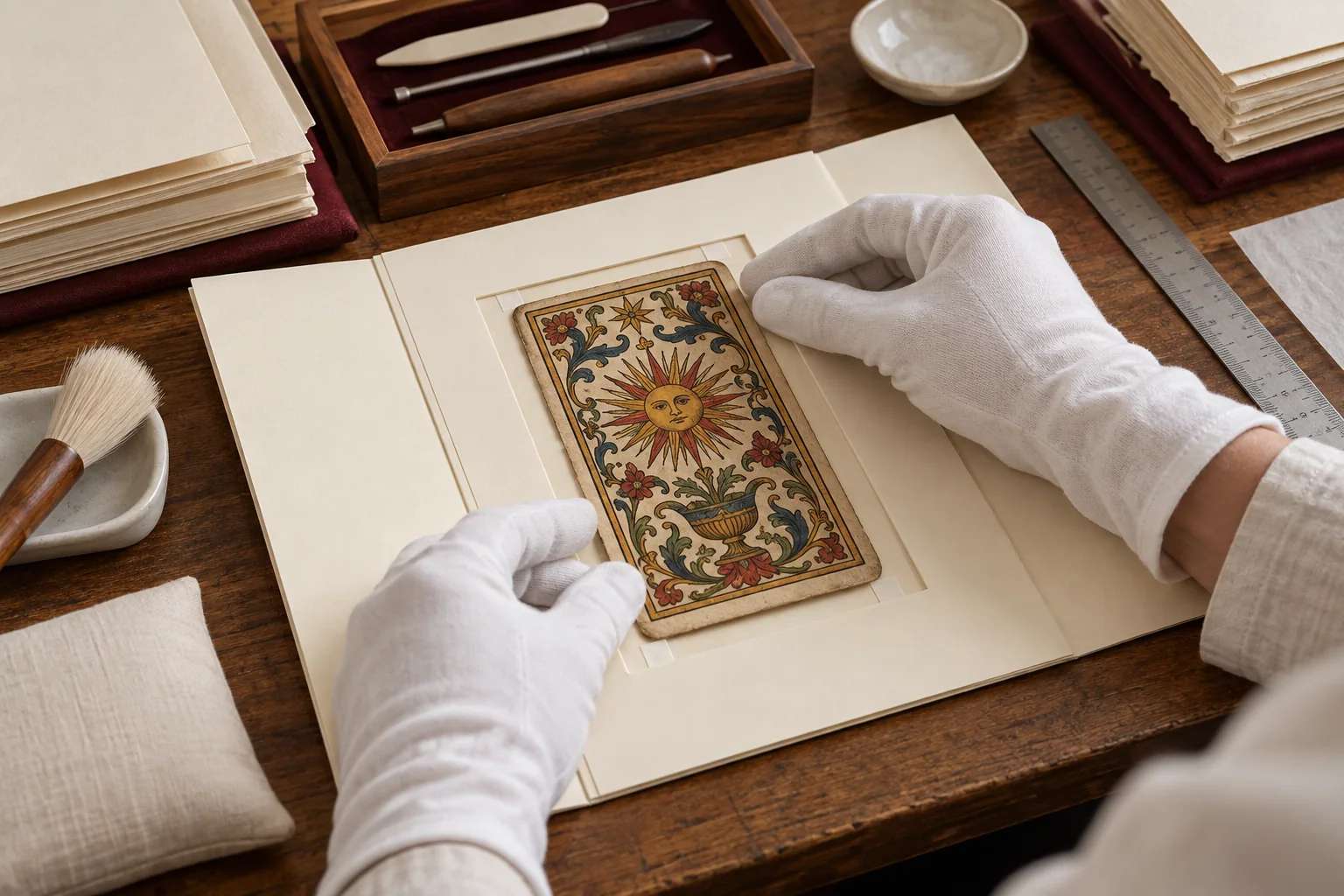
A photograph of an old card lets us see a figure. The museum preserves something far more complex: an object with two sides, a support, dimensions, a material condition, a history of ownership, and a place within a collection. That difference changes the way we talk about the past of tarot. An isolated image can suggest that all the cards in a deck were the same, that we know when they were drawn, or that their current meaning was already fixed. An object record, by contrast, forces us to ask what has been verified and what remains a hypothesis.
Let us take a concrete example. The Morgan Library & Museum catalogs thirty-five cards from the Visconti-Sforza set under shelfmark MS M.630.1–35. Its catalog indicates dimensions, technique, approximate chronology, and acquisition by Pierpont Morgan in 1911. That information is not administrative decoration. It makes it possible to identify the pieces the institution holds and to separate them from other cards from the same set preserved in other collections. When a shop sells a modern deck that gathers the surviving cards, we are dealing with a publishing product that reproduces the set; the museum's cards remain original objects distinct from that product.
The Shelfmark: The Object's Stable Address
The first piece of data I would look for in a record is the shelfmark or inventory number. A card's title can vary: 'The Fool,' 'Fool,' and other historical names may appear depending on the language, edition, or catalog. The shelfmark makes it possible to return to the same piece even if the way of naming it changes. 'Visconti-Sforza' designates a historical set; MS M.630.1–35 identifies the thirty-five cards that the Morgan describes as part of its holdings. Citing only the deck's name and pasting an image without provenance does not make it possible to verify which piece we are looking at.
A good explanation for the reader should answer three simple questions: What institution holds the piece? What identifier does that institution use? And is the original object or a reproduction being shown? If one of these is missing, the image may still be attractive, but it stops functioning as precise historical evidence. The Morgan's catalog makes it possible to locate its group of cards; the Bibliothèque nationale de France's record for a tarot associated with Conver, for example, offers another identifier and describes a different deck, with its own technique and dimensions. They are not interchangeable images of a supposed universal deck.
The Support Matters as Much as the Figure
To know a card, one must look at what it is made of. Paper, adhered layers, pigment, gilding, engraving, and color applied afterward produce different objects. A card painted for a courtly setting does not tell the same material story as a print run colored with a stencil. The Metropolitan Museum of Art explains in its exhibition The World in Play that some luxury playing cards of the fifteenth century were highly elaborate objects and that other examples used printing techniques. Even among cards from a nearby period there is diversity of materials, formats, and uses. Reducing this to an inevitable evolution from 'handmade art' to 'modern tarot' would erase that variety.
Measurements help one imagine the object in the hand. The Morgan's record gives approximately 173 by 87 millimeters for its Visconti-Sforza cards. The BnF catalogs a deck in Conver's name at 11.9 by 6.2 centimeters. That comparison does not by itself demonstrate how each was played. It does prevent us from treating them as two versions of the same digital file. A photograph that automatically fits the width of the screen can visually equalize pieces of different sizes.
The Reverse Is Also a Source
Web pages usually show the front, because that is where the scene we recognize is. However, the reverse can record a pattern, a color, a repair, or a layer of paper. The BnF's record on the Conver tarot describes reverses with patterns of dotted diamonds and crosses, in blue or black, or with red paper. That information makes it possible to formulate questions about manufacture and variants of the cataloged object. It does not authorize saying that all Marseilles tarots had that back. On a visit or in a digital record, it is worth expressly searching for 'reverse,' 'dos,' or 'back' before interpreting the card as if it had only one side.
A reverse does not usually resolve a date or an authorship by itself. If a museum describes several types of back within one set, one must ask whether the differences come from different print runs, repairs, or later mixtures. If the record does not answer, that is the honest conclusion: we know the variation and we still do not know its cause. The article on how to read the backs of old cards goes deeper into that problem.
Provenance and Date Are Not the Same
Provenance is the documented history of ownership and custody of a piece. Knowing that Morgan acquired his cards in 1911 does not mean they were manufactured in 1911. The acquisition is a modern episode in their journey. Likewise, a date printed on a reproduction does not turn that copy into an original from the indicated date. A serious record distinguishes the proposed dating for the object, the ownership records, the arrival in the collection, and later interventions.
When an institution writes 'circa 1450–1480,' it offers a reasoned range, not the exact date of printing or painting. When a card is attributed to a workshop, the phrase is not equivalent to an unequivocal signature on each sheet. Those words of caution must be preserved when telling the story. The reader who wants to compare two editions can start with how to identify the date of a historical deck; comparing only the numbers printed on the boxes usually leads to false conclusions.
Condition: What Is Visible Today Was Not Always Visible Before
A card may be worn, trimmed, recolored, or pasted onto another support. The catalog may report this, and the absence of a note does not prove that no intervention ever occurred. Caution is especially important when using an enlarged digitization. Screen contrast, lighting, color correction, and framing can make a faint line appear crisp or hide the edge of the piece. The digital image facilitates study, but it does not replace a material conservation description.
There is also a difference between a surviving card and a card reconstructed to complete a sellable deck. The Morgan's shop describes a facsimile that reproduces seventy-four surviving cards from the Visconti-Sforza set and incorporates four recreated cards. A reader can enjoy the product's seventy-eight cards; to investigate the fifteenth century, they must know which are based on originals and which are editorial reconstructions. The article why incomplete decks survive explains the implications of that absence.
How to Read a Museum Record in Five Minutes
First open the museum record, not a shared image without a caption. Copy the identifier and check whether the record describes one card, several cards, or an entire deck. Read the technique and dimensions. Look for the reverse and the condition note if they are available. Distinguish the dates: estimated creation, edition, acquisition, and catalog publication. Finally, look at the degree of certainty in the verbs: 'signed,' 'attributed,' 'workshop of,' and 'after' do not say the same thing. Write down the doubt in your own summary when the record is provisional.
You could keep a note like this: 'The Morgan holds thirty-five cataloged original cards from the Visconti-Sforza set; the commercial facsimile gathers reproductions of the surviving ones and four recreations; the exact date and some artistic attributions are matters of catalog scholarship.' It is less spectacular than 'the complete original tarot,' but much more useful. It lets you return to the source, correct a statement, and explain to someone else where each piece of data comes from.
What This Teaches Us When Reading Tarot Today
Material research does not require giving up contemporary readings. It simply prevents confusing a personal interpretation with proof of how a card was used centuries ago. A person can work today with the symbolism of a card and, at the same time, recognize that the historical piece has a support, a provenance, and a play context that must be documented separately. That separation makes the practice more honest and the history more interesting.
If you begin to study a Marseilles deck, use museum records to compare objects and current editions to practice with a copy you can handle. Do not put the copy in the place of the original or attribute to the original what a later editor added. The question 'What does the museum preserve?' thus becomes a tool for critical reading: we see an image, we investigate an object, and we state with precision the distance between the two.
Sources Consulted
- The Morgan Library & Museum, catalog of the Visconti-Sforza cards, MS M.630.1–35. Record of the object, measurements, dating, and provenance.
- The Metropolitan Museum of Art, The World in Play: Luxury Cards, 1430–1540. Material context of painted and printed playing cards, including game cards not belonging to tarot.
- Bibliothèque nationale de France, record for the deck 'tarot Conver'. Example of a record with technique, dimensions, and reverse.
- Morgan Shop, Visconti-Sforza facsimile. Editorial description of the reproduced and recreated cards; it is not a record of originals.