Sabio Tarot · History and curiosities
What We Know About an Early Testimony of the Tarot Game
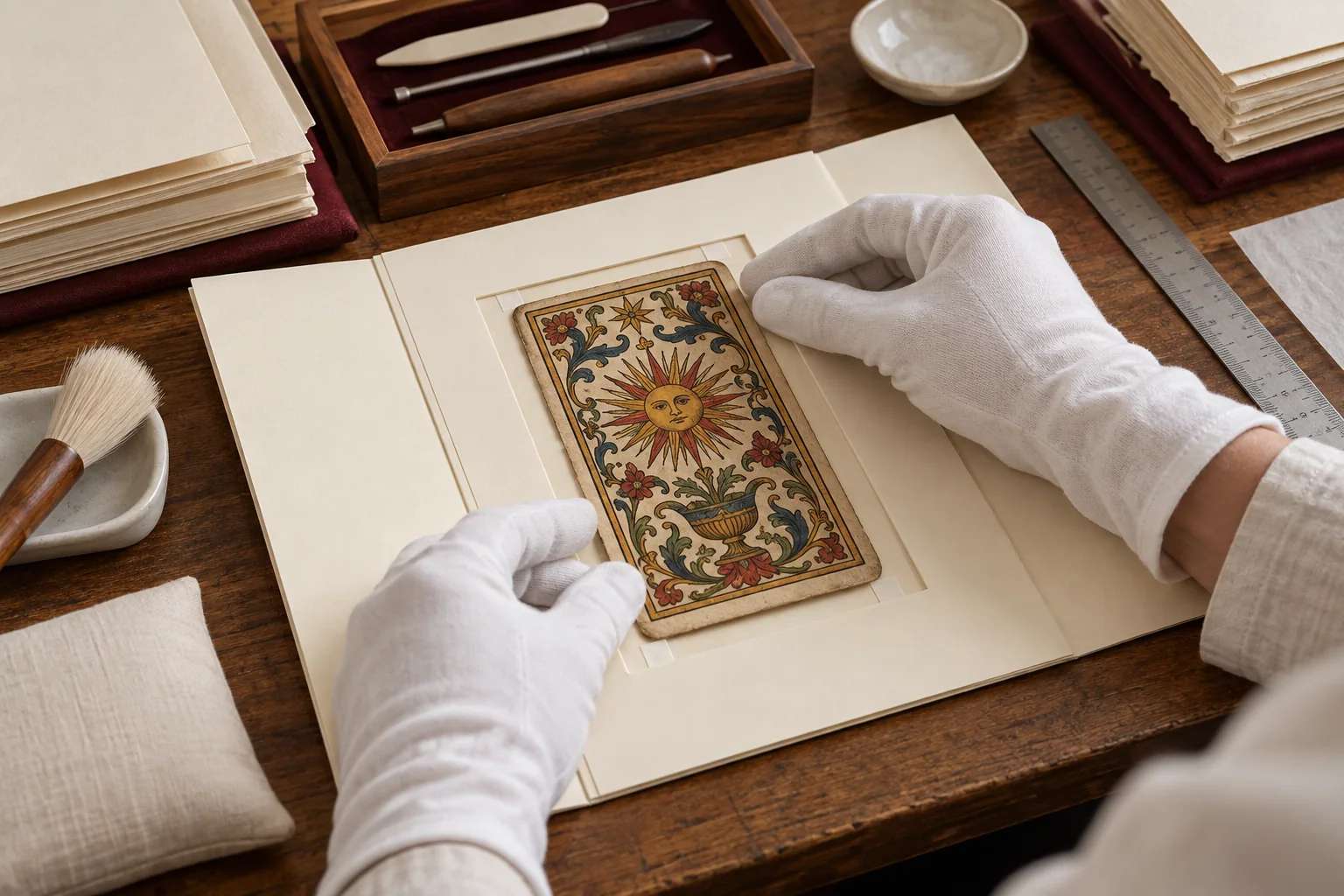
A preserved card shows us an image and its material. A rules manual brings us closer to what people did with the cards. The two sources are needed, but they do not say the same thing. In the catalog of the Bibliothèque nationale de France there is a printed work titled Règles du jeu des Tarots, attributed to Michel de Marolles and published in Nevers around 1637 according to the record. It consists of eight pages and is preserved in a manuscripts unit with a later handwritten addition. These data alone already permit an important statement: a text dedicated to explaining the game of tarot existed in a specific place and date. They do not authorize reconstructing all the rules of all previous centuries.
The BnF record classifies the document under “Tarot (jeu)”. This label directs us toward a playful practice, not toward a manual of cartomancy. The BnF itself recalls that the Tarot de Marseille had a game function before gaining a later divinatory profile. If someone searches Google for “how cards were laid out in 1637” and arrives at this booklet, they need to know that “rules of the game” does not mean “instructions for divining.” The title of the source is the first warning.
A Bibliographic Record Is Not the Same as Reading the Whole Booklet
The catalog offers title, attributed author, place, proposed date, extent, note on addition, and location. It does not present in its summary all the rules one by one. Therefore, this article does not invent moves, scores, or number of players from the booklet. To describe a precise rule, one would need to consult the complete text through authorized access or a study that transcribes it with verifiable location. Secondary sources can help interpret it, but they must be distinguished from the original document.
That limit teaches a method. First verify that the document exists and what its edition is. Then check whether there is a legible digitization. If you only have a record, you can write “the BnF catalogs a printed rules booklet from 1637”; you cannot write “page four requires playing in such and such a way” without seeing it. An honest description of a partial source is better than a fictitious summary of a text no one has opened.
Publication Date and Era of the Deck
The printed work from around 1637 belongs to the seventeenth century. The Visconti-Sforza cards preserved by the Morgan are from the fifteenth century. There are almost two hundred years between the contexts. Although both are related to tarot as a game, it does not follow that every rule of Marolles literally reproduces the way of playing of an early Milanese environment. The Metropolitan Museum of Art considers that tarot participated in trick-taking games and that some rules may have maintained continuity, but it also recognizes variations. Caution is necessary when we connect a late document with an earlier piece.
The same holds within a single era. A booklet written in Nevers may describe a local practice or a form that its author knew. It does not prove that all French tables played identically. In a historical explanation, place and date must always be kept: “in Marolles’s cataloged text,” not “in ancient tarot” as a universal block. Why the Order of the Trumps Varied develops the consequences of that diversity.
What Should One Look For Inside a Manual?
If the text is available, first read how it defines the deck: number of cards, suits, trumps, and special card. Then identify the sequence of the game: dealing, obligation to follow suit, role of trumps, tricks, and scoring. Note the original words before translating them. Some game terms do not have an exact equivalent in current Spanish. Finally, record whether the text presents alternative rules or exceptions. A manual that offers variants should not be summarized as a single fixed rule.
Also pay attention to what does not appear. That a game manual does not mention divination does not prove that no one performed any reading in the same city; it does prevent using that manual as a direct source for a reading technique. If the instructions are about winning tricks, do not turn them into positions in a spread. To document cartomancy, one must look for texts and objects from that use, with their own dates.
The Handwritten Addition Is Another Temporal Layer
The BnF record mentions a handwritten addition by Aug. Dupuy. The record does not by itself allow us to attribute its content to Marolles or date it the same as the printed work. A later annotation may clarify, correct, or comment on the text. The object that reaches the library is therefore more than the eight original pages: it has a material biography. A photograph or facsimile should distinguish printing and added hand. The principle holds for decks with later reading inscriptions: the intervention does not retrospectively change the purpose of manufacture.
The guide how to read a catalog of playing cards applies that same separation to card records. A note on the reverse, a stamp, or a copied name may belong to different times. Manuals also accumulate layers when they are reissued, bound, or annotated.
A Useful Comparison with a Modern Manual
Open a current tarot guide and look at what it promises: symbolic reading, spreads, meanings per card, and advice for formulating questions. Now look at the record of the printed work from around 1637: Règles du jeu des Tarots. The difference in title and classification already shows that we should not take the old manual as a direct precedent for a current cartomancy guide. Both texts speak of cards, but they respond to different reader intentions. The history of tarot includes that transformation of uses, not an identical tradition that passes intact from one to the other.
If you want to study the game out of historical interest, do not begin by assigning each figure its modern esoteric meaning. First learn the structure of suits, trumps, and the Fool documented by museums. Then look for legible rule sources and compare them. If you want to learn to read the cards today, use a current method and explain that it is current. Both paths are legitimate if they do not exchange evidence.
What We Can Assert and What Remains Open
We can assert that the BnF preserves and catalogs a printed tarot rules booklet from around 1637, attributed to Michel de Marolles, of eight pages, with a handwritten addition. We can place it in the history of the game. We cannot simply call it “the first tarot manual in the world” based on that record, because that priority requires an exhaustive comparison of documents. Nor can we extract its concrete rules without reading the text. Research gains credibility when it leaves those limits visible.
The booklet is an invitation to look at tarot as a social practice. Cards were not only images to collect or symbols to interpret: they also ordered turns, bets, tricks, and conversations around a table. A manual preserves a part of those actions. Reading it with its date, place, and purpose brings us closer to that historical life without inventing a perfect continuity with our spreads.
Sources Consulted
- BnF, Règles du jeu des Tarots, notice cb33577078q. Record of the printed work from around 1637, extent, attributed author, and handwritten addition. No transcription of the internal content has been used.
- The Metropolitan Museum of Art, «Before Fortune-Telling». Context of tarot as a trick-taking game and variations.
- BnF, «Un tarot qui rebat les cartes». Framework of the playful use of an early Tarot de Marseille.