Sabio Tarot · Decks and systems
Landscape and Background in a Tarot Card
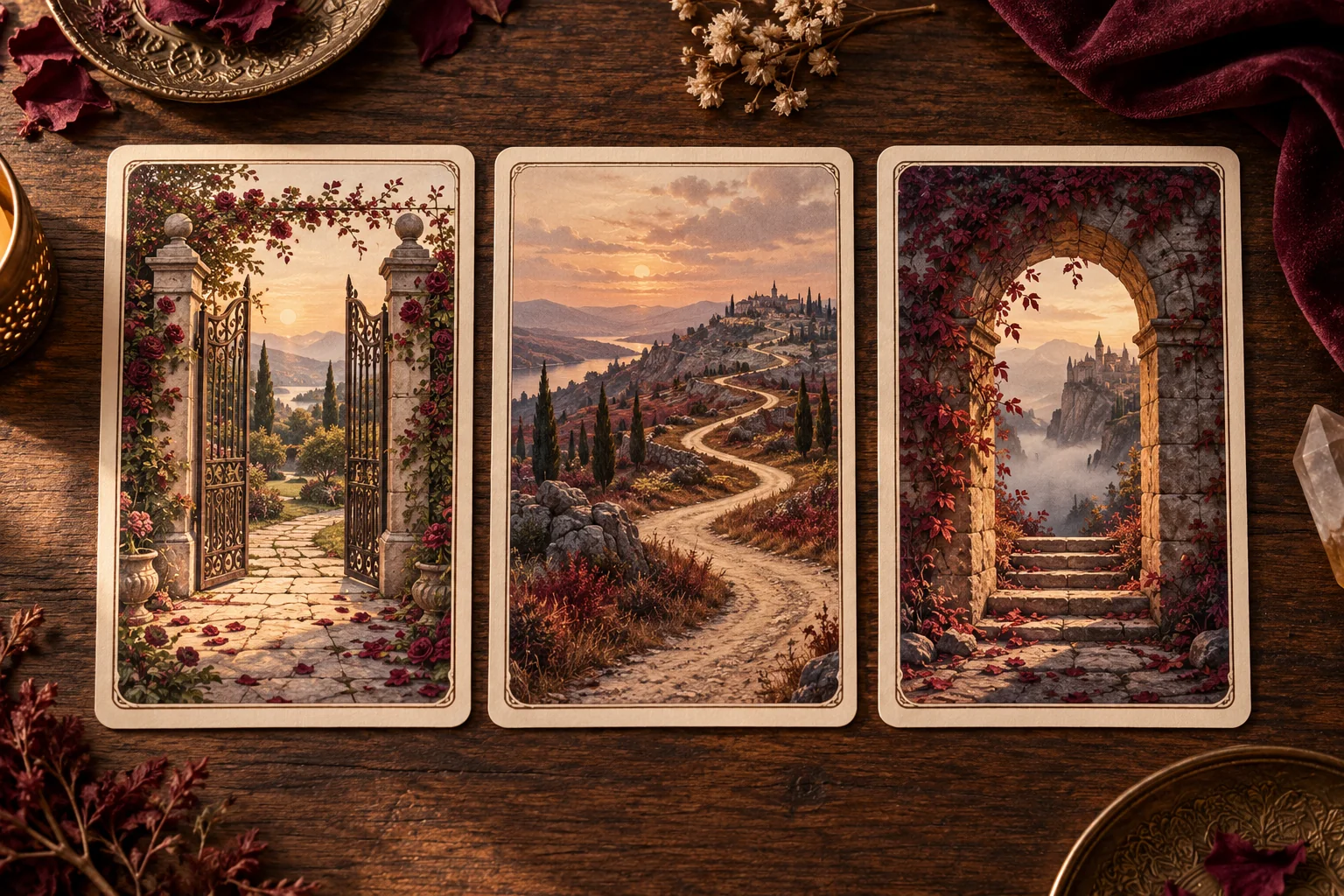
When we look at a card, the figure or object in the foreground usually absorbs our attention. The landscape may remain as decoration, although sometimes it organizes the direction, distance, or scale of the scene. The question is not "What does a mountain mean in tarot?" but what does that background do in this specific image and does it change the reading for this query. To answer, we will use an experiment: first describe without the background, then restore the landscape, and compare both interpretations.
Foreground, Middle Ground, and Horizon
Open the card from your edition and mentally divide the image into three bands. In the foreground there may be a figure, a table, or an object. In the middle ground, a path, another figure, or a barrier. In the background, a horizon, building, sky, or indeterminate space. Not all cards contain those three layers. In a Marseille numeral card, for example, you may find suit symbols and ornaments without a narrative landscape. Do not invent a mountain because you remember another deck.
Also describe how much space each zone occupies. A tiny castle in the background does not necessarily have the same weight as a door that fills half the card. Size, sharpness, contrast, and position influence our attention. This is a compositional observation, not a spiritual interpretation. An edition that crops the margins or modifies color can change what stands out; record which version you looked at.
Experiment: Cover and Uncover the Background
Place a piece of paper over the distant area without covering the main element. Write a sentence about the scene that remains. Then remove the paper and note a new detail that the landscape contributes. Ask whether it changes your hypothesis or only adds atmosphere. If the initial sentence holds up the same way, you are not obliged to give the background symbolic prominence. If the background shows a route that contradicts your first idea of confinement, then it is worth revisiting it. The experiment is an original visual reading technique from this website, not a psychological test or a historical procedure attributed to a school.
The illustration on this page, created for this site, allows you to do this without reproducing others' cards. In the central card, a curved path leading toward a distant building can be seen. If you cover the background, part of the route and nearby terrain remain; if you uncover it, a visual destination appears on the horizon. That does not prove that the reader will reach a city. It changes the composition: there is a represented direction and a drawn place. What you do with that information depends on the question.
Fictitious Example: A Study Project
Invented example. Hugo asks, "What aspect of my study plan am I not seeing?" In the "aspect to check" position, an illustrative card appears with a seated figure in the foreground and a path that disappears among mountains. When he covers the background, Hugo interprets pause and concentration. When he sees it in full, he adds a hypothesis: perhaps he has thought a lot about today's session and little about how he will get to the next topic. He checks his calendar and discovers that he had not planned a week for review.
His action is to reserve two sessions to review exercises before starting the next topic. That decision comes from the calendar, not from the mountains "meaning review." An alternative reading would be that the path indicates a distant goal that Hugo had already set and that the seated figure represents a necessary pause. To choose between them, consult how he studied last month. The card serves to ask about the link between present and horizon, not to declare that he knows his future progress.
The Background Can Also Distract
A highly detailed image can invite infinite associations: every cloud, tree, and window becomes an alleged message. Set a limit: choose at most one feature of the background that is visible and relevant to the question. If you need to argue for its importance, explain why the composition makes it stand out or why it contrasts with the foreground. If you cannot do so, perhaps you are filling with symbols a piece of information you should obtain outside tarot.
On the cover of Rider-Waite Tarot from Scratch, reproductions of the Star, the Moon, and the Sun appear with different skies and terrains. We can observe that variety in the images on the cover. We cannot conclude that the color of every blue sky has the same interpretive value in all decks. The V&A explains the authorship and visual evolution of the cards; to assert a specific intention of the artist regarding a cloud or a mountain, specific evidence would be needed.
Comparing Editions Without Confusing Variants
If you have two versions of the same card, place them side by side and record differences in color, cropping, and detail. Avoid saying "the card always has this background" if an edition modifies it. In a deck inspired by Rider-Waite-Smith, a contemporary illustrator may add buildings that do not appear in the historical reproduction. An added landscape does not automatically become a teaching of Pamela Colman Smith. If you compare a Marseille with a Rider, remember that in the minor numeral cards one may have no scene and the other may; the absence of landscape is a feature of the drawing, not a deficiency in the reader.
The experiment can be repeated with a card without a narrative background. Cover part of the ornamentation of a Marseille numeral card and observe whether the distribution of the suit symbols changes. Do not call that ornamentation "mountains" or "paths" by analogy. A faithful description of what is in the card is more valuable than an attractive metaphor that adds nonexistent things to it.
Closing Sheet
Write four lines: "In the foreground I see...", "In the background I see...", "My reading without the background was...", "With the background I maintain or change this hypothesis because...". Add the question and the position. If nothing changed, say so. A visual technique does not always have to produce an interpretive twist to be useful. It can confirm that the foreground was sufficient or reveal that you had ignored an important spatial relationship.
These imagined cards allow you to practice attention, but they do not document a historical deck. The guide to describing a card by its position helps you decide whether the background adds relevant information. In any case, a drawn landscape does not by itself prove the geography, plans, or emotional state of a real person.