Sabio Tarot · Decks and systems
Doors, Paths, and Thresholds in the Cards
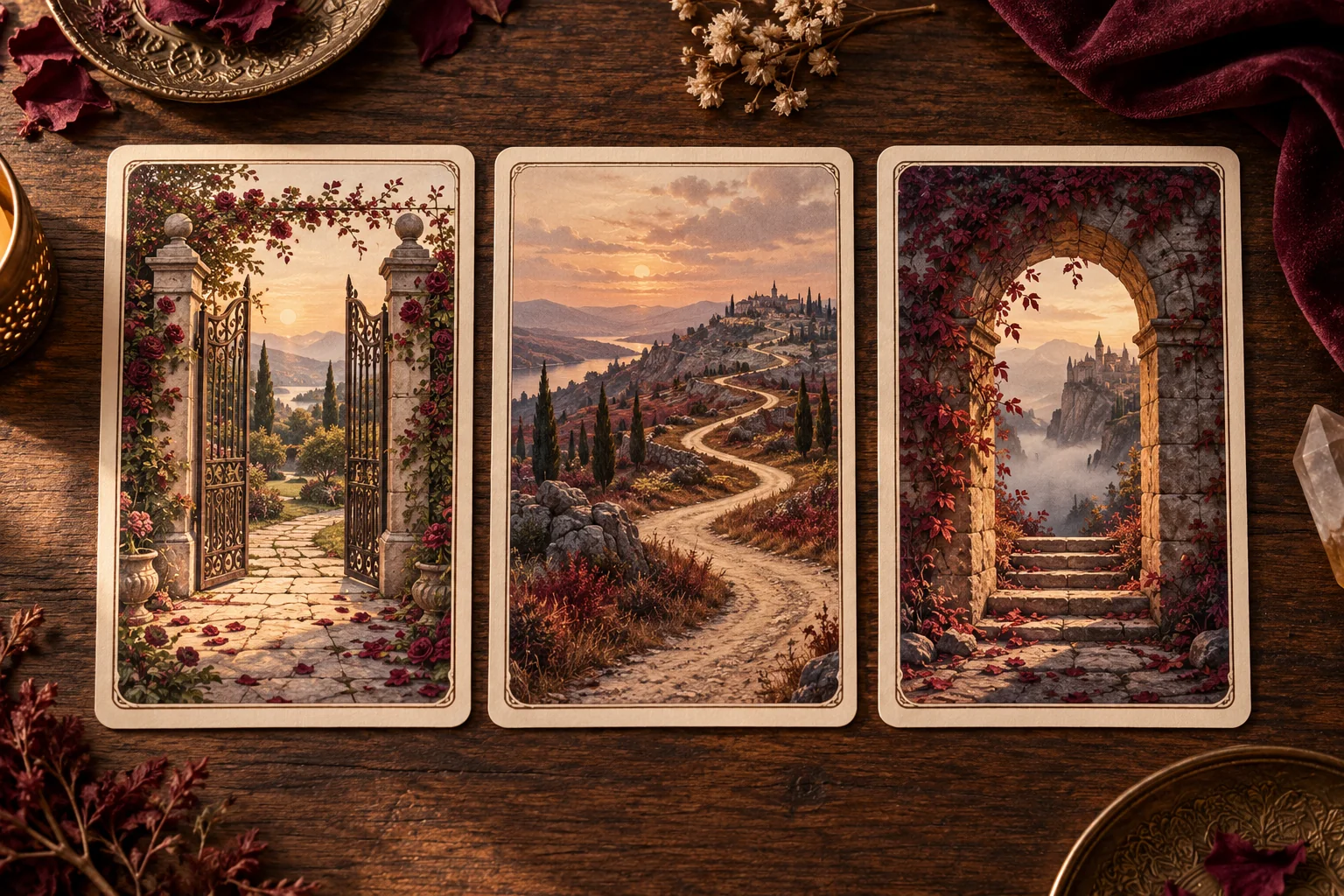
A path reaching the horizon can immediately awaken the phrase “a new chapter opens.” A half-open door can become “an opportunity will arrive.” These readings can be evocative, but first it is worth asking a simpler question: what is actually drawn? The illustration on this Sabio Tarot page offers three invented cards for practice. The first shows an open gate toward a garden; the second, a winding path leading to a distant building; the third, steps beneath a stone arch that opens onto a misty landscape. None is a documented historical tarot card.
Describing the route without assigning it a destination
At the gate we see an opening and a path continuing behind it. We do not see anyone crossing it. In the central card, a route is traced into the distance, but we do not know how long it takes, who uses it, or what happens upon arrival. In the third, the stairs pass through an arch and the ground in the background seems different; nor do we know whether the journey is safe. These sentences can be verified in the illustration. “Someone will invite you into a new life” cannot be verified there: it is a story we add.
Try recording starting point, threshold, visible direction, and area not shown. If a person does not appear, do not attribute decision or emotion to them. If a route leaves the frame, write that it leaves the frame, not that it leads to a specific goal. The visual direction can support a metaphor of transition, but the question and the facts of the consultation decide whether that metaphor helps. The V&A documents the variety of deck designs; our visual is an original contemporary illustration, with no claim to represent a mandatory motif of the historical system.
Three thresholds, three different questions
An open gate can invite the question “what condition should I check before entering?” A long path can lead to “what stretch can I travel now, and what remains outside my view?” An arch with stairs can inspire “what support do I need to descend carefully?” None of these formulations promises that the crossing is good or bad. They are working questions based on what each image makes visible. If all three produced the same generic answer—“positive change”—the exercise would have erased precisely the differences we wanted to observe.
You can also invert the hypotheses. An open gate can be an exit, not an entrance. A winding path can be a familiar route and not a new adventure. The stairs can lead to a place you have already visited. The image does not contain the person’s previous story. Write at least one alternative reading for each threshold and indicate what external data would allow you to choose. That test reduces the risk of treating any door as an announcement of work, love, or travel.
Fictitious example: choosing a course
Invented reading, with no real client. Lidia compares an in-person course with an online one. She defines the position “what I need to check before enrolling” and uses the illustration of the winding path as a stimulus. Her first interpretation is “the learning will be long.” She corrects the sentence: the image shows a long path in the drawing, not the duration of the course. A useful version is “I must review how much real time the program requires and whether I can sustain it.” She looks for a calendar, number of assignments, price, and refund conditions.
If Lidia had seen the open gate, she might think about access requirements. If she had seen the arch with stairs, she might think about support during the first weeks. None of those images contains the terms of the contract. The symbol helped formulate questions; the data came from the institution. At the end, Lidia writes a list of verified conditions and another of pending doubts, not “the tarot told me which course to choose.”
A route is not equivalent to real movement
The figure of a path can be empty. It can appear behind someone motionless or end outside the frame. Distinguish drawn path from represented action. If the character is still, perhaps the card shows the possibility of movement, not current movement. If there are several exits, perhaps the composition poses a visual choice, not a single destination. These observations can enrich an interpretation, as long as they do not become facts about the reader.
In a specific Rider-Waite-Smith deck, a path, a door, or a landscape can be part of a numbered scene. In many Marseille numerals there are no narrative scenes, but rather suits and ornamentation. Do not transfer the path from the invented visual to those numerals. The difference between systems and editions is central: a motif that does not appear in your card cannot be the evidence for the reading. To recognize the role of the image in each deck, see the deck comparison published in the library.
Designing an honest didactic outline
To practice, point out in the illustration three visible places: the entrance of the gate, the curve of the path, and a step of the staircase. In one column write what is observed; in another, a question that each detail suggests to you. Do not label “success” at the end of the route or describe a city that is not seen. The difference between observing and interpreting is the main learning of this exercise.
To compare these scenes with historical cards, first identify the edition, provenance, and rights of each image. The illustration on this page allows you to study the distinction between looking and inferring, but it does not constitute documentary proof about an old deck.
Closing without a promise of a new beginning
Write a synthesis in three parts: “I see this threshold,” “in this question it makes me consider this possibility,” and “I will check this fact or do this test.” If the answer depends on another person, make clear that their decision can only be known by talking with them. If it depends on a deadline or money, consult documents. Tarot can offer a metaphor for ordering a transition; it does not by itself reveal what is behind a door that the image does not show.