Sabio Tarot · Decks and systems
Gazes and Direction of Figures in Tarot
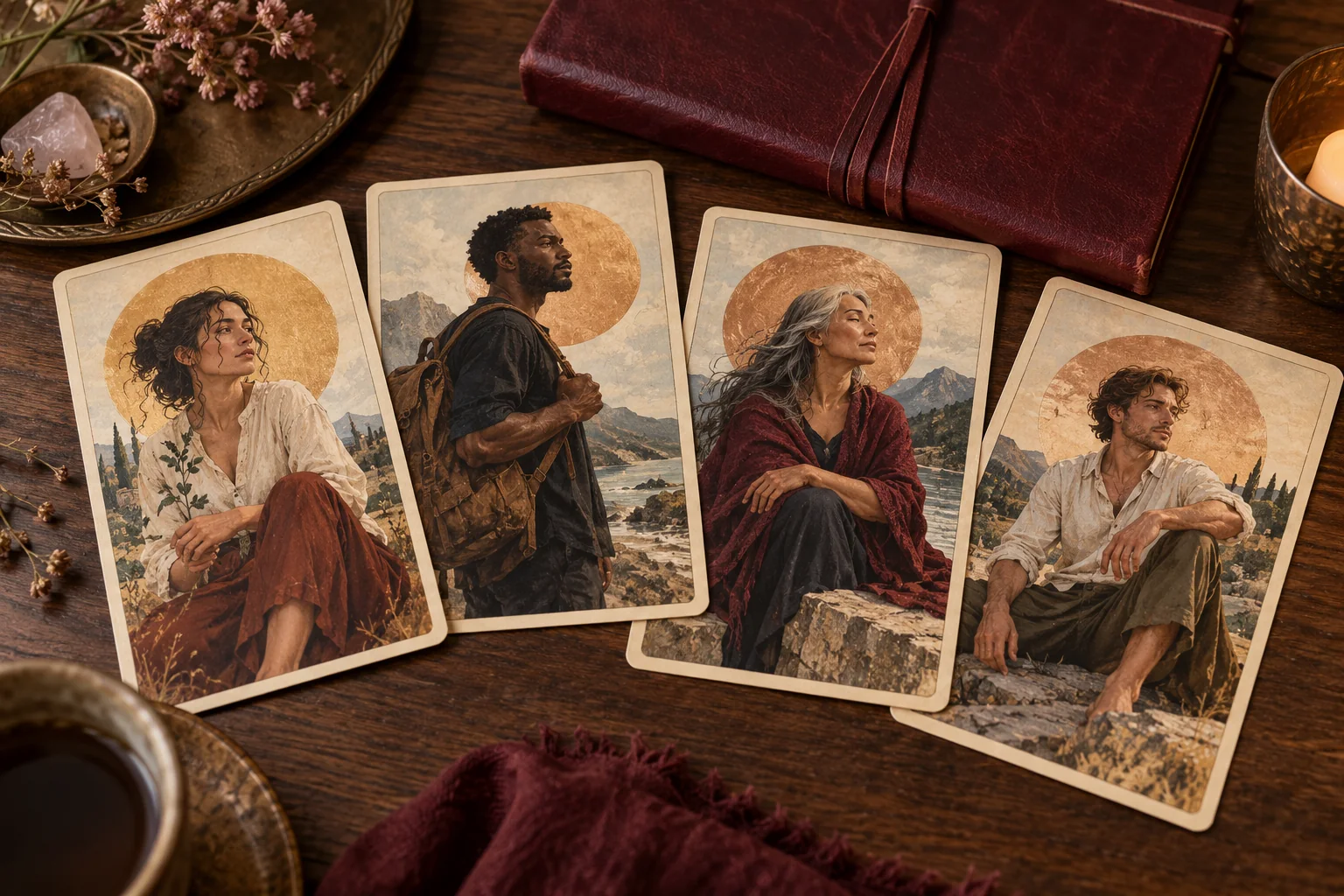
Gazes are one of the first things we believe we see in a card and one of the easiest to invent. A figure can turn its head without its eyes being distinguishable; two characters placed face to face do not necessarily look at each other. This article teaches how to separate body orientation, face direction, visible eye line, and relationship with another card. Only afterward is a useful hypothesis formulated for the question. The image does not give access to the thoughts of the person drawn in it or of a real person in your life.
Four levels of observation
Start with the body: is it facing forward, in profile, turned, or partially covered? Then look at the head: does it align with the torso or turn in another direction? Third, look for the eyes: can you see the pupil, or only a tilt of the face? Finally, identify a possible destination within the drawing: another figure, an object, the landscape, or a space outside the frame. If the reproduction is small, record “direction not verifiable” instead of drawing an invented arrow.
The illustration on this page offers a concrete exercise, not a historical deck. In the image inspected, the figure on the left looks up and to one side; the second appears oriented to the right; the third has closed eyes; the fourth turns the head to the left. These are features of that editorial illustration. It would not be correct to describe all four as “people looking at one another”: their cards are together on a table, but a joint composition does not automatically create a visual conversation.
The arrow only represents what can be pointed to
If you are going to draw arrows on a working copy, use three different styles: one for body orientation, another for face direction, and another for verifiable gaze. If the eyes are not visible, do not draw the third. This system prevents the arrow from becoming an excessive statement. A figure can look toward the edge of its card and not toward the card you placed next to it; the relationship between cards depends on the order and the spread that you set.
The cover of Tarot Rider-Waite from Scratch reproduces several historical cards attributed to the Rider-Waite-Smith system. In it, the frontality of the High Priestess can be compared with other figures in profile or with less legible faces. The V&A documents Pamela Colman Smith as the designer of the deck. This source allows the visual tradition to be identified; it does not offer a universal rule according to which looking to the right means future or looking to the left means past.
Fictional example: two people in a project
Invented reading. Noa asks: “What do I need to clarify before dividing two tasks with my partner?” She lays out two cards from an illustrative deck in fixed positions: “what I can explain” and “what I must ask.” In the first, she sees a figure oriented toward a table; in the second, a figure looking outside the frame. A hasty reading would say “my partner looks away and doesn't care.” That would be attributing to a real person the gesture of a drawing. Noa formulates a more modest hypothesis: perhaps she has explained her tasks, but has not yet asked what her partner's priorities are.
The resulting action is to write two questions: “What part are you interested in taking on?” and “What deadline can you confirm?” The second card does not reveal the answer. If the partner says they are waiting for information from a third party, Noa updates the plan. If they say they do not want to participate, she updates it too. The usefulness of the reading was to remember a gap in information, not to know someone else's intention.
When two cards seem to look at each other
In a physical spread, two figures can end up facing each other because you have placed their cards side by side. Try reversing the placement order only as an analytical exercise, not as if it had been the original reading. Does the visual arrow disappear? Did you change the meaning of the story even though the cards are the same? If the conclusion depends entirely on the proximity created by your hand, acknowledge it. A reading can make use of a spatial relationship, but it must explain where it comes from.
The edition also matters. A contemporary deck may reverse a scene, crop it, or change the orientation of a figure. Do not say “the character on this card always looks at the other” without checking your copy. Note the publisher, year, or edition name when possible. If your method relies on an eye line, describe exactly which one you see. In Marseille, a court figure may have a face in profile, but the numerals of the Minors lack narrative characters; let us not transfer a dialogue of gazes to a card without faces.
Closed eyes, indeterminate gaze, and empty space
A figure with closed eyes is not looking “inward” as a visual fact; that is an interpretive metaphor you can propose if the question makes it relevant. It may suggest rest, attention to a task, or something completely different depending on the drawing. The empty space toward which another figure seems to be heading also does not demonstrate the absence of someone in the querent's life. It is simply an area of the composition. Ask what is actually drawn before turning it into a story.
In the illustration on this page, the third figure appears to have closed eyes. It can be used for a two-column exercise: observation: “closed eyelids”; possible readings: “rest,” “listening,” “disconnection.” The second column is not meant to be a universal key. A question about rest may favor the first hypothesis; one about conversation may make it more useful to ask whether the person is listening. The interpretation remains open until it is connected to facts.
Closing: a sentence without mind reading
Write the synthesis as “In this edition, the figure appears to look toward X; in position Y, this invites me to ask Z.” Avoid “that person feels X” or “the other will turn their back on you” if you do not have their testimony. To move from an observation to a two-card reading, the guide how to interpret two cards together explains how to maintain context.
The four figures in the illustration are invented. You can observe their eyes and heads, but not infer a conversation between them just because they appear together. If it is not clear where one is looking, record the doubt. A reading of gazes begins by recognizing the limits of the image.