Sabio Tarot · Decks and systems
Objects on a table in tarot: inventory before symbol
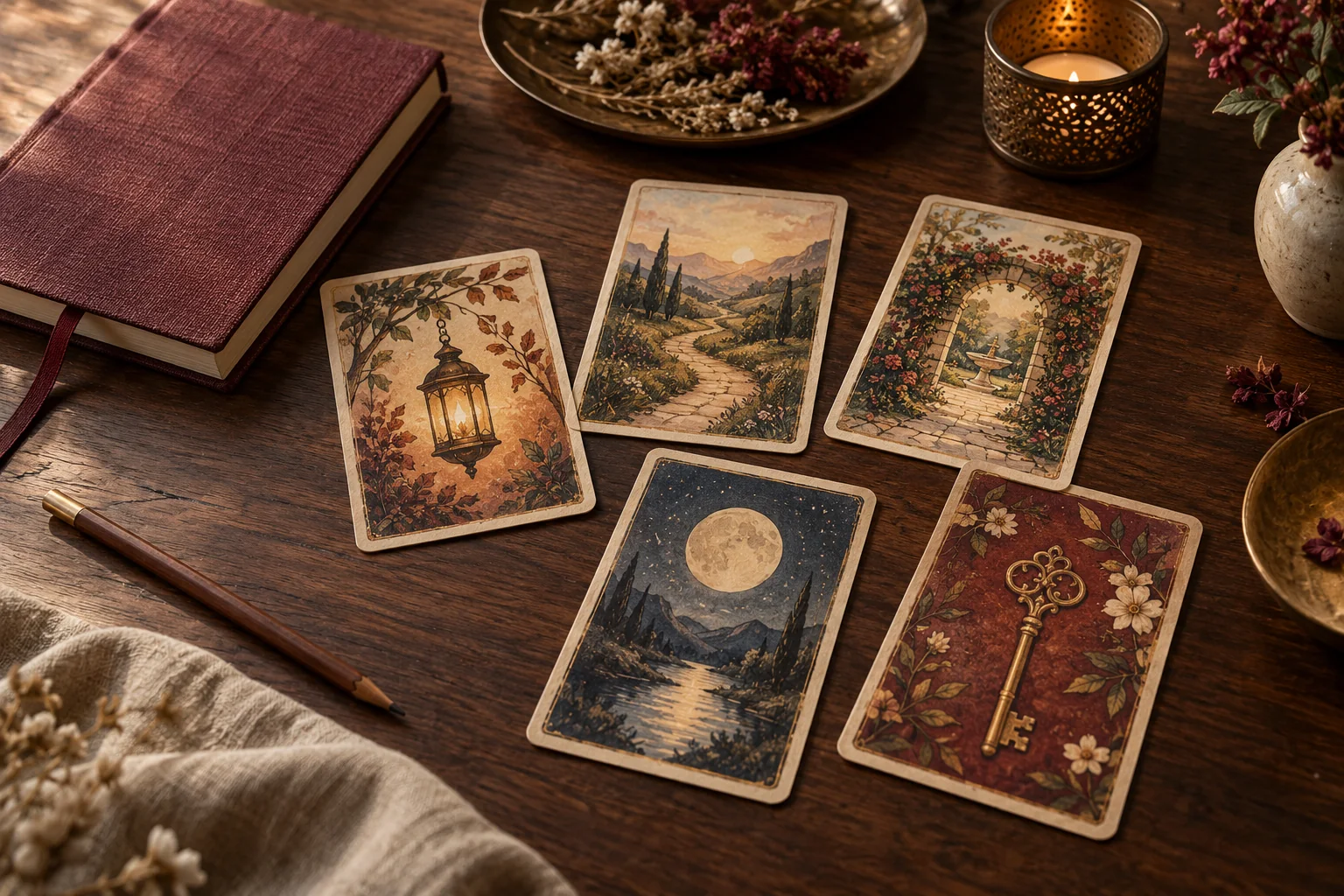
A drawn table can hold tools, containers, or things that are difficult to identify. If we immediately call it the “table of destiny,” we stop looking at the image. The method on this page begins with an inventory: what objects are visible, where they are, whether the figure touches them, and which ones remain out of reach. Then we relate that distribution to a specific question. The table does not have a single meaning for every deck, and the presence of an object does not predict that it will appear in the reader’s life.
Two covers, two compositions
On the cover of Tarot Rider-Waite from Scratch the Magician from the Rider-Waite-Smith system is reproduced in front of a table with objects. On the cover of Tarot de Marsella: casos reales: 60 consultas leídas paso a paso, de la pregunta a la respuesta (Spanish edition used as a visual source) Le Bateleur is seen next to another table, in a different composition. Both images are visible on the local covers we have inspected. We do not claim that the covers show the entirety of each deck or that all historical copies preserve identical colors or objects. The V&A places Pamela Colman Smith in the creation of the Rider-Waite-Smith; it does not prove that the two tables share a universal interpretation.
Take the card from your actual edition and write a list without interpreting: “round object on the left,” “container in front,” “tool near the hand.” If you cannot identify an element, describe shape and location before giving it a name. A small reproduction can confuse cup, glass, coin, or ornament. The order of the objects also matters: an object in the hand is not the same as another separated by the whole table. This precision prepares better questions than a list of four memorized elements.
Object, action, and context
An object can be displayed, in use, stored, or barely hinted at. Look at whether the figure touches it, whether they seem to choose among several, or whether the scene shows no interaction. Then ask what the table contributes to the composition: it organizes elements, separates figure and viewer, or serves as a workplace. These are all visual possibilities; none by itself proves a psychological intention. If you do not see the hands clearly, avoid saying that the figure “chooses” a specific object.
In a consultation about preparing a task, a full table can suggest available resources or too many options. The decision between both readings depends on the position and the real state of the task. If the question is “What do I already have?”, the inventory of tools makes sense. If it is “Why don’t I start?”, it may be relevant to review whether so many tools complicate the choice. The card does not know whether the reader owns those materials; we ask them.
Fictitious example: organizing a presentation
Invented reading scene, not a real case. Vega is preparing a presentation for a workshop. She asks, “What should I organize before showing it?” A card comes up illustrating a figure before a table where three different objects are visible. Vega notes their features without assigning fixed meanings: one looks like a notebook, another like a container, and the third like a tool. In the “available material” position, she proposes that she has content, examples, and a way to show the process. She reviews her files and discovers that the visual example is incomplete. The action is to finish one slide and rehearse it with a volunteer.
The same card in the “obstacle” position could inspire another reading: perhaps Vega is gathering materials without deciding on the central message. To distinguish them, check whether a presentation structure already exists. If there is one, the missing object may be a concrete aid; if not, the problem may be ordering the argument. The table allows hypotheses to be formulated, but it does not replace examining the files.
Not every drawn table is the Magician’s
A household table, a counter, and a workbench offer different visual relationships. Before applying an association learned from the Magician, identify the scene of the card that actually came up. In a contemporary deck, the artist may place a computer, a plant, or a cup. Those objects belong to that edition, not to a historical tradition that we should attribute retrospectively. If you compare two decks, write their names and publication dates when you know them.
The illustration on this page contains, among other invented motifs, a key on a floral background. That key is not a historical tarot card. It can serve to practice how an object is recorded before attributing to it a promise of “opening opportunities”: it has a visible shape, position, and surroundings. If the object appears outside a table, do not describe it as if it were on one just so the exercise fits the title. This scene serves to observe a motif; it provides no evidence about the Magician.
A comparison exercise without copying images
If you have two decks of your own or authorized access to their images, open the Magician or Bateleur card in both. Make a table with four rows: recognizable objects, relative position, relationship to hands, and areas you cannot identify. There is no need to publish the photographs. Then write a sentence that is true for one edition and not necessarily for the other. For example, “in this specific image an object appears in front of the figure” is verifiable; “the Magician always possesses the four tools” requires checking variants and defining what you consider a tool.
The comparison must respect image and design rights of the edition photographed. The fact that an old pattern is in the public domain does not mean that a contemporary photograph can be copied without conditions. You can draw your own schematic with generic objects and state that it does not reproduce a historical card. If you show a specific card in a public study, record manufacturer, edition, provenance, and permission or license.
Closing: a table is not an answer
Return to the question and write: “I see these objects in this edition; in the position of the spread they make me consider these two hypotheses; I will check this datum.” If the sentence begins with “the table announces…” and ends with a certain result, return to the inventory. An image can help you remember resources, limits, or pending tasks. It cannot by itself confirm that another person will contribute a resource or that a project will culminate. The guide on the position of a card allows you to maintain that relationship with the consultation.