Sabio Tarot · History and curiosities
Why the Order of the Tarot Trumps Varied
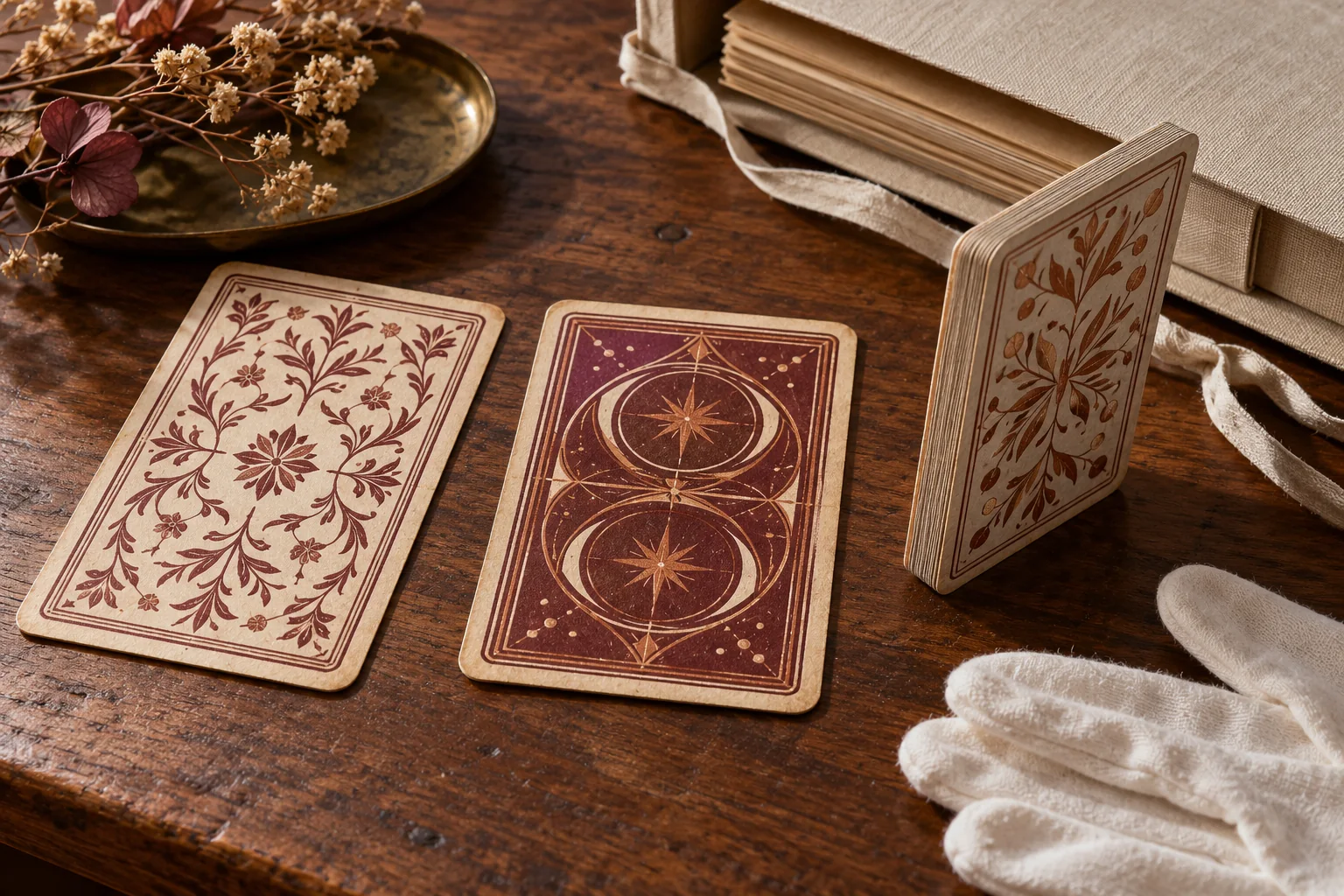
Anyone who learns tarot with a current deck usually encounters a numbered sequence and assumes it always existed exactly that way. The order seems obvious because every card comes with it printed on it. When looking at early sets, the question becomes more complicated: some trumps had no number, surviving cards may be incomplete, and different regions or games could order the figures differently. To explain this variety, we must separate three things: the rank of the cards in a game, the way a catalog orders them today, and the symbolic journey proposed by a reading guide.
The Metropolitan Museum of Art states explicitly that the trumps of certain early sets are not numbered and that their hierarchy varies according to geographic origin. The Morgan Library & Museum, commenting on the Visconti-Sforza trump images, notes that the exact logic of their sequence still presents uncertainties. Both institutions invite us to avoid a list presented as a universal fifteenth-century norm. That does not prevent studying a specific sequence: it requires citing which deck and which reconstruction are being used.
Game Order and Exhibition Order
In a trick-taking game, rank determines which card beats another under the rules of that variant. A display case, by contrast, may order the pieces to tell a visual story, follow a cataloging system, or accommodate gaps in the set. The number we see next to a card on a website may be a navigation index. None of those numbers should automatically become an original numeral on the card. To know what a piece actually has printed on it, you have to look at its image and read its record.
The Met offers an interpreted sequence of the Visconti-Sforza trumps and places the World at one end. It is a useful reference for that set and for the state of knowledge presented by the museum. It does not authorize us to claim that all Italian decks had the same order or that every surviving card is numbered in the form we know today. The exhibition itself distinguishes other sets with different compositions, including an early Visconti tarot whose structure does not completely match the later seventy-eight-card formula.
Why a Hierarchy Can Change
There are several possible explanations, and each requires evidence. A local game may establish different ranks. A maker may follow a regional model. An incomplete deck may force us to infer the place of missing cards. A later publisher may rearrange the images to fit an interpretive system. We do not have to choose one cause for all cases. The Met documents geographic variation; the Morgan warns of uncertainty in the reasoning behind a specific sequence. They are two points of support, not a license to reconstruct every lost game.
Variation does not mean absolute chaos. Allegorical images could form recognizable groups of social power, virtue, fortune, or heaven, as the Morgan proposes in its curatorial commentary. But recognizing visual affinities is not equivalent to proving a single mandatory scale for all players. A hypothesis of order can be reasonable and still remain a hypothesis. In an honest article, it is marked as such, and the sources that make it plausible are shown.
The Error of Projecting the Current Deck Backward
Suppose a reader sees “VIII” on their Justice card and decides to look for “the original eighth trump.” They may find another deck where that place is occupied by another figure or an old card that bears no numeral. If they conclude that one of the two is “wrong,” they are judging historical objects by the rule of a particular edition. Study begins the other way around: identify each object, check the actual numbering, and ask what sequence the institution or relevant game manual documents.
This also affects the so-called “Fool’s journey.” As a contemporary pedagogical structure it can be fertile, but it does not prove that all Renaissance workshops composed a linear story of inner growth. The article the Fool as a historical game card separates that figure from the modern zero slot. The article trump cards before they were called arcana explains why vocabulary can already change our reading of the sequence.
How to Compare Two Orders Rigorously
Choose two sets identified by museum, edition, and proposed date. Make a table with one row per figure and columns for visible name, printed number, position proposed by the source, and degree of certainty. Do not fill the gaps of an incomplete deck with a card from another edition without saying so. If a museum offers a reconstruction of the sequence, cite its explanation and preserve its cautions. If a source only shows isolated images, do not extract a historical hierarchy from the digital gallery without checking how the page was ordered.
A good comparative chart may have more empty cells than filled ones. That does not make it useless: it shows where the evidence ends. In research on old cards, the blank is information about loss or lack of documentation. An attractive graphic that fills every cell with modern art may serve for play; to explain history, it must label each reconstruction.
What “Varied” Means Without Exaggerating
It does not mean that any order we invent is historically equivalent. It means that the surviving sources do not support a single immutable arrangement from the beginning. Every claim needs its scale: “in the set analyzed by the Met,” “in a regional variant,” or “in this modern edition.” When rules from a place are not documented, it is preferable not to propose a specific local order. Variations that an institution substantiates are more valuable than spectacular lists without provenance.
The date of the source also matters. A game manual from a later century may describe an order in its own context; it does not prove that a fifteenth-century deck was played exactly the same way. A restored or facsimile deck may print numerals that the old pieces did not have. The researcher must ask at every step: Am I looking at the original object, a faithful reproduction, a restoration that adds details, or an editorial reconstruction? The answer changes what we can conclude.
For Anyone Who Reads Cards Today
You can use the order of your deck as a study map: compare neighboring figures, look for tensions, and practice a sequential reading. You do not need to resolve all historical debates in order to do so. If you tell the history of tarot to someone else, add a sentence of precision: “The numbering and order of the trumps varied; this journey follows the edition I am using.” That sentence avoids presenting your method as a fixed secret from the fifteenth century.
The history of the order reveals something broader: a deck is both a system of rules and a set of images. Rules could circulate and change; images could be copied; museums preserved only part of the objects. Studying the differences gives us a richer understanding than memorizing a single list and calling it universal.
Sources Consulted
- The Metropolitan Museum of Art, The World in Play. Regional variation of hierarchies in unnumbered trumps.
- The Metropolitan Museum of Art, “Before Fortune-Telling”. Example of a proposed sequence for the Visconti-Sforza set and comparison with other sets.
- The Morgan Library & Museum, “Tarot Trump Cards”. Commentary on the unresolved logic of the sequence and its images.