Sabio Tarot · History and curiosities
Trump Cards Before They Were Called Arcana
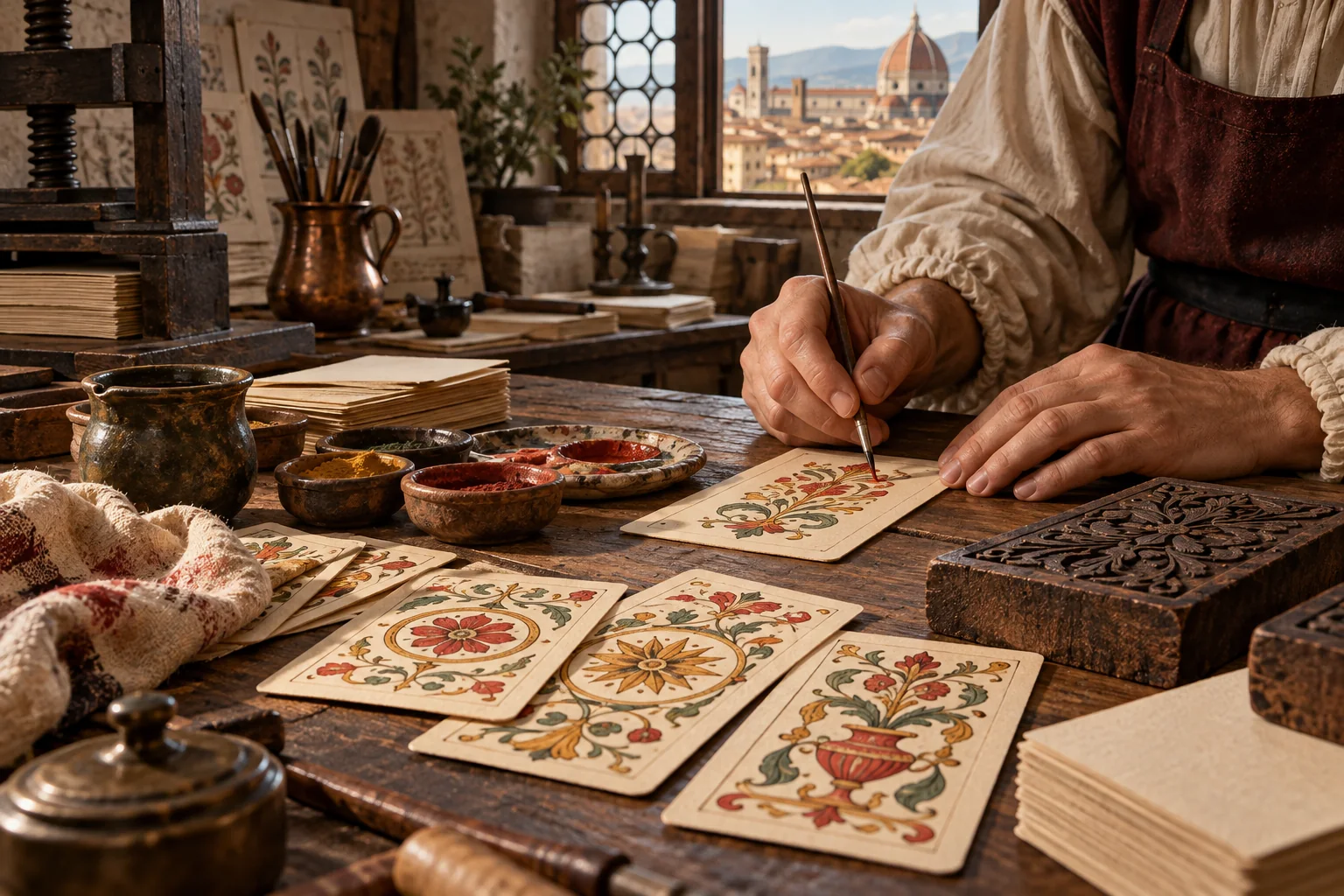
Today people speak casually of “major arcana.” The expression is useful so that a person can find books, spreads, and meanings. It should not lead us to imagine that a fifteenth-century Italian player called their cards that. The history of tarot contains changes in words and practices. Studying them makes it possible to explain what function the trump cards had in the game and when we are using a later interpretive vocabulary. A current name can serve for learning; it does not always serve as proof of origin.
The Metropolitan Museum of Art catalogue on luxury playing cards notes that, during the fifteenth century, the cards we today associate with tarot were called in Italian carte da trionfi, trump cards. It indicates that the term “tarot,” derived from French tarau and related to Italian tarocco, appears later, in the sixteenth century. The ultimate etymology is not considered certain in that source. This sequence does not require eliminating “tarot” from a modern page: it is enough to write “the cards we now call tarot” when we speak of an era that used another term.
What “Trump” Means in a Game
In many kinds of trick-taking games, a trump card can beat cards from the ordinary suits under specific rules. The Met describes early Italian tarot as a trick-taking game with additional trump cards. The Morgan catalogues a structure of fifty-six cards in four suits, twenty-one trumps, and the Fool for the Visconti-Sforza set. These figures describe a game structure; they do not demonstrate a program of esoteric interpretation. When a card had an allegorical image, that image coexisted with a function within a game.
If we say “major arcana” when looking at a fifteenth-century card, we may accidentally convey that its purpose was to reveal a spiritual secret. The Morgan is explicit in placing its Renaissance pieces in a gaming context and in explaining that their association with occultism and divination came centuries later. The word “arcanum” belongs to the later reading framework, not to the material evidence of the first manufacture. The distinction does not reduce the card’s symbolic interest; it clarifies which era each interpretation comes from.
Not All Words Change at Once
The same object can receive different names depending on language, city, era, and use. The fact that a word appears for the first time in a preserved source does not prove that nobody pronounced it before. The opposite also happens: that a term is known today does not prove that it was used then. That is why it is useful to distinguish “attested in documents” from “probably said.” The Met catalogue serves to date the evidence it studies, not to listen to every conversation at a lost Italian table.
Card titles add another layer. A figure that appears as “Time” in a catalogue may relate to names from another tradition, but we should not automatically substitute one name for another without indicating the edition. The Morgan’s Visconti-Sforza cards, for example, have current English catalogue labels. Those labels help navigate the collection; not all of them should be read as literal inscriptions on the originals. The catalogue entry and image of each object can clarify which name is on the card and which is supplied by the institution.
From a Game Structure to a Reading Vocabulary
In a contemporary tarot guide, “major arcana” separates twenty-two figurative cards from the four suits. The separation makes it easier to study sequences, spreads, and comparisons between decks. It is a practical organization. Even so, a historical explanation must say that the Fool had a singular status within the game structure and that not all ancient sequences were ordered like a modern numbered deck. The article on the Fool as a historical game card develops that case; for now, let us not take it as equivalent to a universal “zero” slot.
Nor should it be implied that “trump” meant a positive card. In a game, it describes a relation of strength between cards; not a promise of success in the person’s life. In a current reading, the same card can suggest questions about change or conflict. They are two systems of use. We can relate them creatively, but not turn the contemporary reading into a literal translation of an ancient rule.
A Well-Constructed Historical Sentence
Compare these two formulations. “The major arcana were created to keep hidden secrets” attributes intention and vocabulary to an era without documenting them. “Fifteenth-century Italian decks incorporated trump cards in a game; later traditions called them major arcana and developed symbolic readings” distinguishes a documented function from a later use. The second sentence makes it possible to speak of both history and practice without falsifying either.
You can apply the method to every statement about tarot. Ask which source preserves the term, whether it speaks of a game or cartomancy, and what object it refers to. The BnF recalls in its study of a recently acquired old tarot that the Tarot de Marseille first had a game-playing function and that its divinatory profile reached prominence much later. A modern commercial page describing “mysteries of the arcana” can be attractive current literature; it should not replace a catalogue when dating uses.
What to Do When a Translation Erases Nuances
In Spanish we say “triunfos”; in Italian the sources speak of trionfi; in English a museum uses trumps. Translating all those words as “arcana” to make them familiar eliminates the game function that united them. A good translation can keep the original term in italics the first time and explain it in a sentence. Afterward it is possible to use “trump cards.” When reaching the part about modern reading, “arcana” becomes appropriate again.
The translation of card names also requires caution. “Bagatto,” “Juggler,” and “Magician” can point toward a similar card, but we should not promise a perfect identity between workshops. The very order of trumps and their titles varied; comparing decks requires naming the copy. The article painted playing cards and printed playing cards offers another way to prevent a generic word from hiding differences in object.
A Current Reading with Historical Memory
When you draw a card from a current deck, you can call it a “major arcana” card without a problem. If you also want to know its past, look at what historical piece is preserved, what term the source uses, and what game function is documented. History does not dictate the meaning you should give your reading today. It offers you a framework so as not to attribute to an ancient craftsman decisions made by later editors and readers.
Curiosity grows when we do not force a perfect continuity. An image was born in a visual and ludic culture, circulated through workshops, changed its name, and was reinterpreted. Calling it a trump when we study its early function and an arcanum when we describe a later reading tradition allows that journey to be told with precise words.
Sources Consulted
- The Metropolitan Museum of Art, catalogue of The World in Play. Context of carte da trionfi and later terminology.
- The Morgan Library & Museum, Visconti-Sforza, MS M.630.1–35. Deck structure and game function.
- BnF, “Un tarot qui rebat les cartes”. Context of the Tarot de Marseille game and later uses.