Sabio Tarot · History and curiosities
Why Some Old Tarot Cards Have No Number
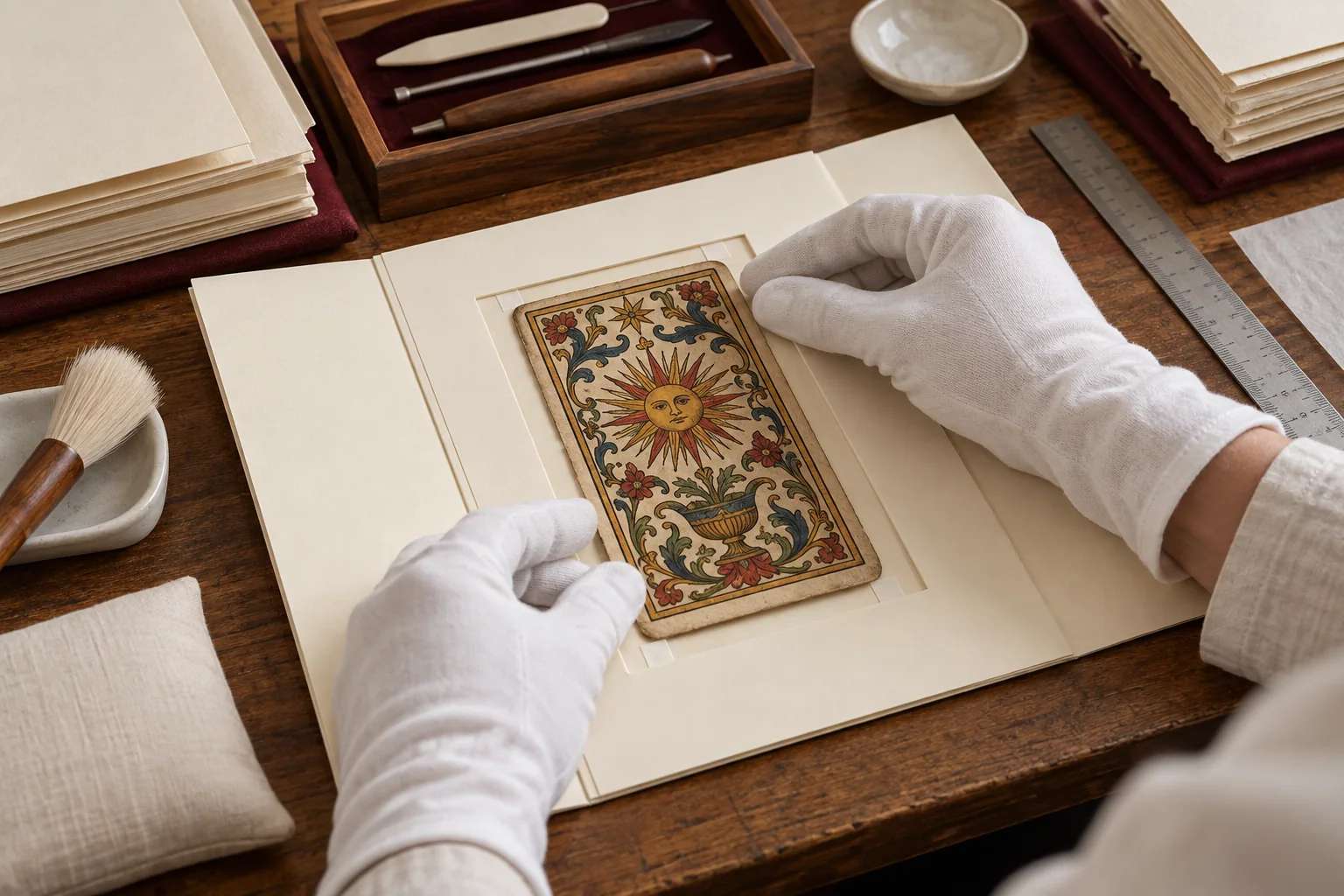
A modern card usually has a large numeral. It lets us locate it immediately in a list of “major arcana” and compare it with a book. So when looking at an early card without a number, it is easy to think that a piece of the design is missing. That conclusion is not justified. The Metropolitan Museum of Art notes that trumps from early sets were unnumbered; their hierarchies were known within game practices that varied by region. The absence of a numeral is therefore a historical datum that we should study, not a defect that we should silently repair.
Three numbers can coexist around a card: the value or rank it has in a game, a numeral printed on its face, and a museum inventory number. A fourth appears when a website orders images in a gallery. Confusing them produces false captions. If a page shows “015. The Fool,” that 015 may be the page’s navigation position, not an “XV” drawn on the card. To decide, you have to open the image and the individual record.
No Visible Numeral Does Not Mean No Function
In a game, a community of players can recognize a figure and know its rank through learned rules, even if the maker does not print a number. We do not know all early local rules in detail, so it is best to frame this as a general possibility supported by the Met’s observation: hierarchies existed and could vary. A card without a numeral does not prove that it was used at random or that it lacked a position. It shows only that the surviving copy does not provide that datum explicitly on its surface, if the complete image confirms the absence.
We also have to check whether we are looking at a complete card. A digital crop can hide the corner where a number appears. A damaged edge may have lost an inscription. A reproduction may omit or add numerals to fit an edition. Before writing “it had no number,” consult the conservation record and an image showing the entire object. If the catalog does not provide both faces or the edge, the prudent wording is “no numeral is visible in the available image.”
Why a Museum Numbers Unnumbered Cards
The museum needs to identify each object in inventories, loans, photographs, and studies. The Morgan Library & Museum groups its thirty-five Visconti-Sforza cards under MS M.630.1–35. That range is administrative: it makes it possible to distinguish pieces within the collection. We cannot read M.630.15 as the trump number that card carried in a fifteenth-century game. The institution also orders gallery pages with consecutive numbers for navigation. They are tools for accessing the objects, not necessarily part of the object.
The difference may seem tiny until someone interprets a supposed “15” as proof of an esoteric sequence. Historical reading is built on the real surface of the piece and the game sources, not on the museum’s digital menu. The guide what a museum preserves when it preserves a card explains how to use the shelf mark without turning it into an attribute of the card.
Suits and Trumps Are Not Numbered the Same Way
Suit cards can show quantities through repetition of their signs: three cups, five coins, ten swords. Court figures are distinguished by characters and attributes. Trumps, by contrast, show unique scenes or figures. The Morgan describes for Visconti-Sforza four suits of fourteen cards each, twenty-one trumps, and the Fool. The card count of the set does not imply that every trump bears a visible number. The article on the four early Italian suits develops the material difference between a number card and a trump figure.
Later numbering can help fix a sequence for printing, selling, or teaching the deck. When a current edition adds Roman numerals, that decision can be legitimate and useful. If the product is presented as a facsimile of an old object, it should state what has been copied and what has been added. For the reader there is a simple question: does the numeral appear in the photo of the original, in the commercial reproduction, or only in a book’s index?
A Small Verification Experiment
Choose a historical card in a digital collection. Save its shelf mark and open the image at the maximum permitted size. Look at the four edges. Copy any visible numeral, without yet converting it into a modern list. Check the record’s title and the number the website assigns to the image. Then open a modern edition of the same figure that you have at home. Mark in different colors what appears in both and what only the new edition has. You do not need to publish the images or copy protected art: it is enough to describe your observations in a notebook.
If the institution states expressly that its trumps are unnumbered, you can cite it. If you only see a photo, cite the scope of your observation. If two catalogs disagree about the proposed position, do not decide in favor of the one that matches your favorite deck. Check what objects and periods they refer to. Why the order of the trumps varied explains why a sequence can be a reconstruction and not a printed datum.
What a Modern Number Does Not Prove
A number on a card bought today does not prove that the image was born in that position, that all traditions shared the same classification, or that its meaning was fixed by the figure. It may be part of the design of an edition. Conversely, an old card without a numeral does not prove that people did not distinguish ranks; there could have been rules known to those who played. Both conclusions require independent sources. This distinction protects both the historian and the contemporary tarot reader: each can use numbers, but must declare what for.
Let us consider a deliberately fictitious example. A teacher prepares a didactic deck based on old images and adds “IV” to each copy of the Emperor so that her students can quickly find the chapter. The number solves a present-day teaching need. It would be a mistake to present those copies as proof that every old copy of the Emperor bore exactly that sign in the same place. The illustration and the label belong to different editorial layers.
An Absence That Opens Inquiry
Cards without numbers force us to listen to sources we often ignore: game manuals, object catalogs, comparisons between editions, and conservation studies. The easy number disappears and a richer question appears: how did those who made and used these figures recognize and order them? Sometimes we will only be able to answer in part. That partial answer is worth more than a modern sequence projected without warning onto an old piece.
You can keep using your deck’s numbering to learn and read. When you write about history, give the numeral its exact place: inscribed on the original, added in an edition, assigned by a catalog, or inferred from a documented rule. That way the card preserves its material identity and the reader knows what kind of evidence is in front of them.
Sources Consulted
- The Metropolitan Museum of Art, The World in Play. Explains that early unnumbered trumps had variable hierarchies.
- The Metropolitan Museum of Art, “Before Fortune-Telling”. Structure of suits and trumps and discussion of sequences.
- The Morgan Library & Museum, MS M.630.1–35. Example of inventory numbering of preserved pieces.