Sabio Tarot · History and curiosities
How to Read an Old Playing-Card Catalogue Without Confusing Model and Copy
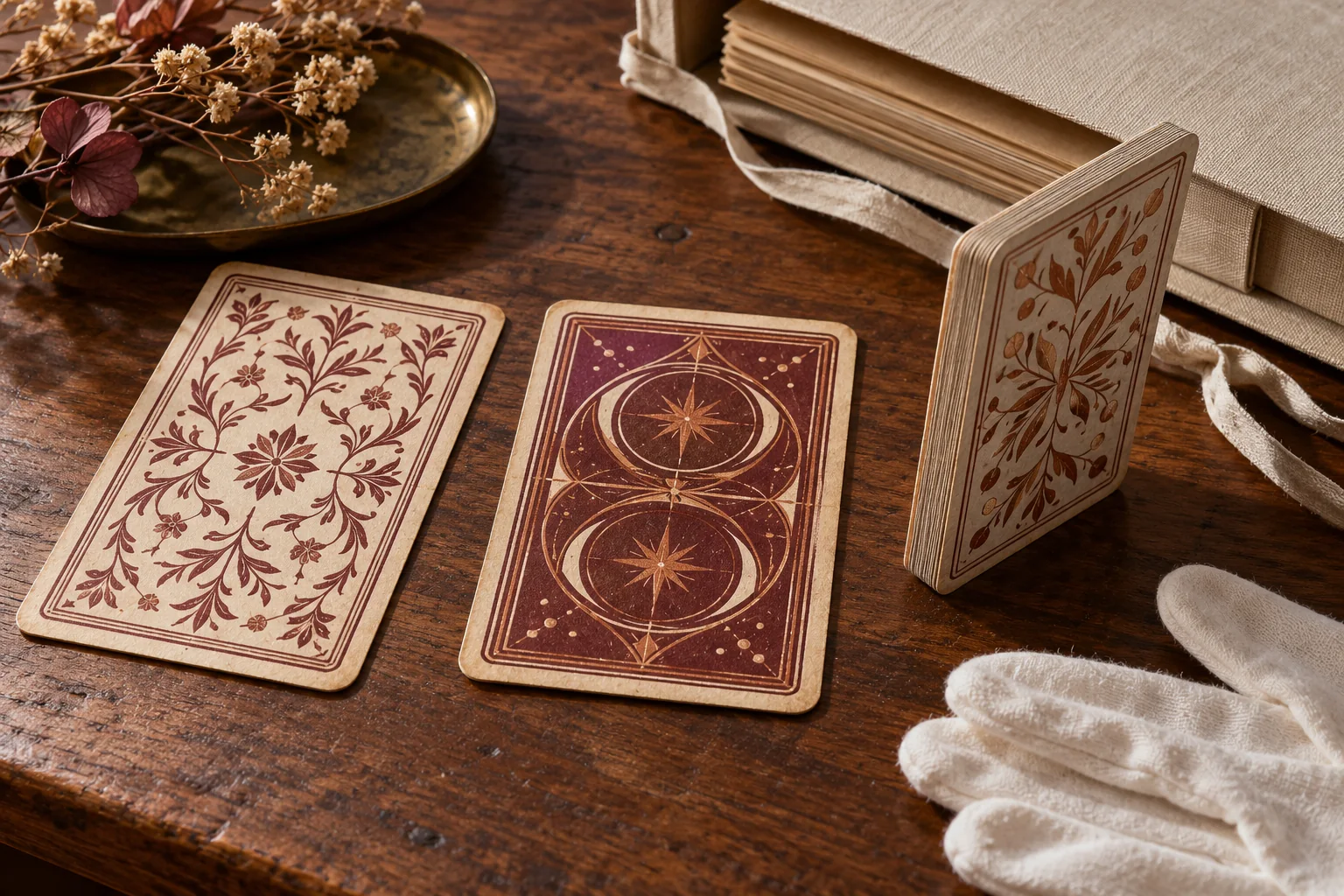
A catalogue record may look like a dry series of fields: title, author, year, technique, measurements and number. In reality it is the fastest tool for avoiding legends about a deck. It tells us what an institution holds, how it identifies the object and what data it considers certain or approximate. The trick is not to read the title as the whole story. “Tarot de Marseille” or “Conver tarot” may be classification names; the physical copy may have been produced at another date or be a reissue of an earlier model.
Let us take a record from the Bibliothèque nationale de France for a deck associated with Conver. The catalogue records visual content, woodcut technique with stencil-applied colour, seventy-eight cards, measurements and notes on the back. It also contains the mention “N.as Conver 1760”. Read without context, the date seems to close the case. Another BnF record catalogues a modern reissue of the model, produced by A. Camoin between 1890 and 1899. A third describes a Camoin copy from 1890–1900 that bears the old mention and an 1890 revenue stamp. The three records together teach better than a single number.
Start with the Identifier
The catalogue number or ARK lets you return to the same record. Copy cb43706229t for the first deck and do not replace it with a search result with a similar title. Two records may call different objects “Conver tarot.” The Morgan uses a different shelfmark, MS M.630.1–35, for thirty-five Visconti-Sforza cards it holds. The identifier is not the number of a card in the deck nor the position of a trump: it is a stable institutional address for citing the object.
When saving the reference, also copy the institution. An identifier beginning with cb at the BnF and a shelfmark like M.630 at the Morgan belong to different systems. If you later publish a comparison, the reader can open each record and check the claims. A link to a general Google search may change; the catalogue’s permanent link is much more reliable for a specific card.
Who Supplied the Title?
A title in square brackets in a catalogue may be a description assigned by the institution, not words printed on the original box. Check the notes before citing it as a historical title. The BnF speaks in its records of “jeu de tarot à enseignes italiennes de Marseille, dit tarot Conver” and of “réédition moderne” of the same model. Those expressions tell of a cataloguing relationship. We must not turn “dit” or “based on the model of” into proof that a manufacturer printed exactly those words on the title page.
The difference matters when answering a frequent question: “What was Conver’s original 1760 tarot like?” If the cited piece is a later reissue, calling it original misinforms. To answer well, state the date and nature of each copy, and let the reader open the catalogue record. That way they can check what is preserved and what was reconstructed or reissued.
Read the Material Description Before Looking at Interpretations
The BnF record gives 11.9 by 6.2 centimetres for a Conver copy; the Camoin reissue has different measurements and only fifty-eight cards preserved in the cited record. The figures tell us what object has been inventoried, not how it felt to shuffle the complete original deck. Technique and support help compare: woodcut, pochoir colour, patterned back. If another page shows an enlarged photo, you cannot infer dimensions from it without going back to the catalogue.
The Morgan catalogues thirty-five painted cards from the Visconti-Sforza set; the number does not mean that the historical deck was designed with only thirty-five. The material description field refers to the portion preserved by that institution. The article why incomplete decks survive explains how to distinguish the count of the set, survivors and facsimiles.
The Notes Are Where the Difficult History Appears
Many readers stop at the heading and miss the notes. There the decisive information may be: an inscription on the Two of Deniers, an alternative back, an added stamp, or handwritten annotations. In the BnF record for a Camoin edition based on Conver, both the old mention and a blue 1890 revenue stamp appear, along with later divinatory notes. The authority record for Nicolas Conver warns of the discrepancy between “1760” and the maker’s lifespan. If we cite only the title and the first visible date, we tell an impossible story.
Notes can distinguish observation from interpretation. “One reads such an inscription” is a description. “It is attributed to such-and-such a workshop” is a cataloguing proposal that can be revised. “Probably” expresses a degree of certainty. Keep those words when summarizing. Do not remove the caution to make the sentence more emphatic; caution is part of the data.
What Counts as a Primary Source Here?
The preserved object is the primary material source. Its institutional record is an expert description of that object, with curatorial decisions. A modern reissue is a primary source for its own production, but it does not replace the old card in what it has recreated. A shop advertising a deck can provide data about its edition; to date the object it claims to reproduce, you have to go back to the institution. These distinctions allow each source to be used for the claim it actually supports.
If you are comparing divinatory uses, a handwritten annotation in a copy can be evidence of a reading intervention, provided the catalogue documents it and its date is investigated. It does not prove that the deck was originally manufactured for that purpose. From game to cartomancy explores that transition with documents, but the principle is already visible in the BnF records.
A Five-Field Method for Your Notes
For each record, note institution and identifier; title as given by the catalogue; proposed date of the object and inscribed dates separately; technique, size and number of pieces; notes on provenance, back and interventions. End with a sentence saying what the record does NOT allow you to claim. Example: “This record describes a Camoin reissue from 1890–1899; it does not prove that its fifty-eight preserved cards were printed in 1760.” That sentence protects your notes against future simplifications.
The catalogue does not replace observation. Open the images if available and check that the record corresponds to the object you are studying. A museum photograph, an explanatory diagram and a recreation show different things. Before using any of them as evidence, read its caption and credits: a diagram can clarify the parts of the record, but it does not document the material appearance of the historical card.
Read Slowly to Tell It Well
A good record does not answer all questions, but it prevents many false answers. It forces us to separate name, object, model and edition. It also reveals uncertainties that a popular text usually erases. To understand historical tarot, that small work of reading is more fruitful than memorizing a spectacular date. It allows you to say “we do not know with this record” and to pinpoint exactly what document would be needed to move forward.