Sabio Tarot · History and curiosities
How a Lost Tarot Card Is Reconstructed
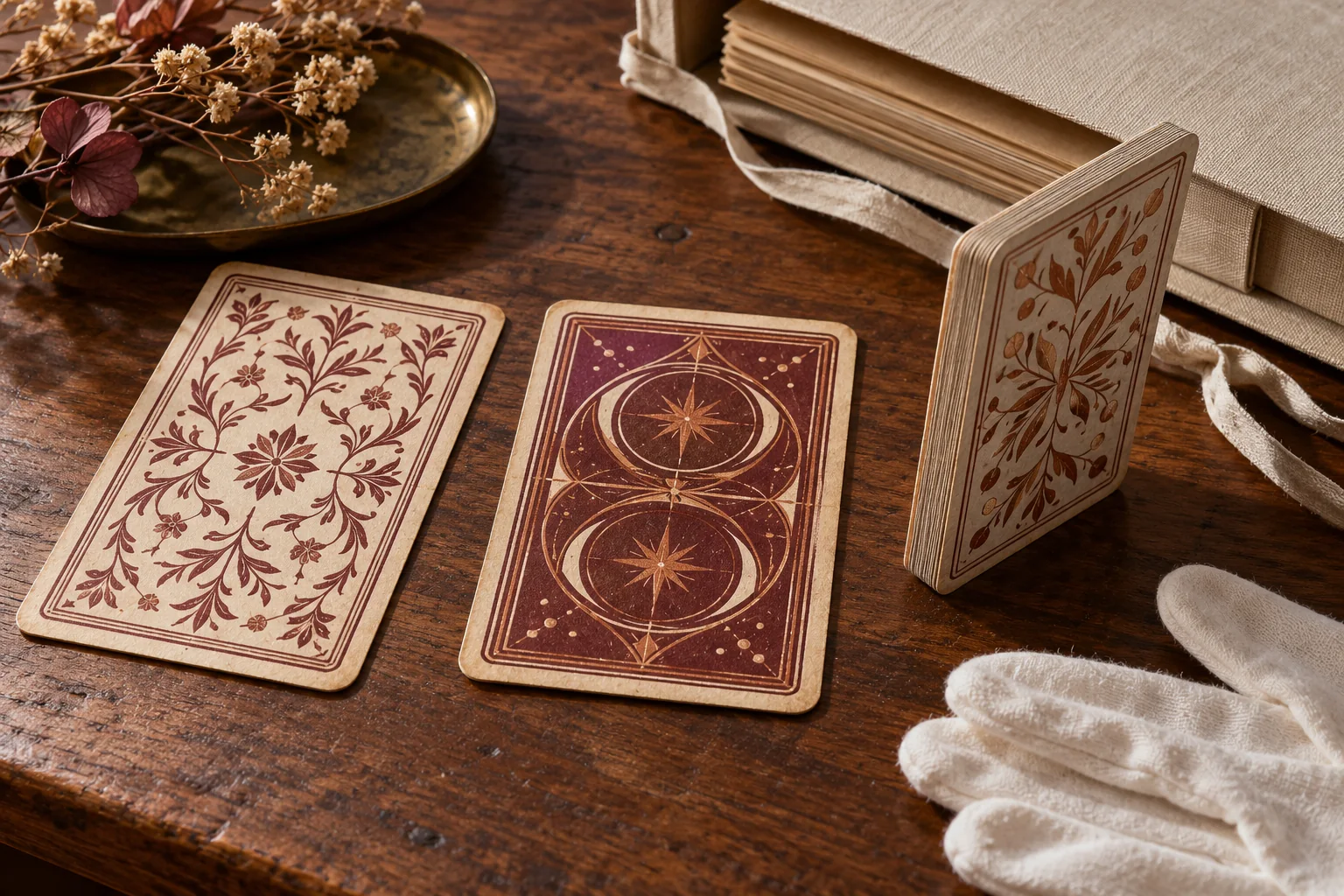
When a card is missing from a historical deck, the modern edition faces a decision: leave the gap visible or create an image that makes it possible to use a complete deck. The creation can be rigorous and beautiful, but it does not turn the new image into an old object. To assess a reconstruction, we must follow the chain of decisions: which pieces survive, what external information exists, which features are inferred by comparison, and what part the artist has imagined. A good edition shows that chain instead of hiding it beneath a uniform appearance.
The Morgan Library & Museum shop presents a facsimile of the Visconti-Sforza set with seventy-four cards reproduced from surviving pieces and four recreated: The Devil, The Tower, Three of Swords, and Knight of Coins, according to the product description. It is a clear example for studying the method. Those four cards can fill the positions needed for a contemporary seventy-eight-card deck. For research on the fifteenth century, the specific appearance of its recreations belongs to the modern publisher and should not be cited as direct testimony of the lost piece.
First Step: Define the Gap
Before drawing, one must verify that the piece is truly absent from the attributed set. The Morgan holds thirty-five cards; its catalog points to another thirty-nine preserved in Bergamo (twenty-six at the Accademia Carrara and thirteen at the Casa Colleoni); the modern edition gathers the known survivors under a common identification. A list of missing cards depends on that attribution and on the deck structure adopted. If a new card appeared or an attribution changed, the gap could be redefined. Therefore a reconstruction should indicate the state of knowledge and the date of its criterion, not present itself as definitive truth.
The absence can have different scopes. Perhaps we know the name of the card from other decks but not its image in that set. Perhaps a written description survives. Perhaps part of the object exists, damaged, and lost areas are restored. These are different problems. Completing a fragment is not the same as designing an entire card; adapting an image from another workshop is not the same as copying an original from the set. The reader needs to know which case it is.
Second Step: Separate Data and Analogies
Direct data are identified pieces, inventories, period descriptions, and material remains. Analogies are comparisons with decks close in workshop, iconography, or function. An analogy can guide proportions or motifs, but it does not prove that the lost original looked identical. In early sets, the variety of artists’ hands, suits, and iconographic models documented by the Morgan and the Met prevents assuming a universal template. Even if a card from another deck shows a Tower, copying it does not recover the Tower from a set in which that piece does not survive.
The artist may decide to draw inspiration from the colors of the surviving cards, repeat borders, or imitate gilding. Each decision should be describable: “we took the palette from the preserved pieces,” “the scene comes from a later model,” “the central composition is new.” A reader can then appreciate the work without confusing levels of evidence. If an edition offers no notes, we must use its cards as graphic interpretation, not as historical proof of absent details.
Third Step: Declare the Degree of Invention
An editorial reconstruction can be deliberately discreet, so that all the cards appear to belong to the same deck. Another can differentiate the new pieces with a border or notice. Neither option is automatically superior. For everyday reading, uniformity makes shuffling comfortable. For an academic catalog, visually distinguishing original from recreation can be essential. The minimum is an accessible list indicating which images are new and what sources they are based on. The explanation must travel with the product, not remain hidden on a page that later disappears.
It is also worth stating what has been done with the back. If all the cards in the edition share the same back, that consistency may respond to a contemporary play need. It does not prove that the originals had it. The article what a tarot facsimile is discusses this difference between reproduction and usable edition. The guide to backs of old cards shows what data an institutional record can provide.
The Digital Reconstruction of a Damaged Card
There is another case: the card has not disappeared completely, but its image is partially lost. Physical restoration and digital reconstruction are distinct operations. A retouched photograph can propose how an area looked, while the object retains its actual damage. If a published image removes cracks or reconstructs a hand, look for that explanation in the caption or technical record. Otherwise, you might attribute to the ancient painter a line drawn by a digital restorer. Conservation techniques require specific documents; they cannot be inferred from a clean photo alone.
Let us consider a fictitious and clearly marked example: a publisher receives a digitization in which the lower half of a baton is damaged. It copies the visible section and draws an extension following another card of the same suit. It publishes two versions, before and after, with the note “hypothetical extension.” The reader can study the damaged object and use the complete image for practice. If it published only the “after” as an intact original, it would be manufacturing a certainty that the source does not offer.
What a Reconstructed Card Does Not Allow You to Claim
It does not allow proving the date of an image that did not survive, the exact intention of a workshop, or an original meaning based on an invented detail. Nor does it allow concluding that all old decks carried that same scene. It can support other questions: what decisions a current edition makes, how a lacuna has been interpreted, which comparisons the artist finds convincing. The reconstructed card has its own history from the moment of its creation; it is not a worthless gap. Its value is different from that of a period piece.
If you find a photograph of a complete Visconti-Sforza deck, check which cards it reproduces from preserved originals and which are recreations. In the case of The Devil, the facsimile description identifies the card as recreated; the record for the original set shows that The Devil is not among the preserved pieces, while the editorial note declares it recreated. A convincing image does not by itself prove that this drawing existed in the fifteenth century. This distinction resolves the doubt about the “original” card better than the appearance of a complete deck.
How to Judge a Reconstruction in Five Questions
Ask what is missing; what direct evidence remains; which decks or documents were compared; what the artist added; and how the buyer is informed. If any of the answers is missing, treat the image as a proposal. If all are present, you can assess its coherence, beauty, and usefulness separately from its documentary value. A reconstruction can be magnificent as design and limited as proof. An original piece can be damaged and still remain indispensable to history.
Tarot history does not end where a card is missing. There begins an investigation into survival, comparison, and editorial responsibility. Making clear “this survives” and “this has been created” allows enjoying a complete deck without erasing the absences that teach us how we know the past.
Sources Consulted
- The Morgan Library & Museum, Visconti-Sforza catalog. Preserved original pieces and relation to the set.
- Morgan Shop, Visconti-Sforza facsimile. Editorial identification of four recreated cards.
- The Metropolitan Museum of Art, The World in Play. Material variation and partial survival of historical playing cards.