Sabio Tarot · History and curiosities
The Four Italian Suits in Early Tarot Cards
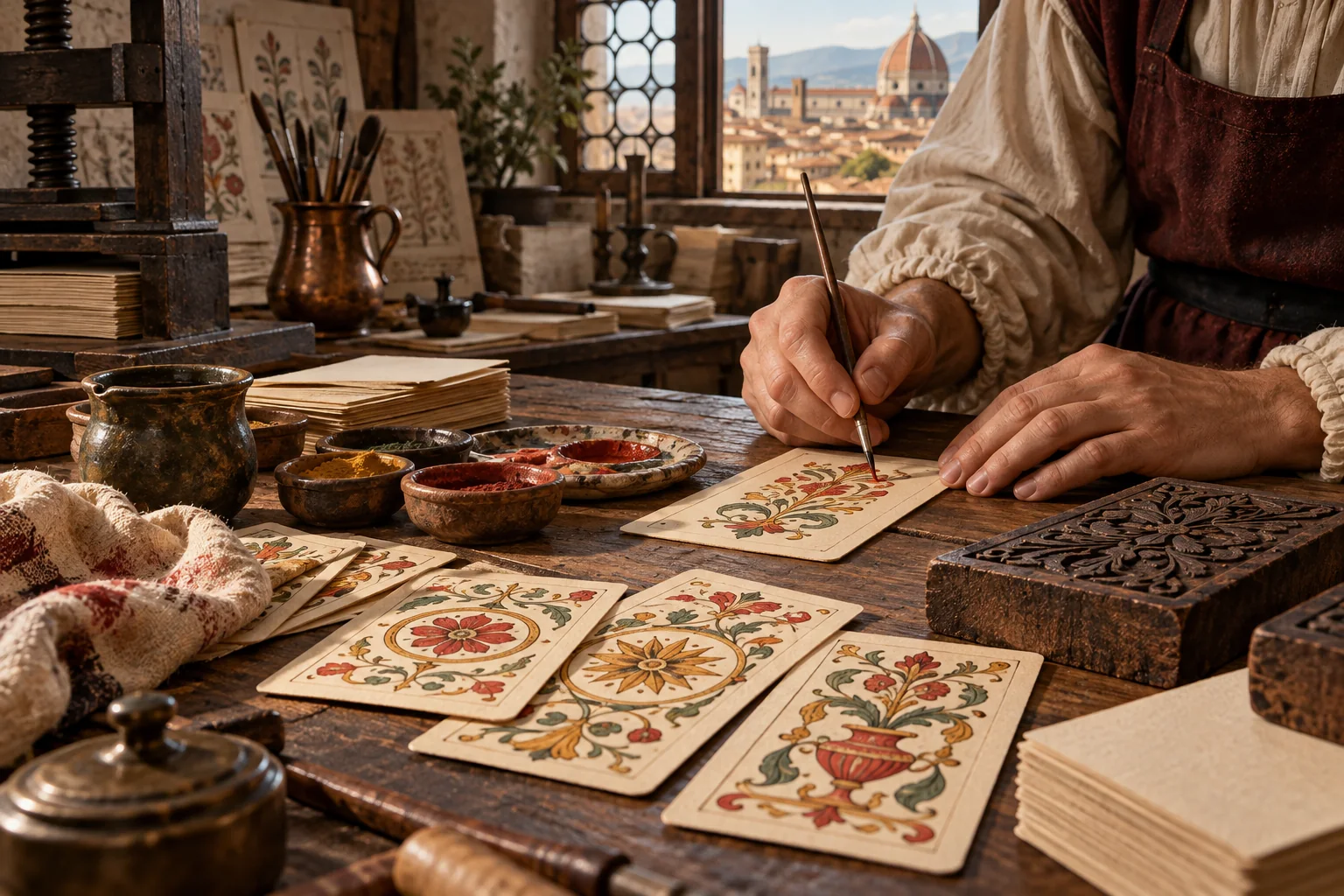
Cups, swords, batons, and coins appear in many decks that we now call tarot. For someone learning to read cards, each suit usually comes with a field of interpretation: emotions, conflicts, action, or resources. In material history, the first question is simpler and more verifiable: how was the deck organized and which cards survive from each suit? The symbols belonged to a system of playing cards before becoming a vocabulary for personal readings. Looking at that structure prevents us from presenting current meanings as if they were documented rules of a fifteenth-century game.
The Morgan Library & Museum describes, for the Visconti-Sforza set, fifty-six cards divided into four suits of fourteen: cups, batons, coins, and swords. Each suit included ten number cards and four figures: page, knight, queen, and king, depending on the translation we use. The Metropolitan Museum of Art gives the same general structure for an early form of Italian tarot. The Bibliothèque nationale de France, when explaining the Tarot de Marseille, speaks of equivalent Latin suits. These institutions allow the composition to be documented without claiming that all surviving examples preserve all fifty-six pieces.
What Is a Suit Card?
On a number card, the quantity may be indicated by repeating the sign of the suit: five cups, eight coins. A court figure presents a character associated with the suit and a rank. That distinction is useful before looking for meanings. If a card shows several swords, first count how many there are and check whether the catalog entry for the piece confirms its identification. If it shows a person with a sword, see whether the institution catalogs that person as page, knight, queen, or king. The appearance of a modern edition does not always reproduce exactly the title or attributes of an old example.
The Morgan gallery offers surviving examples of all four signs within its thirty-five cards: figures of cups, coins, and swords, as well as number cards and batons. The complete set is dispersed, so we should not infer the survival of an entire suit from a digital selection. The main catalog entry counts the pieces held by that museum; other collections preserve related pieces. Why Incomplete Decks Survive explains how to read those counts.
Names Change Language Without Always Changing the Object
The English term staves can be translated as batons or staffs; coins as coins or deniers, depending on the editorial tradition. The BnF uses bâtons, coupes, deniers, épées when discussing the Marseille model. A practical translation should not hide the fact that graphic forms can vary between workshops and periods. The coin on an Italian painted card is not materially the same object as a French printed denier, even though both serve as a suit sign.
Nor should a modern elemental correspondence be transferred automatically. Many guides link cups with water or swords with air; these are systems of interpretation that a person may choose. The museum source on the game's composition only attests suits and ranks. To assert that an elemental correspondence was used in a specific historical context, a document from that context is needed. A responsible sentence distinguishes: "This deck had four suits" is a description of the object; "in my method I read cups as emotions" is a contemporary proposal.
The Fourteen-Card Structure Does Not Require a Fixed Image
Four figures per suit and ten numbers offer a counting scheme, but they do not determine exactly how each card was painted. A hand may hold the sign, a field may receive decoration, a workshop may order the figures in its own way. The Met notes that other European playing cards from the same period had very different suits and hierarchies. It is advisable not to use those non-tarot playing cards as direct evidence of the appearance of the four Italian suits; they do serve to understand that standardization was not universal from the beginning.
To compare two decks, prepare a table with one row for each suit and columns for number of surviving cards, visible signs, court figures, and technique. Leave a cell empty when the original does not survive or the catalog entry does not identify it. If your modern deck fills the gap with a recreation, mark that difference. The exercise teaches more than memorizing a list of keywords, because it connects each statement with an object.
From the Suit of the Game to the Suit of a Reading
When you do a reading today, the suits can function as lenses for conversation. Cups can invite questions about bonds or feelings; swords about language and difficult decisions; batons about movement; coins about resources. These are associations from a current method, not results that the card verifies on its own. The same card can raise different questions depending on position and context. If the query concerns money, do not replace figures, contracts, or professional advice with a supposed "message of deniers."
Practice can enrich the historical view without absorbing it. By knowing that each suit had court figures and numbers, you better understand the structure your deck works with. By comparing a painted card with a printed edition, you discover design decisions that affect your visual reading. Painted Cards and Printed Cards explains those technical differences. History does not impose a single meaning; it forces you to know where each layer comes from.
A Fifteen-Minute Exercise
Open the Morgan page and choose a number card of cups and a figure from another suit. Note only visible observations: number of signs, position, colors in the photograph, and the name given by the catalog. Then consult the main catalog entry to place them within the described fifty-six suit cards. Finally, compare with the equivalent cards from a current deck. Write down what the new edition has added. Do not call something you have only seen in your deck an "original detail."
Repeat the exercise with the BnF's description of a Tarot de Marseille if you are interested in the French printed tradition. The institution specifies technique, dimensions, and manufacturer's name for specific examples. A similarity between signs does not imply identity of date or workshop. The work begins with the object, not with a collage of anonymous images. A contemporary icon of a cup can be used in an educational infographic, provided it is labeled as such and not presented as a photograph of a historical piece.
A Precise Way to Describe the Four Suits
The four Italian suits are a structural part of early tarot decks documented by museums. Their number and court cards made play possible; their images circulated and changed; their reading meanings developed in other contexts. These statements can coexist if we do not confuse play function, material object, and current method. When someone asks "What does the suit of swords mean?", we can offer a responsible interpretation. When they ask "What was a sword like in a fifteenth-century tarot?", we have to open the catalog of the surviving card. That difference is the basis of a history of tarot that can be verified.
Sources Consulted
- The Morgan Library & Museum, Visconti-Sforza, MS M.630.1–35. Structure of the four suits and rank of the figures.
- The Morgan Library & Museum, gallery of surviving cards. Concrete examples of suit cards; the gallery is not a complete deck.
- The Metropolitan Museum of Art, "Before Fortune-Telling". General composition of early Italian tarot.
- Bibliothèque nationale de France, "A Tarot That Reshuffles the Cards". French terminology for the Latin suits.