Sabio Tarot · History and curiosities
What the backs of old tarot cards tell us
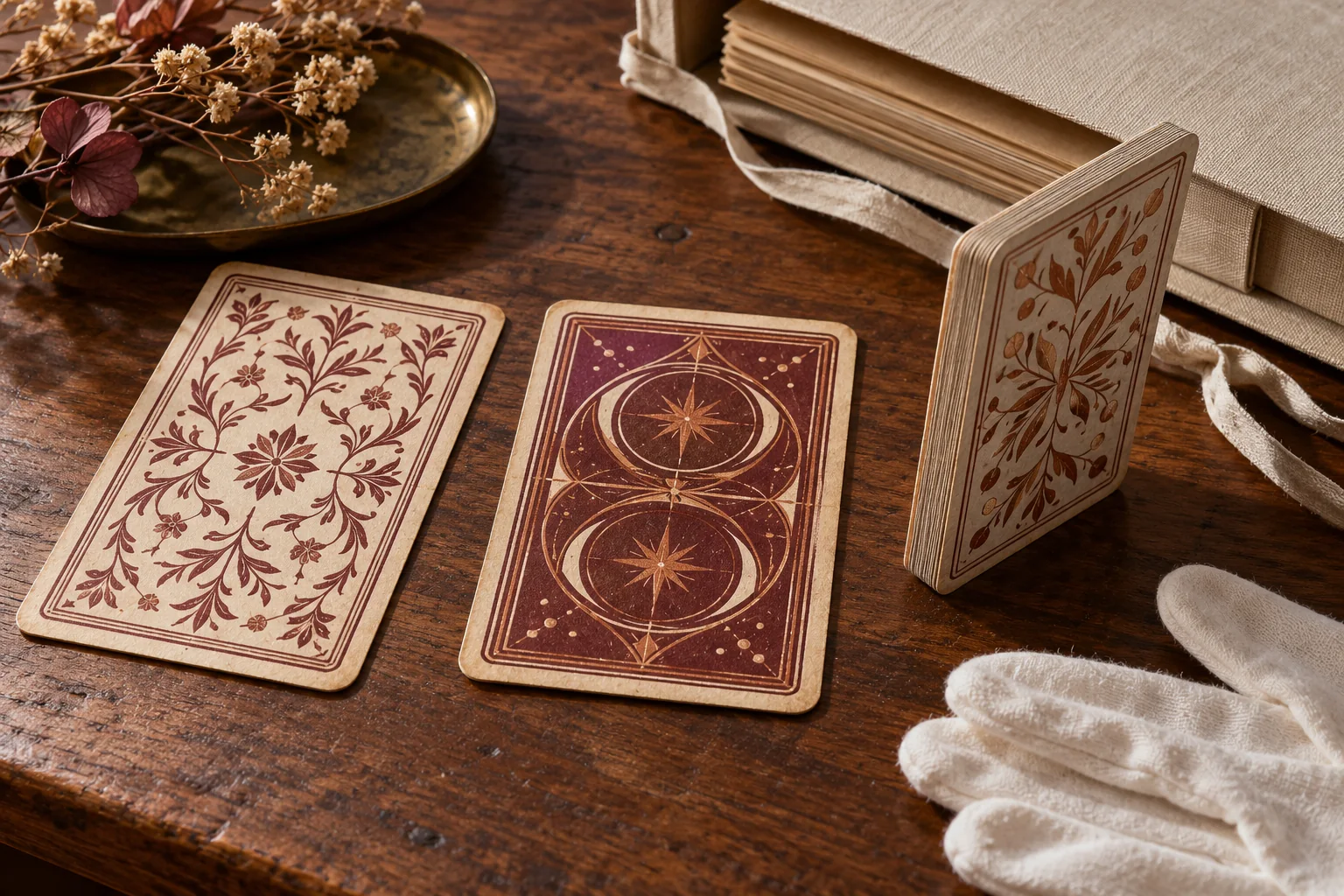
In an image shared on social media, we almost always see the figure on a card. The back remains outside the frame, as if it were a wrapper without history. For someone who studies objects, it can be as revealing as the front: it records a repeated design, a material layer, a repair, or a variant between copies. It also shows the limits of our information. Two cards having the same back is not enough to claim they were made together; their having different backs is not enough to separate them definitively. Both sides must be read within a catalog record.
The Bibliothèque nationale de France describes backs in several records of Italian-suited tarots. In the record for a deck associated with Conver, it mentions dotted diamonds and crosses in blue or black, or red paper. In a deck published under the name Joseph Feautrier in 1762, the record registers hexagonal cells with a sun. The record for the later Camoin edition based on the Conver model catalogs a red grid. These data are concrete because they belong to cataloged copies. They do not constitute a general rule about all Tarots of Marseille.
The back is documented per copy, not by tradition
When a catalog describes “red grid back,” we must ask to which object it applies. To all the cards in that copy? To a part? To a model reproduced in several print runs? The record may answer this or leave the question open. The name “Tarot de Marseille” groups models and editions; it does not turn each back into the unique hallmark of a family. If you buy a current deck with that name, its back pattern may be a contemporary design decision.
Comparing three BnF records demonstrates the usefulness of noting the exact identifier. We can say that record cb435725033 describes a Feautrier deck with a back of hexagonal cells and a sun. It would be another claim, not supported by that single record, to say that “the first Tarots of Marseille had a sun on the back.” The second extends a specific datum to different centuries and workshops. Good popular writing keeps the subject of the sentence as narrow as the source.
Layers, paper, and color: more than decoration
The back can be part of the card’s structure. Some old cards were made with several layers of adhered paper; the Met describes examples of historical playing cards manufactured as layered paper board. Not all those cards are tarot, but the comparison explains why looking at the complete support makes sense. The back face is not only a surface on which a motif is printed: it can indicate how the piece was assembled or reinforced. The BnF record for the Conver tarot even considers “red paper” as an alternative back for the object described.
To verify a material hypothesis, direct examination, images of the back, and, depending on the question, conservation analysis would be needed. A reader who has only a front-facing photo cannot decide how many layers there are or when each one was added. They can formulate a question and look for a source that answers it. That gesture, less showy than an instant interpretation, avoids turning a digital texture into a fact about old paper.
Does a pattern allow dating the deck?
It can be a clue for comparing copies, but not a self-sufficient clock. A pattern may be preserved when a workshop reuses a model; another may copy it; a repair may change the back face; a record may group pieces with different backs. To date an object, evidence is cross-checked: inscriptions, technique, paper, provenance, documented comparisons, and context. The article how to identify the date of a historical deck explains that cross-checking with a case from the BnF.
Even a very distinctive back needs a chain of identification. Imagine that you see a card with hexagonal cells and a sun in an online shop. You may suspect a relationship with a model described by the BnF, but you cannot claim that the shop’s copy is from 1762. It could be a recent facsimile, a reissue, or a retouched image. You must verify the physical object, its provenance, and the edition. Visual similarity is a starting point, not a certification.
What the back can tell about use
Uneven wear on the back can suggest handling, storage, or contact with other materials. But, without conservation examination, we cannot deduce a specific scene: “this card was shuffled every night in a tavern” is an invented story if the record only shows abrasion. The Met reminds us that cards were ephemeral objects, susceptible to wear, breakage, and loss. That general observation does not allow reconstructing the exact biography of an individual piece. A conservator can provide a description of marks; the historian evaluates which practices are documented around them.
It is also worth separating “use for playing” from “use for divination.” A back pattern does not by itself reveal the deck’s purpose. A copy may have been manufactured for play, kept as a collection, and annotated later for cartomancy. Added handwritten notes, if they exist, are another stratum of the object and must be dated separately when there is evidence. In the BnF record for a Camoin edition based on Conver, handwritten divinatory annotations added to trump cards are described. That information speaks of an intervention on the cataloged copy; it does not automatically turn the original manufacture of the model into a divinatory act.
How to compare two backs without fooling yourself
Start by opening the records of the two institutions or collections. Note the full title, inventory number, measurements, technique, attributed date, and literal description of the back, preferably with authorized images. Then compare large motifs—grid, diamond, plain paper—and small details—line, color, orientation. Write separately what is observed in the image and what is stated by the catalog. A compressed scan can turn two different reds into one; different lighting can darken the same pigment.
Make a table with three columns: “observation,” “document that supports it,” and “interpretation.” In the first, “the record describes a red grid.” In the second, the link to the BnF. In the third, “it could help compare this copy with another.” Avoid writing “it is the same workshop” until additional evidence is available. This method may seem slow, but it allows correcting a hypothesis without rewriting the whole story if a new record appears.
Original, reproduction, and reconstruction are also distinguished by their backs
A facsimile may carefully reproduce the front and choose a new back so the cards shuffle better. A digital restoration may even out stains or edges. A reconstruction of a lost card may receive the same back pattern as the copied cards. The result looks like a cohesive deck, but that cohesion belongs to the modern edition. For research, one must check whether the publisher states where each back comes from and what changes were made. What a museum preserves when it preserves a card offers a general identification guide.
The back deserves attention precisely because it often remains invisible. It reminds us that a historical card is a two-sided object, with distinct layers and trajectories, not just a symbol floating on a screen. Looking at it broadens the questions we can ask and narrows the answers we can sustain. In contemporary practice, you can choose a deck for the comfort or beauty of its back. In historical research, always ask which copy it corresponds to and who documents its materiality.
Sources consulted
- BnF, tarot deck associated with Conver, cb43706229t. Describes back variants, technique, and measurements of the cataloged object.
- BnF, Joseph Feautrier deck of 1762, cb435725033. Registers the motif of hexagonal cells and a sun.
- BnF, Camoin edition based on Conver, cb40918777p. Registers a red grid and added divinatory annotations.
- The Metropolitan Museum of Art, The World in Play. General context on the support and conservation of playing cards, including non-tarot objects.