Sabio Tarot · History and curiosities
Playing-card workshops and maker's marks: what they really prove
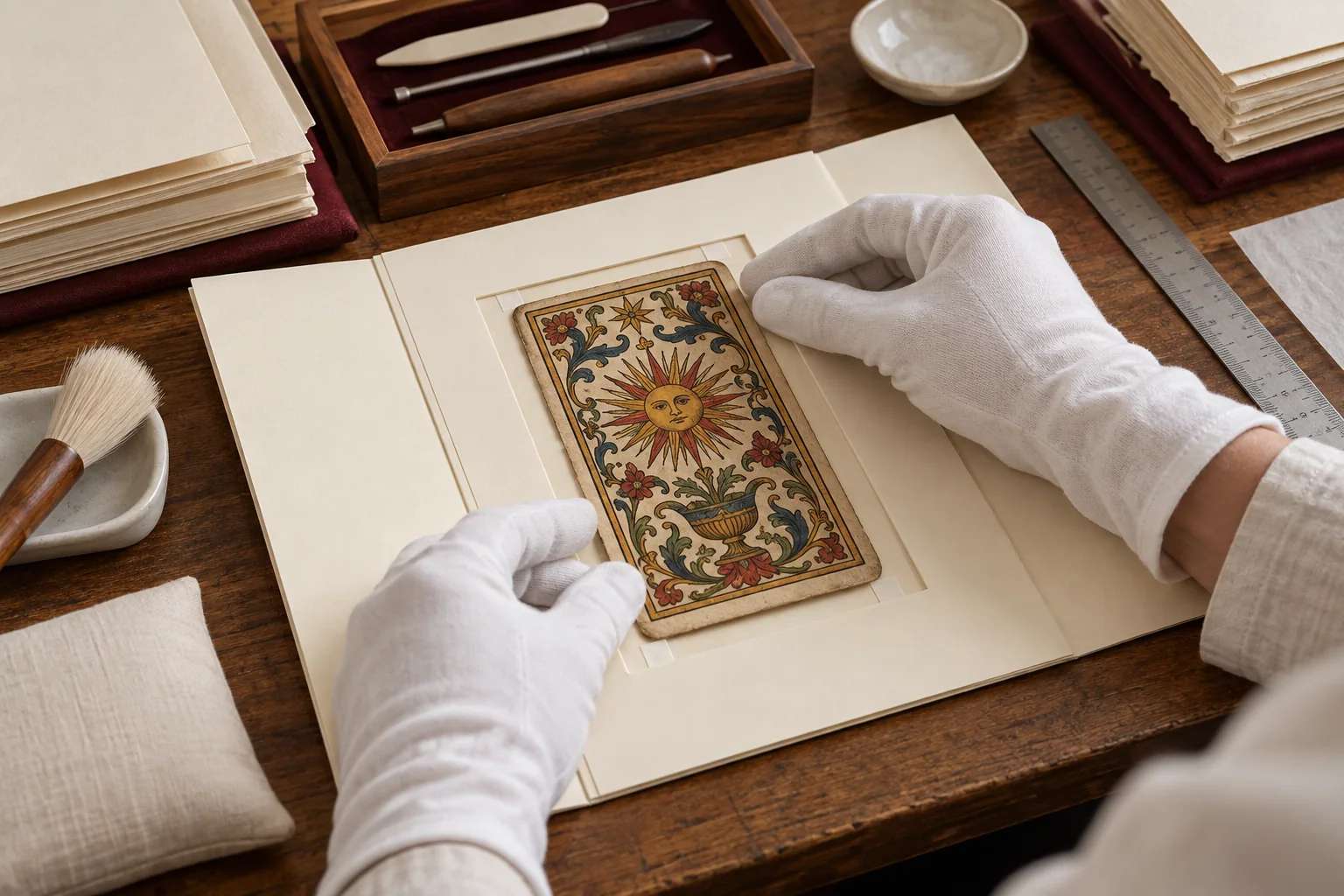
A small inscription can completely change how a deck is read. On a number card appears the name of a cardmaker; on another, a workshop sign. Those marks serve to investigate who produced or sold a deck, where and when it may have circulated. They can also mislead if we read them in isolation: an old inscription may still be printed in a later reissue. The right question is not only “What name does it give?” but “On what object does it appear, how is it made, and what does the catalogue say about that copy?”.
The Bibliothèque nationale de France announced the acquisition of a complete deck attributed to the cardmaker Philippe Vachier, dated 1639 on the Two of Deniers. Its workshop mark, «À l’enseigne des deux rois», appears on the Two of Cups according to the institution. The BnF presents the copy as the oldest known of the type later called «Tarot de Marseille» made in that city. The case allows us to observe how date, city, and mark support one another when an institution has studied the object. It does not mean that every card with a similar image came from that same workshop.
The mark within a specific card
Location matters. Saying “the deck is signed” can conceal that the mark appears on a particular card and that other cards do not bear the same inscription. In the Vachier case, the BnF identifies the Two of Deniers for the date and the Two of Cups for the mark. The record for a 1762 Joseph Feautrier deck also records the cardmaker's signature on the Two of Deniers. That precision allows one to recheck the claim and compare ways of signing without inventing a stamp on every card.
A reader who sees only a photograph of The Sun or The Tower from that deck cannot verify the mark if the signed card is not in the image. They must go to the complete record. The same happens when buying a reproduction: the publisher can copy the Two of Deniers from an old model and produce the deck a century later. The copied signature tells us about the source of the design, but it does not always date the printing you hold in your hand. How to identify the date of a historical deck develops that problem with the Conver case.
Maker, designer, and printer can be different people
“Author” seems a convenient word, but it can cover different tasks. One person designed the images, another prepared the plate, another printed, another applied color, and a merchant sold the deck. For certain objects, we do not know all those hands. The BnF uses responsibility fields that should be read literally: publisher, engraver, designer of the model, and maker are not synonyms. Attributing every visible line to the merchant whose name appears on the Two of Deniers would be as risky as attributing every page of a book to its bookseller.
A mark can associate the product with a workshop without identifying the worker who colored a particular copy. It can also survive a change of owners of the business. The BnF authority record for Nicolas Conver summarizes the continuity of his workshop and his name after his death, with changes of ownership. That trajectory explains why a brand name can persist and why dating a copy requires more than reading a signature. There is no need to deduce a genealogy for every deck: it is enough to recognize that the commercial mark has a history.
What a documented mark can prove
It can help distinguish workshops, locate a place of production, or connect a card with a set. If it is dated and its authenticity is examined alongside paper, technique, and provenance, it can be an important chronological clue. But it alone does not prove how many copies were printed, who bought each one, or how they were used. Vachier's mark does not tell us how many games were played with his deck. Answering those questions would require other documents: contracts, taxes, inventories, or accounts of play.
Nor does a visual mark guarantee that two loose cards belonged to the same original box. There may be reissues, different print runs, and later mixings. A museum groups pieces according to material and documentary evidence; a shop may group them by design to offer a complete deck. The two operations have different aims. Why incomplete decks survive explains why a reconstructed set does not erase the individual history of each card.
Exercise: investigating a signature without repeating a legend
Open the BnF record for the Feautrier deck. Write down the maker's name, the city, the date proposed by the institution, and the card on which the signature appears. Then note the technique and the back as described. Repeat the exercise with the BnF news item about Vachier. When comparing, avoid saying that a mark is “the first” in all of Europe if the source only states that the copy is the oldest known of a certain type in Marseille. Keep the exact scale of the claim.
If you do the exercise with your own deck, photograph separately the box, the signed card, and the credits page. The modern box may name a restorer, publisher, or artist who do not appear on the reproduced historical object. Those people deserve credit for their work and should not be confused with the old cardmaker. If a record does not clearly identify the role, write “responsibility not clarified” instead of completing the datum by intuition.
A mark is not a secret message
In tarot, there is a tendency to interpret every detail as a symbol. A commercial inscription may be of iconographic interest, but first it serves to identify the workshop, the edition, or the product. Material history begins by verifying that function. When we see initials or a sign, we search the institutional catalogue and period sources before constructing an esoteric narrative. Leaving open a question that the evidence does not resolve is preferable to inventing a code.
The BnF does not reduce the Vachier deck to its mark; it describes it as a complete object of seventy-eight cards, woodcut and stencil-colored. It is the combination of data that sustains its importance. A mark without an object, or an object without provenance, leaves more gaps. The best public-facing writing shows the card where it is read, identifies the edition, and explains the limit of what the inscription can demonstrate.
From the workshop to today's reader
Knowing the cardmakers adds real people to the history of tarot. Their production and trade decisions explain why certain models were preserved or copied. At the same time, they prevent speaking of «the tarot» as an image that emerged without material labor. Anyone who chooses a deck today can investigate who designed, printed, and published their copy. Anyone describing an old deck should apply the same curiosity with more caution: mark, date, workshop, and object corroborate one another; none replaces the others.
Sources consulted
- BnF, “A tarot that reshuffles the cards”. Vachier deck, date, mark, and acquisition context.
- BnF, Joseph Feautrier deck, cb435725033. Signature on the Two of Deniers and material description.
- BnF, deck associated with Conver and maker's authority record. Contrast between inscription, person, and continuity of the mark.