Sabio Tarot · History and curiosities
Why Incomplete Tarot Decks Survive
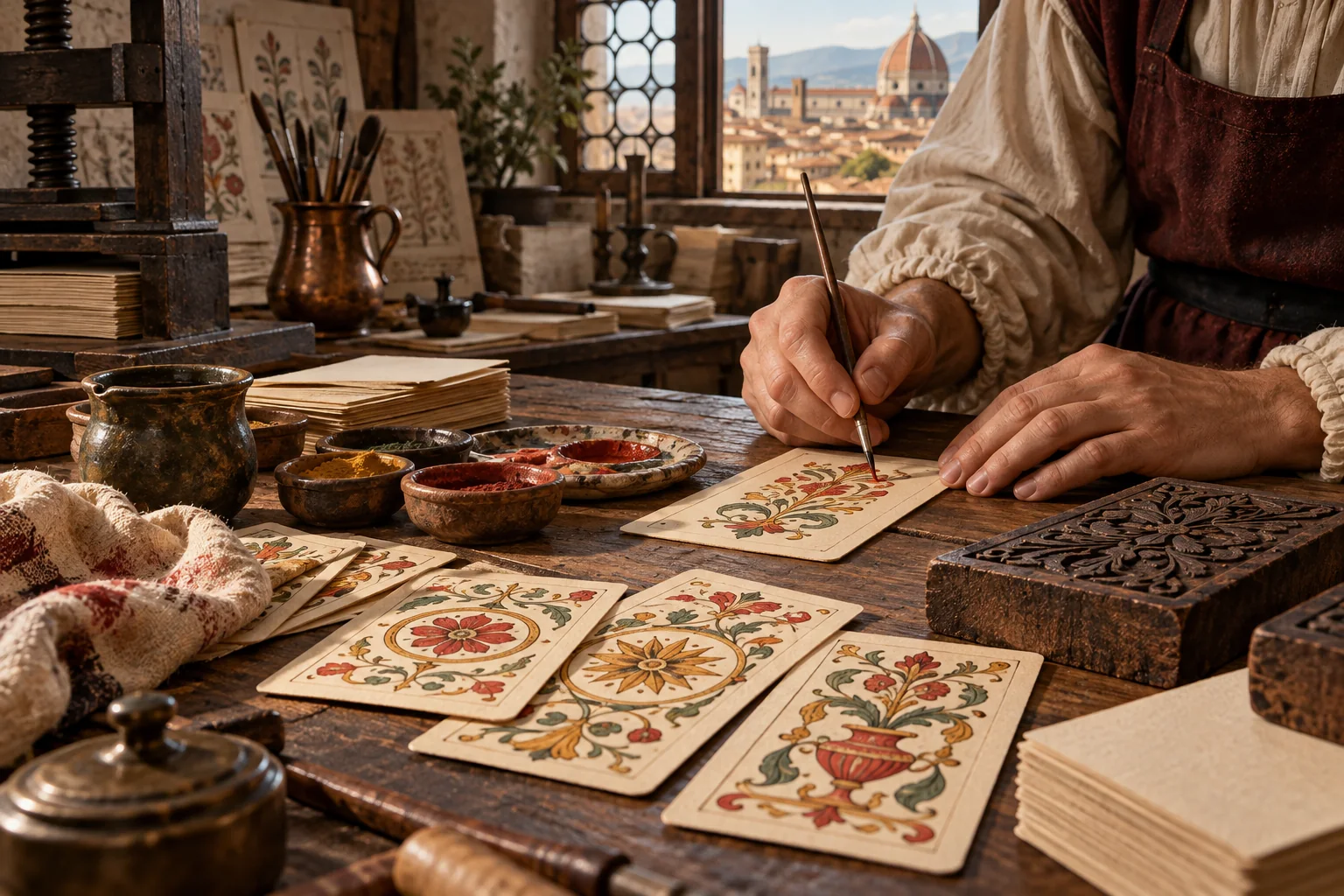
Imagine you find thirty-five old cards in a museum. What can you say about the deck they belonged to? A great deal about those pieces; considerably less about the ones that are missing. Decks are objects of use: they are shuffled, transported, separated, sold and, at times, kept for reasons we do not know. The loss of a card does not necessarily leave a record. That is why an incomplete deck is not a flaw we should hide; it is an essential characteristic of historical evidence.
The group known as Visconti-Sforza offers a clear example. The Morgan Library & Museum holds thirty-five cards; other related pieces are in different collections. The museum’s own shop explains that its facsimile edition reproduces seventy-four surviving cards and recreates four that are missing in order to present a seventy-eight-card deck. In the modern box, those four cards serve a practical and visual function. For studying the historical group, their status is different: they are not four originals that had just appeared, but four editorial solutions to an absence.
A historical group is not an intact box
The idea of an “old deck” invites us to imagine a box that passed from hand to hand without losing anything. The reality of museum holdings is usually more fragmentary. Some pieces may have been dispersed through sales or inheritances; others may have deteriorated; others remain unidentified. We often cannot decide which of those explanations applies to a particular card. The Morgan catalogue lets us know which thirty-five objects the institution holds. It does not by itself allow us to reconstruct all the decisions of every previous owner.
When it is said that seventy-four cards from a group have survived, the sentence should be formulated carefully. It speaks of the known state of research and of the attributions that link pieces now separated. It does not guarantee that they were all always together, nor that we can trace each one without gaps back to the fifteenth century. Material history relies on available objects and documents, and it accepts that a future discovery may change the count. Seeking absolute certainties where there is only partial survival often leads to overly perfect narratives.
Why cards are missing: hypotheses we should not turn into facts
There are plausible general causes. A card may wear more because it is handled frequently; it may be lost during a game or a move; it may be damaged by damp; it may be separated from a group to be sold or given away. The Metropolitan Museum of Art recalls that playing cards were ephemeral objects: use wore them down and they could be lost or broken. That observation helps explain why survivals are exceptional. It does not prove the cause of each gap in a particular group.
There is also a selection in preservation. A piece with luxurious painting or prestigious provenance may have received more attention than an ordinary card. It would be a mistake to infer, from that selection, that all cards of an era were luxury objects. The Met exhibition distinguishes precisely between highly elaborate commissioned cards and other modes of production. What survives is not a neutral statistical sample of everything that was made or played with. Sometimes we know the preserved exceptions better than the everyday objects that disappeared.
Three distinct numbers worth noting
When investigating a deck, separate the number of cards that the type of deck is supposed to have comprised, the number of original objects identified today, and the number of cards included in a modern reproduction. In the Visconti-Sforza example, the facsimile edition offers a core of seventy-eight tarot cards: seventy-four reproduce surviving pieces and four are recreations according to the Morgan shop’s description. The edition currently advertised by the museum adds two portraits as extra cards, so the box contains eighty pieces. The arithmetic serves precisely to avoid erasing the difference between “78 tarot cards in the reproduction” and “78 historical originals preserved”; the latter statement would be false.
The count also depends on which units are grouped together. Are we talking about thirty-five cards with a museum call number, all the pieces attributed to the same group, or all the cards from several Visconti decks? They are different questions. The article what a museum preserves when it preserves a card explains why the call number and provenance matter as much as the deck’s popular name. If a text adds up cards from different provenances without explaining the criterion, distrust the total.
Reconstruction can be useful if it is labeled
A publisher who wants to produce a deck for play or study must decide what to do with the gaps. It can leave blank spaces, draw new cards based on comparisons, adopt images from another group, or commission a completely contemporary interpretation. None of these options automatically restores a lost original. The quality of the edition depends, in part, on declaring what has been done. A faithful reproduction of a preserved piece, a hypothetical restoration of a damaged area, and a new drawing of a missing card are different operations.
For the reader, the distinction has practical consequences. You can use a reconstruction in a contemporary reading without pretending that it is direct testimony from the fifteenth century. You can study the style of the modern illustration as a decision by its creator. You can compare the proposal with other decks and ask what evidence it uses. What you cannot do is cite the color of that recreated card as proof of the historical workshop’s palette if no original supports it. The guide on what a museum preserves when it preserves a card helps separate original object and modern edition.
A reading exercise before buying a facsimile
Read the edition’s description and make a three-column list: documented originals, reproductions of those originals, and cards created to complete the series. Then note whether the publisher has retouched color, border, size or back. If it does not explain this, do not attribute the final appearance to the ancient object. A promotional photograph of the spread-out deck may show all the cards with a uniform texture; that visual coherence is an editorial virtue, but it can hide the fact that some pieces have different material histories.
Nor should you take the word “facsimile” as an automatic guarantee of absolute accuracy. Decisions about scanning, cleaning, size and paper can produce differences. An edition oriented toward play may favor manageable cards; another aimed at research may include details of provenance and conservation condition. Choose according to your goal and check the editorial note. A deck useful for practice need not be a sufficient source for a historical claim.
Absence can also guide questions
A missing card does not tell us what its image was like, but it does force us to delimit what we know. Is an old description preserved? Is there a comparable card in another group? Is the sequence of trumps from the context known? Does the modern reconstruction declare its model? Each answer reduces or increases uncertainty, without turning a conjecture into a material object. The habit of naming the absence helps avoid claims such as “all original decks had exactly this scene” when we know only a part.
This way of reading does not impoverish tarot history. It brings it closer to real work with objects. A missing card can inspire a research question, an editorial illustration, or a comparison between traditions. The condition is to keep the labels visible: original, reproduction, recreation and hypothesis. Those who practice tarot today can use a complete deck; those who study its past must continue to see the gaps that the modern box has resolved.
Sources consulted
- The Morgan Library & Museum, Visconti-Sforza cards, MS M.630.1–35. Identification of the originals preserved by the institution.
- Morgan Shop, description of the Visconti-Sforza facsimile. Count of seventy-four reproduced cards and four recreated; a commercial source for the edition, not for the original object.
- The Metropolitan Museum of Art, The World in Play. Context on partial survival and uses of historical playing cards, including examples that are not tarot.