Sabio Tarot · History and curiosities
How the date of a historical tarot deck is identified
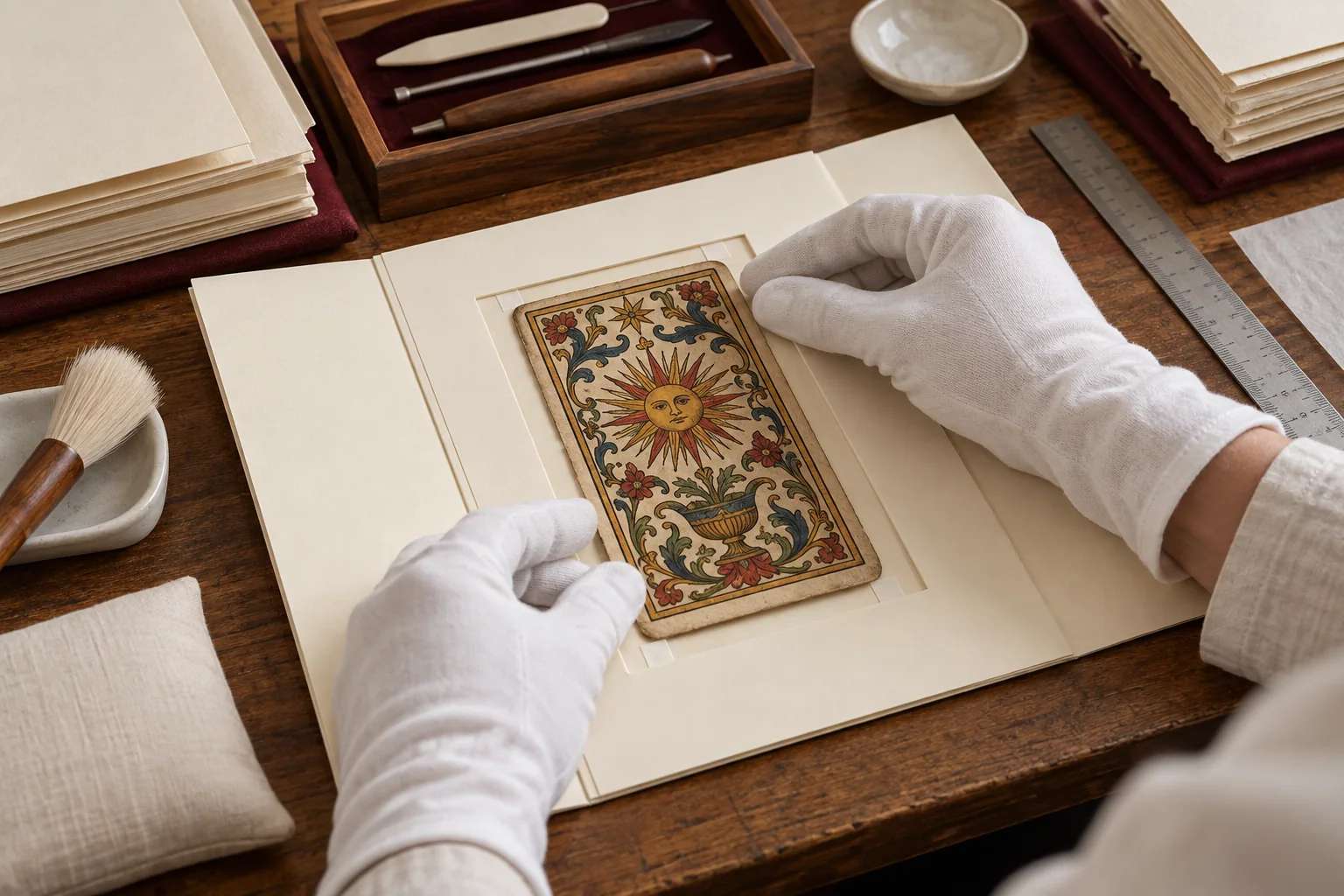
An old card shows “1760.” It seems the work is done: just copy the year into the caption. But a visible date may refer to a model, a printing plate, a signature, a remembered event, or an impression that continued to be used later. The date of manufacture of the copy before us is another question. Tarot history is full of reissues and copies, so learning to separate these clocks prevents errors that are then repeated in sales listings, articles, and social media.
The case of Nicolas Conver is especially instructive because the Bibliothèque nationale de France holds several related records and an authority record for the cardmaker himself. A game record bears the wording “N.as Conver 1760.” However, the BnF authority record identifies Nicolas Conver with dates 1784–1833, documents his activity as a maker in Marseille between 1809 and 1833, and warns that the tarot dated 1760 cannot be attributed to an ancestor or namesake simply to resolve that discrepancy. The printed number and the maker’s biography should not be compressed into the sentence “Nicolas Conver published this copy in 1760.”
Four dates that can appear on a single record
The first is the date of the model: when a composition that other editions repeated was conceived or documented. The second is the production date of the physical copy preserved. The third is the date of a later intervention, such as a handwritten note, a tax stamp, a binding, or a restoration. The fourth is the date of acquisition by a library or museum. All can be true and refer to different moments. A fifth, the date when a digital record was updated, speaks only to the catalog record.
The BnF catalogs a modern reissue of the Conver model, made by A. Camoin between 1890 and 1899, of which it preserves fifty-eight cards and a case. The word “reissue” already warns that the earlier model and the preserved object have different histories. Another catalog record describes a deck based on Conver, manufactured approximately between 1890 and 1900, that bears “N.as Conver // 1760” on one of the cards, a blue tax stamp from 1890, and added handwritten divinatory annotations. It is an almost textbook example of several temporal layers present in a single object. Citing only the number 1760 would erase at least a century of its material history.
Read the complete phrase, not just the year
In a catalog, the words surrounding a date matter. “Circa” expresses approximation; “between” indicates a range; “model of” indicates a relation to another work; “edition” and “reissue” place an object in a sequence. A title in brackets may have been assigned by the institution to describe a piece that does not bear that title in printed form. When summarizing the record, preserve those nuances: the oldest number tends to attract attention, but it may date only the model and not the preserved copy.
The Morgan Library & Museum record for the Visconti-Sforza cards proposes an approximate dating for fifteenth-century pieces and records their acquisition by Pierpont Morgan in 1911. The second date does not push the manufacture back to the twentieth century; it records a stage of provenance. Likewise, the fact that a digital photograph is published today does not change the date of the original support. Identifying the clock of each piece of data seems basic, but many errors about historical cards arise from mixing them up.
How to reason about dating when there is no exact day
Specialists cross-check several clues. An inscription can provide guidance, but one must study whether it belongs to the original printing or to a copy. Technique, paper, and style can be compared with documented pieces. Coats of arms, maker’s marks, and stamps can provide chronological limits, provided that it is identified when they were added. The known history of owners can establish that an object existed before a certain acquisition. No single clue necessarily answers everything. The institutional record summarizes an investigation and usually indicates when the date is estimated.
The ordinary reader does not need to perform physical analysis to detect a contradiction. It is enough to open two sources. If an object appears to be “from 1760” and the identified maker was born in 1784, do not solve the problem by inventing another Conver. Read the authority record and distinguish model, inscription, and copy. There may be uncertainty about the exact journey of the printing plate or of the naming. Explain the uncertainty; do not fill it in with an imaginary genealogy. This case shows why one should link to the specific record, not repeat a date from a shop.
The date of one card is not the date of an entire deck
A deck can bring together cards from different moments: replacements, pieces attributed to another workshop, or cards added to complete a series. The Morgan describes complex attributions among the surviving pieces of the Visconti-Sforza group. Even if a catalog proposes a range for the group, we should not turn it into an exact date for every brushstroke. If a current edition reconstructs four missing cards, those four images belong to the modern edition even if they imitate an old style. The article why incomplete decks survive details that difference.
Nor does a tax stamp necessarily mark the birth of all the cards in a deck. It can be a clue about circulation or a specific edition, whose scope must be verified. In the Camoin record with annotations, the blue stamp from 1890 coexists with the printed mention of 1760. The combination forces us to read the object as an accumulation of phases. Without further examination, it is preferable to say “the BnF catalogs this copy between 1890 and 1900” than “the card was manufactured exactly in 1890 because it bears that stamp.”
A small protocol for dating without overstating
First, locate the record of the institution that preserves the copy and copy its identifier. Second, note separately the date proposed by the catalog, the date that appears in print, and any acquisition or intervention date. Third, check the attribution wording and the maker’s authority record. Fourth, if you compare two decks, verify that they are two objects and not two photographs of the same reissue. Fifth, write a sentence with the real degree of certainty: “catalogs as,” “approximately dated,” “after the model of,” “with inscription of.” This syntax avoids promising more than the source offers.
The guide what a museum preserves when it preserves a card helps in reading support, provenance, and inventory number. The comparison between painted and printed playing cards distinguishes the date of the model from the manufacture date of the copy. They are related questions, but each requires its own evidence.
The reward of a well-explained date
A careful chronology makes visible the successive lives of a deck. A design can be born, printed, circulate again, receive notes, and end up in a public collection. That sequence is richer than a solitary number. For someone who reads tarot today, the historical date does not determine the meaning of a reading. For someone who writes about the origin of its images, it does determine what they can claim. A deck that bears “1760” can be an excellent testimony to a later edition that preserved that mention; naming it that way does not make it less interesting, it gives it back its history.
Sources consulted
- BnF, authority record for Nicolas Conver. Biography, activity 1809–1833, and warning about the date 1760.
- BnF, deck associated with Conver, cb43706229t. Description of the object and wording “N.as Conver 1760.”
- BnF, Camoin reissue, cb409188518. Example cataloged between 1890 and 1899.
- BnF, Camoin deck based on Conver, cb40918777p. Example with old wording, stamp, and later annotations.
- The Morgan Library & Museum, Visconti-Sforza cards. Contrast between dating of pieces and acquisition in 1911.