Sabio Tarot · History and curiosities
The Journey of Playing Cards Between European Cities: What We Can Trace
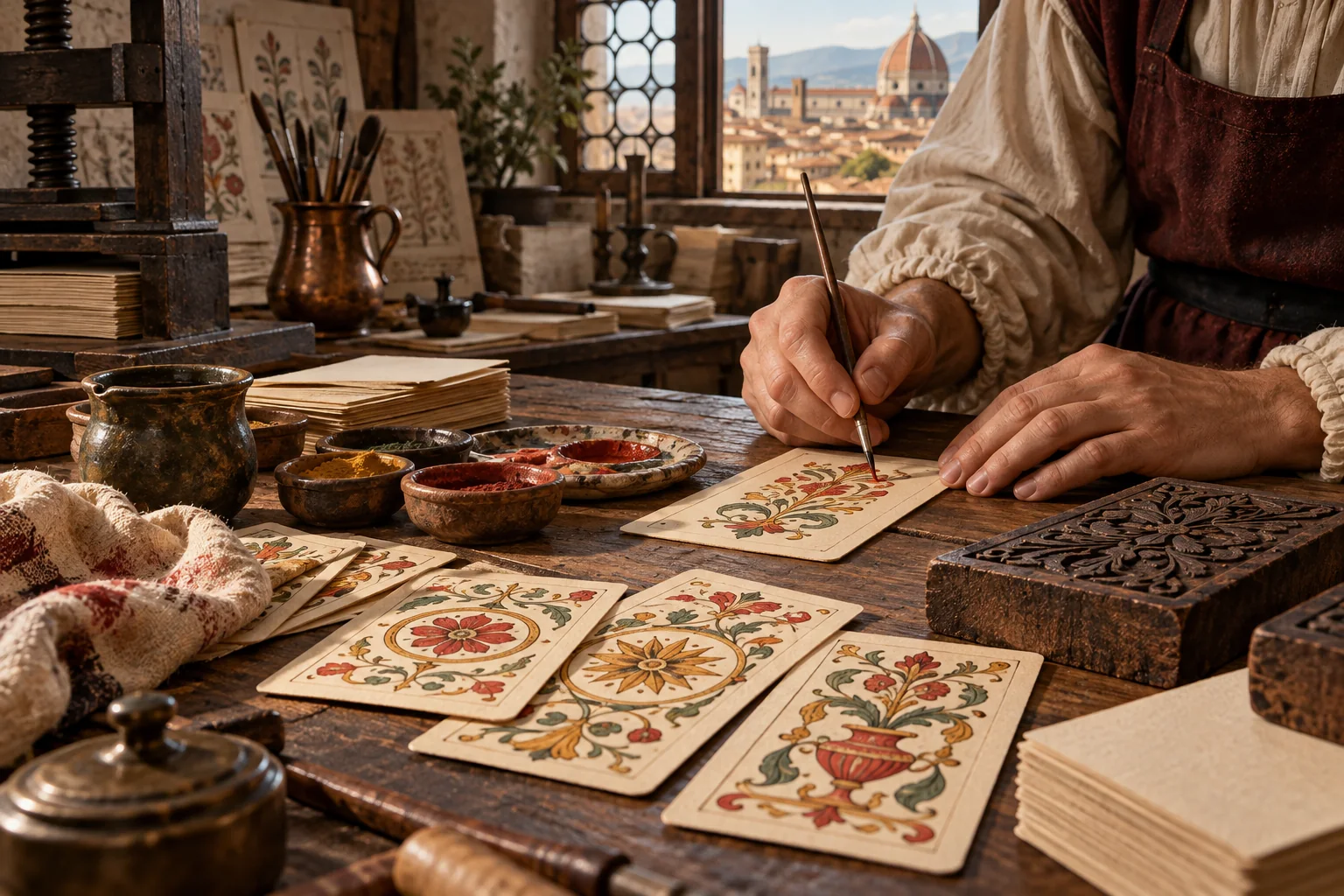
It is tempting to draw an arrow: Italy invents tarot, a deck crosses the Alps, Marseille receives the model, and then the whole world copies it. Arrows are easy to understand, but they can connect cities without any document proving the route. Tarot history is reconstructed from surviving objects, production notices, workshop names, and comparative studies. These data show circulation and influences, although they do not always allow us to describe a specific journey of a particular box. An honest map distinguishes documented points from inferred routes.
The Metropolitan Museum of Art places early references to tarot in several Italian cities of the 15th century, including Venice, Milan, Florence, and Urbino. The Morgan Library & Museum preserves Visconti-Sforza cards made in Milan according to its catalog. The Bibliothèque nationale de France later documents French objects: the tarot of Jean Noblet produced in Paris in the 17th century and a deck by Philippe Vachier manufactured in Marseille in 1639. Those are places and dates supported by institutions. They do not by themselves prove that a copy from Milan was personally carried to Paris and then to Marseille.
A Point on a Map, Not an Automatic Arrow
We can place “Milan, mid-15th century” next to the Visconti-Sforza cards. We can place “Paris, second half of the 17th century” next to the Noblet copy that the BnF describes. We can situate “Marseille, 1639” next to the Vachier deck acquired by the same library. Each point corresponds to an object and a record. The arrow between points would require another kind of proof: circulation of a matrix, contract between workshops, sales record, correspondence, or similarity compared with caution. Mere chronological succession does not say which path it was.
The BnF explains that the graphic type later known as the “Tarot de Marseille” may have had its cradle in Lyon and that the name Marseille became generalized later. In the current state of that research, the Vachier deck changes the evidence available for production in the city. That news makes it even less prudent to tell a single, closed route: a new object can displace the “oldest known” and open questions about neighboring workshops. The expression “may have” matters; it should not disappear when we translate or summarize the source.
Do Not Confuse Circulation of a Model with Transfer of a Copy
A design can circulate without the same physical box traveling from city to city. A card maker can copy a print, adapt a motif seen in another product, or inherit a matrix. To demonstrate which of those things happened in a specific case, we need material or documentary evidence. Visual resemblance can guide a comparison, but it does not automatically fix the direction of influence. Two cards with a similar figure could share a graphic ancestor without one being a direct copy of the other.
There is also later circulation of the preserved object itself. The Morgan documents that its Visconti-Sforza cards were acquired by J. Pierpont Morgan in 1911. That modern collection journey does not necessarily explain how the deck circulated in the 15th century. A line of provenance and a line of model diffusion are different maps. Joining them into a single arrow would make it seem that the history of collecting explains the history of manufacturing.
What the Italian and French Comparison Teaches
Early Italian decks and later French tarots share recognizable structures, but they are not the same object. Technique, format, vocabulary, and manufacturer names change. The Morgan set is a painted series; the BnF’s Vachier deck is described as woodcut and stencil-colored. It does not follow from this that there was a simple march from “art to industry” that happened at the same time throughout Europe. Painted cards and printed cards explains the material difference and its limits.
The Noblet tarot, made in Paris and described by the BnF as a graphic form that we today call Marseille, breaks a common assumption: a style called “Marseille” can be represented in an object manufactured outside that city. The name of the visual family is not a postmark for each copy. In when a deck becomes the “Tarot de Marseille” the name is analyzed as a later category; here what matters is its effect on the map of circulation.
A Useful Map for Investigation
Draw two layers. In the first, mark only objects with an institution, proposed date, city, and inventory number. In the second, add relations between models only when a source argues for that relation; use a dashed line for hypotheses. On each arrow write what supports it: “compared graphic model,” “workshop signature,” “sales document.” If you cannot note any evidence, remove the arrow. A map with few lines can teach more than a continent covered with imagined routes.
We can add a third layer for modern acquisitions and collection movements, but in a different color. The current library or museum is not necessarily the place of manufacture. The BnF preserves the Vachier object today; that does not mean it was produced recently. The Morgan cards were acquired in 1911; that does not date their painting. Visually separating layers prevents confusions that a short sentence can overlook.
What We Do Not Know from Looking Only at the Cards
We do not know how many everyday decks disappeared between the documented dates. We do not know which players saw each model or which commercial routes connected each city without specific records. Preserved luxury pieces can exaggerate the role of elites in overall production. The absence of an early copy in a city does not prove that no one there knew the game. These gaps are not excuses to invent stories; they are questions that guide archives, museums, and future research.
We must also avoid the myth of a “single origin” that a single card would solve. Early Italian references point to several centers. Later French forms show adaptation. A specific deck can be the oldest known copy of a type and place without being the first that existed. The BnF uses precisely that caution when explaining the importance of the Vachier deck.
Traveling with Objects, Not with a Legend
The public looking for “where tarot comes from” deserves an answer that can be verified. We can offer a chronology of identified pieces, explain what a workshop mark means, and show how a later name groups objects from several cities. We can say which routes are hypotheses. That is more valuable than an arrow without a source, because it lets the reader follow the investigation. Tarot traveled through hands, images, and markets; the itinerary of each card must be demonstrated separately.
Sources Consulted
- The Metropolitan Museum of Art, The World in Play. Early references to several Italian centers.
- The Morgan Library & Museum, Visconti-Sforza. Proposed place of creation and modern provenance of a specific set.
- BnF, “Tarot of Jean Noblet”. Parisian object of a type later called “de Marseille.”
- BnF, “A Tarot That Reshuffles the Cards”. Vachier deck from Marseille and cautions about diffusion of the model.