Sabio Tarot · History and curiosities
Painted Cards and Printed Cards: What Changes in the History of Tarot
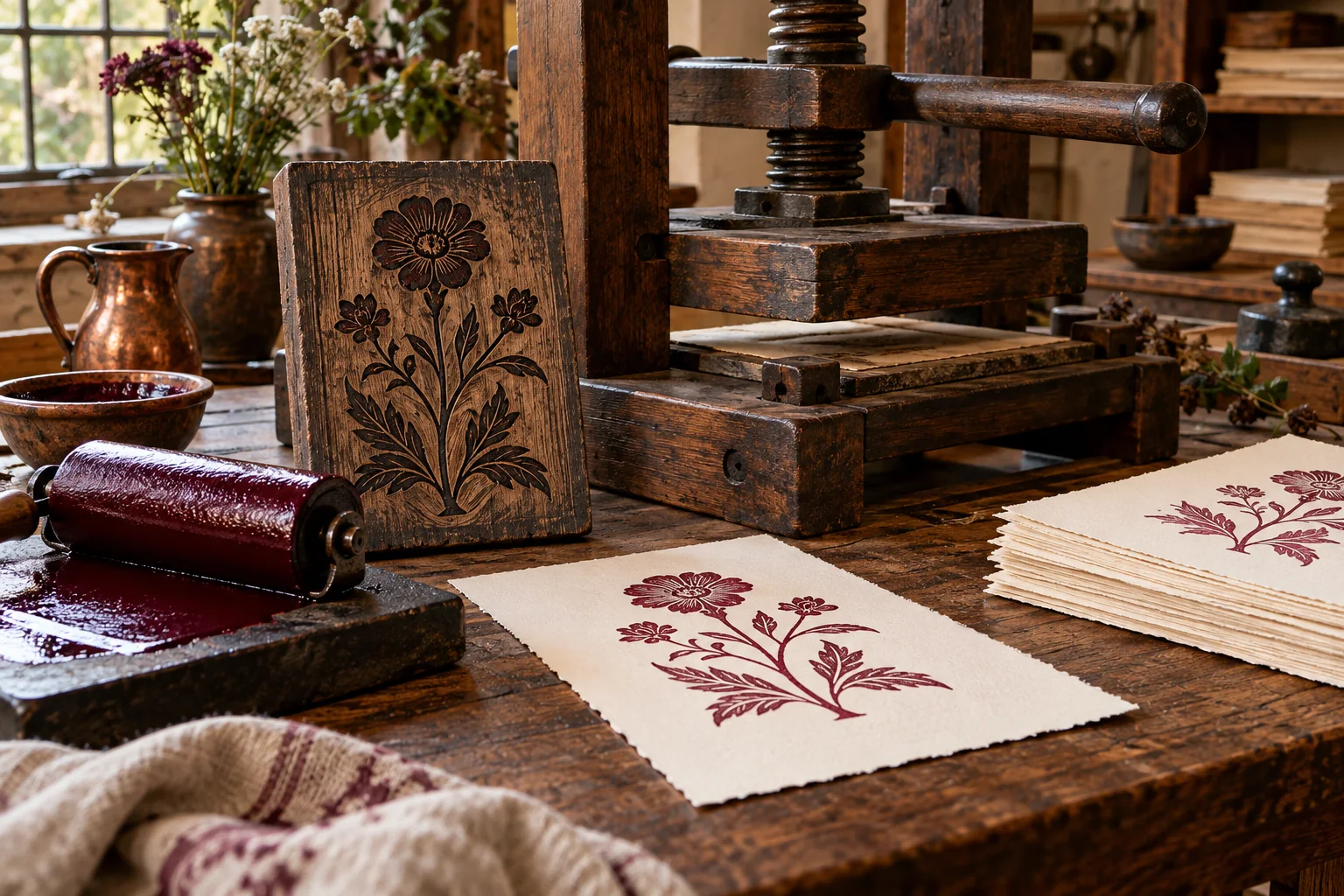
Two cards can depict a similar figure and have reached our hands by very different material paths. One was painted individually; another came from a matrix capable of repeating outlines; a third received color after being printed. Knowing how an image was produced helps us understand why variants exist, why some pieces are unique, and why a date or a printed signature can be repeated in later copies. The history of tarot should not be reduced to a simple shift from artisanal luxury to uniform manufacturing: techniques coexisted, and the surviving objects belong to different contexts.
The exhibition The World in Play at the Metropolitan Museum of Art shows European luxury cards, some painted and others engraved. Not all are tarot: some serve precisely to compare techniques of contemporaneous playing cards without presupposing that they followed the rules and structure of tarot. The Morgan Library & Museum catalogs the Visconti-Sforza cards as painted pieces from an Italian historical set. The Bibliothèque nationale de France describes a Tarot de Marseille associated with Conver as woodcut and colored with pochoir. These three references suffice to observe something fundamental: “tarot card” describes a cultural family of games and decks, not a single way of manufacturing each copy.
The Painted Card: An Individual Work Within a Series
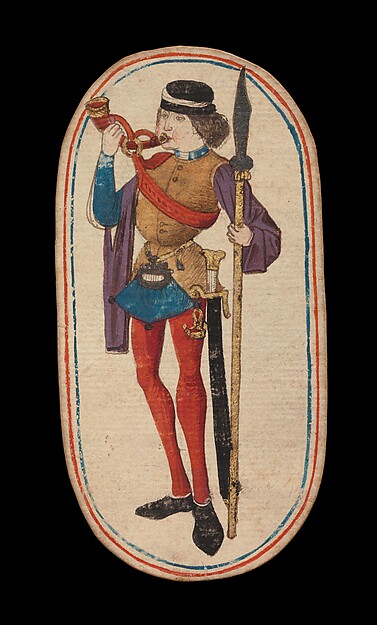
Hand painting allows differences in line, pigment, or finish to be introduced between cards. It does not imply that each scene was invented without a model. A workshop can repeat a design, and several people can work on the same series. Artistic attribution is therefore a task of comparison and documentation, not an automatic signature inherited by belonging to the set. In the cards held by the Morgan, the catalog proposes datings and attributions linked to the Visconti-Sforza milieu. If a card or a group presents different characteristics, that difference should be described before attributing all the images to a single hand.
A luxury card preserved in good condition does not by itself represent the usual way of playing in an entire city. The Met notes that its commissioned cards were exceptional objects and that some were probably not intended for an ordinary game. The survival of these rich pieces can bias our imagination: we see much of what someone considered worth keeping and less of what was worn out in common use. Before stating that “this is how the first tarots were,” one must distinguish the documented example from the generalization.
The Printed Matrix: Repetition Does Not Mean Producing Identical Copies
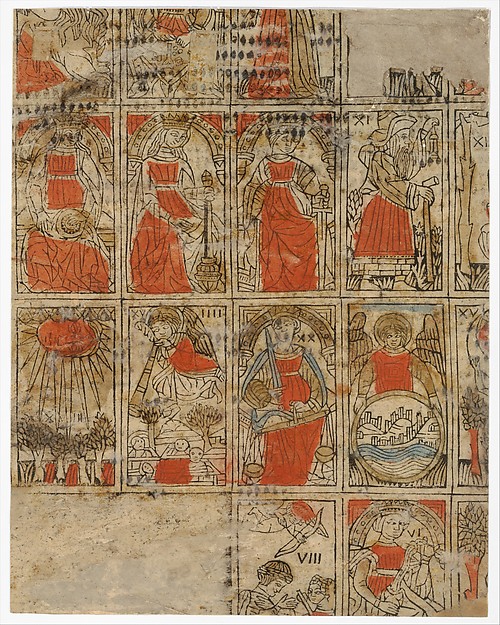
An engraved image allows the same design of lines to be printed several times. The BnF record describes the technique of the tarot attributed to Conver as “gravure sur bois coloriée au pochoir”: woodcut with color applied by stencil. The reproducible outline and the coloring phase are distinct operations. Depending on the copy, there may be variations in registration, intensity, or wear. The existence of a matrix does not turn every card into a perfect duplicate, nor does it guarantee that all print runs were made in the same year.
The Met documents, in its exhibition, cards made by copper engraving by the so-called Master of the Playing Cards in the fifteenth century. Those cards do not form a tarot deck, but they show a printed alternative to individual painting and help explain what it means to produce images from a plate. The source even notes that some figures could be combined with separate suit signs. This label should be kept: a technical comparison among historical playing cards, not proof that the Visconti-Sforza tarot was printed by that method.
Coloring After Printing
The color of a printed card may have been applied after the outline, by hand or by stencils. “Printed” is not equivalent to “without manual intervention.” The BnF’s own description of the Conver deck combines woodcut and pochoir color. When we compare two copies, a difference in tone could come from the applied color, conservation, a digital photograph, or a different edition. Visual observation alone does not allow us to choose a cause. Looking for the catalog’s technical note is the first step.
This detail matters when talking about symbolism. If a modern edition darkens a blue or reinterprets a red, we should not declare that exact tone to have been the intention of a historical printer. Even in old objects, a copy may have aged or undergone interventions. A contemporary reading can use the color seen in its deck; the history of manufacture requires identifying which copy, which technique, and which layer of intervention we are interpreting.
What Changes for the Reader Who Compares Decks
First, the question of authorship changes. In an individual painting, we can study hand, workshop, and patronage. In a print, we also ask about matrix, printer, coloring, and possible reissues. Second, the question of date changes. A model may predate the copy in front of us, and an engraved date can be perpetuated when a design is reused or copied. Third, the question of variation changes. Two printed cards with the same scene may differ in color, condition, or print run; two painted cards within the same set may also differ because of artistic intervention.
The category “original” must be specified in each case. A surviving manuscript card is the original object of its production; an old printed copy can also be a historical original from its print run. A photo of either is a reproduction. A modern deck that reprints its images is another edition. A new card drawn to fill a gap is an editorial reconstruction or recreation. These words do not rank objects by affective value; they explain what evidence each one provides.
A Comparative Exercise with Three Records
Open a record from the Morgan’s Visconti-Sforza set, the BnF record for the Conver tarot, and the Met exhibition. In a table of your own, note the date each institution proposes, technique, dimensions, number of pieces described, and type of object. In the last column, write “what it does not prove”: a painting does not prove early divinatory use; a print does not prove mass distribution without print-run data; a record of non-tarot playing cards does not prove a rule of the tarot game. This last column is the defense against hasty conclusions.
If you find the same image cropped and colored differently online, go back to the institutional record. Ask whether it is a digitization of the original, a catalog plate, a restoration, a facsimile, or a reinterpretation. The web makes it easy to multiply images; precisely for that reason, provenance becomes more important. In what a museum preserves when it preserves a card you will find a method for following that data. In how the date of a deck is identified it is explained why model and copy do not always share a date.
A History of Coexistence, Not Automatic Replacement
The comparison shows manufacturing possibilities, not a ladder in which each technique immediately displaces the previous one. There were luxury commissions, printing and coloring processes, reissues, and later collections. To speak of a specific place or workshop, we will need its objects and documents. The useful question is not “In what year did tarot become printed?”, as if it happened only once everywhere. It is “What technique does this card document, in which copy, and with what date?”
That precision makes looking at a current deck more interesting. Its design may be inspired by a painted card, a colored print, or a mixture created centuries later. If you use it to cast the cards, observe what you have in front of you. If you describe the history of its image, follow the chain of originals, copies, and editorial decisions. The same figure can connect them without making them materially equal.
Sources Consulted
- The Metropolitan Museum of Art, The World in Play: Luxury Cards, 1430–1540. Comparison of painted and engraved playing cards; several examples are not tarot and are treated as such.
- The Morgan Library & Museum, Visconti-Sforza cards. Catalog of painted pieces, provenance, and attributions.
- Bibliothèque nationale de France, tarot deck associated with Conver. Material record that registers woodcut and stencil coloring.